


Transfusion safety in francophone African countries: an analysis of strategies for the medical selection of blood donors
- PMID: 22014098
- PMCID: PMC3668689
- DOI: 10.1111/j.1537-2995.2011.03391.x
Transfusion safety in francophone African countries: an analysis of strategies for the medical selection of blood donors
Abstract
Background: The goal of selecting a healthy blood donor is to safeguard donors and reduce the risks of infections and immunologic complications for recipients.
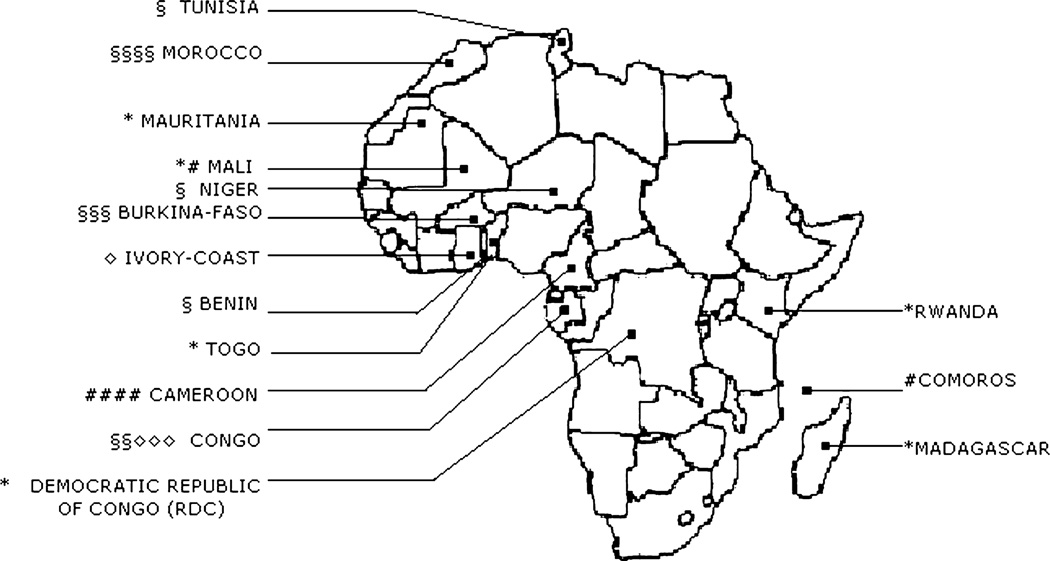
Study design and methods: To evaluate the blood donor selection process, a survey was conducted in 28 blood transfusion centers located in 15 francophone African countries. Data collected included availability of blood products, risk factors for infection identified among blood donor candidates, the processing of the information collected before blood collection, the review process for the medical history of blood donor candidates, and deferral criteria for donor candidates.
Results: During the year 2009, participating transfusion centers identified 366,924 blood donor candidates. A mean of 13% (range, 0%-36%) of the donor candidates were excluded based solely on their medical status. The main risk factors for blood-borne infections were having multiple sex partners, sexual intercourse with occasional partners, and religious scarification. Most transfusion centers collected this information verbally instead of having a written questionnaire. The topics least addressed were the possible complications relating to the donation, religious scarifications, and history of sickle cell anemia and hemorrhage. Only three centers recorded the temperature of the blood donors. The deferral criteria least reported were sickle cell anemia, piercing, scarification, and tattoo.
Conclusions: The medical selection process was not performed systemically and thoroughly enough, given the regional epidemiologic risks. It is essential to identify the risk factors specific to francophone African countries and modify the current medical history questionnaires to develop a more effective and relevant selection process.
© 2011 American Association of Blood Banks.
Conflict of interest statement
The authors certify that they have no affiliation with or financial involvement in any organization or entity with a direct financial interest in the subject matter or materials discussed in this manuscript (e.g., employment, consultancies, board membership, stock ownership, honoraria), except as disclosed in an attachment.
Figures
References
-
- Tagny CT, Mbanya D, Tapko JB, Lefrere JJ. Blood safety in sub-Saharan Africa: a multifactorial problem. Transfusion. 2008;48:1256–1261. - PubMed
-
- Tagny CT, Diarra A, Yahaya R, Hakizimana M, Nguessan A, Mbensa G, Nébié Y, Dahourou H, Mbanya D, Shiboski C, Murphy E, Lefrère JJ. Characteristics of blood donors and donated blood in sub-Saharan Francophone Africa. Transfusion. 2009;49:1592–1599. - PubMed
-
- Ouattara H, Siransy-Bogui L, Fretz C, Diane KM, Konate S, Koidio A, Minga KA, Hyda J, Koffi-Abe N, Offoumou AM, Abissey S. Residual risk of HIV, HVB and HCV transmission by blood transfusion between 2002 and 2004 at the Abidjan National Blood Transfusion Center. Transfus Clin Biol. 2006;13:242–245. - PubMed
-
- Jayaraman S, Chalabi Z, Perel P, Guerriero C, Roberts I. The risk of transfusion-transmitted infections in sub-Saharan Africa. Transfusion. 2010;50:433–442. - PubMed
-
- Toure-Fall AO, Dieye TN, Sall A, Diop M, Seck M, Diop S, Thiam D, Diakhate L. Residual risk of transmission of HIV and HBV, in Senegalese national blood bank from 2003 to 2005. Transfus Clin Biol. 2009;16:439–443. - PubMed
MeSH terms
Grants and funding
LinkOut - more resources
Full Text Sources
Medical
