So what do we call GPR18 now?
- PMID: 22014123
- PMCID: PMC3423231
- DOI: 10.1111/j.1476-5381.2011.01731.x
So what do we call GPR18 now?
Abstract
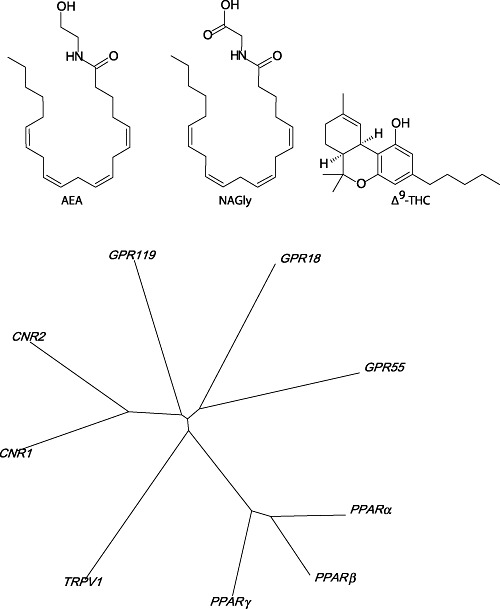
The further characterization of the orphan GPCR GPR18 conducted by McHugh et al. in this issue of the British Journal of Pharmacology has generated a pharmacological profile that raises some interesting questions about the nomenclature of this receptor and may also prompt some questions about the pharmacological definition of the classical cannabinoid receptors, CB(1) and CB(2) . LINKED ARTICLES This article is a commentary on McHugh et al., pp. 2414-2424 of this issue and is part of a themed section on Cannabinoids in Biology and Medicine. To view McHugh et al. visit http://dx.doi.org/10.1111/j.1476-5381.2011.01497.x. To view the other articles in this section visit http://dx.doi.org/10.1111/bph.2012.165.issue-8. To view Part I of Cannabinoids in Biology and Medicine visit http://dx.doi.org/10.1111/bph.2011.163.issue-7.
© 2011 The Author. British Journal of Pharmacology © 2011 The British Pharmacological Society.
Figures
Comment on
-
Δ(9) -Tetrahydrocannabinol and N-arachidonyl glycine are full agonists at GPR18 receptors and induce migration in human endometrial HEC-1B cells.Br J Pharmacol. 2012 Apr;165(8):2414-24. doi: 10.1111/j.1476-5381.2011.01497.x. Br J Pharmacol. 2012. PMID: 21595653 Free PMC article.
References
-
- Bradshaw HB, Rimmerman N, Krey JF, Walker JM. Sex and hormonal cycle differences in rat brain levels of pain-related cannabimimetic lipid mediators. Am J Physiol Regul Integr Comp Physiol. 2006;291:R349–R358. - PubMed
-
- Gantz I, Muraoka A, Yang YK, Samuelson LC, Zimmerman EM, Cook H, et al. Cloning and chromosomal localization of a gene (GPR18) encoding a novel seven transmembrane receptor highly expressed in spleen and testis. Genomics. 1997;42:462–466. - PubMed
Publication types
MeSH terms
Substances
LinkOut - more resources
Full Text Sources
Molecular Biology Databases
Miscellaneous