


Octa-functional PLGA nanoparticles for targeted and efficient siRNA delivery to tumors
- PMID: 22014944
- PMCID: PMC4204797
- DOI: 10.1016/j.biomaterials.2011.09.061
Octa-functional PLGA nanoparticles for targeted and efficient siRNA delivery to tumors
Abstract
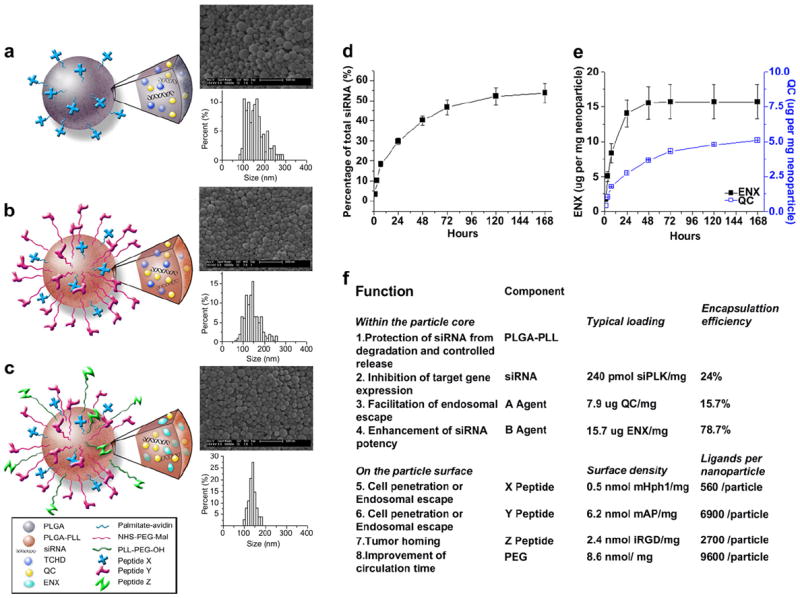
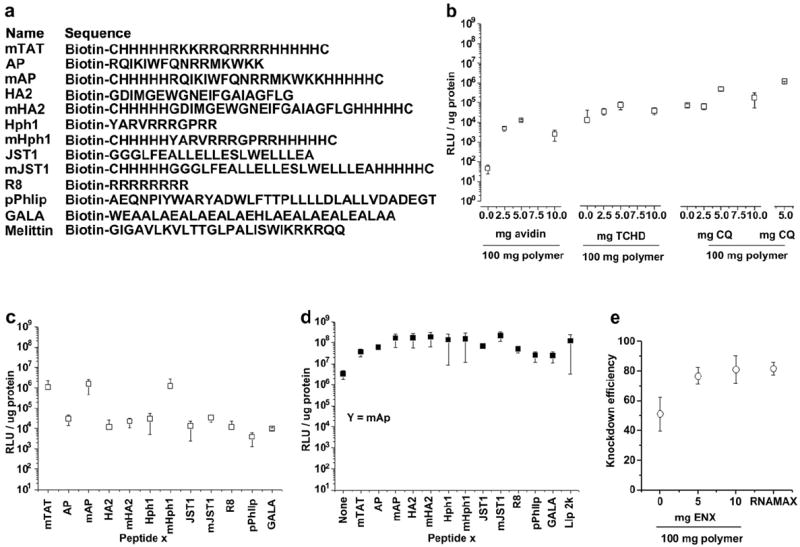
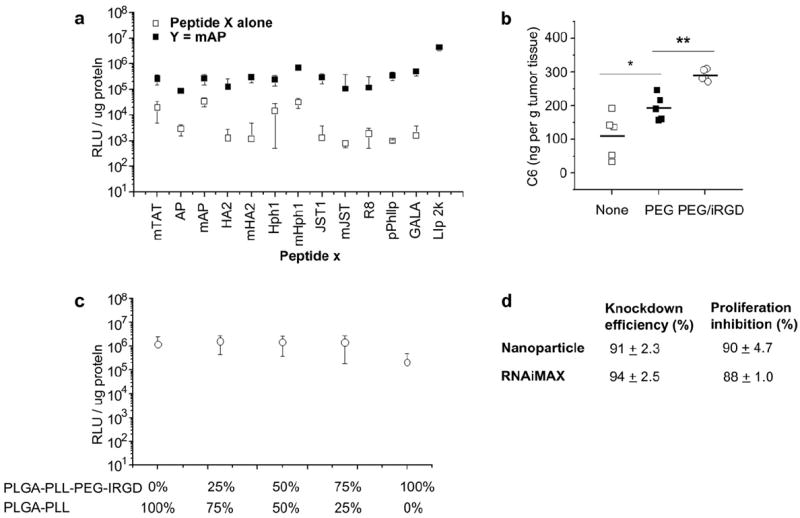
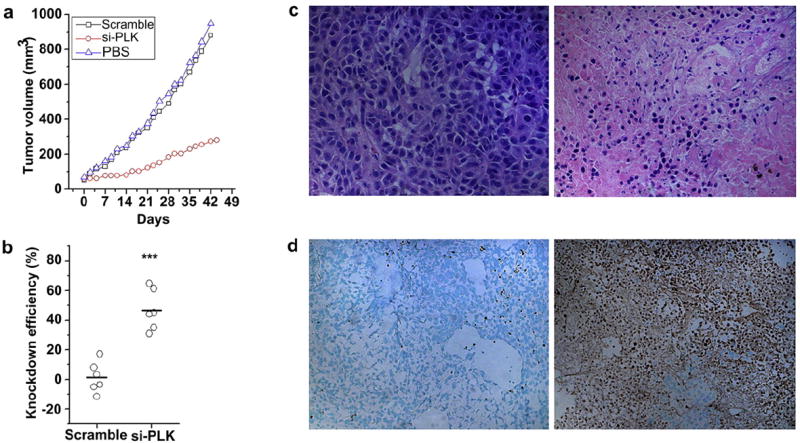
Therapies based on RNA interference, using agents such as siRNA, are limited by the absence of safe, efficient vehicles for targeted delivery in vivo. The barriers to siRNA delivery are well known and can be individually overcome by addition of functional modules, such as conjugation of moieties for cell penetration or targeting. But, so far, it has been impossible to engineer multiple modules into a single unit. Here, we describe the synthesis of degradable nanoparticles that carry eight synergistic functions: 1) polymer matrix for stabilization/controlled release; 2) siRNA for gene knockdown; 3) agent to enhance endosomal escape; 4) agent to enhance siRNA potency; 5) surface-bound PEG for enhancing circulatory time; and surface-bound peptides for 6) cell penetration; 7) endosomal escape; and 8) tumor targeting. Further, we demonstrate that this approach can provide prolonged knockdown of PLK1 and control of tumor growth in vivo. Importantly, all elements in these octa-functional nanoparticles are known to be safe for human use and each function can be individually controlled, giving this approach to synthetic RNA-loaded nanoparticles potential in a variety of clinical applications.
Copyright © 2011 Elsevier Ltd. All rights reserved.
Figures
References
-
- Opko Health, Inc. Safety and efficacy study evaluating the combination of Bevasiranib & Lucentis therapy in wet AMD (COBALT) 2011 Available from URL: http://clinicaltrials.gov/ct2/show/NCT00499590?term=bevasiranib&rank=1; Online.
-
- Allergen, Inc. A study using intravitreal injections of a small interfering RNA in patients with age-related macular degeneration. 2011 Available from URL: http://clinicaltrials.gov/ct2/show/NCT00395057?term=macular+degeneration...; Online.
-
- Pfizer, Inc. Prospective, randomized, multi-center, comparator study evaluating efficacy and safety of PF-04523655 versus laser in subjects with diabetic macular edema (DEGAS) 2011 Available from URL: http://clinicaltrials.gov/ct2/show/NCT00701181?term=PF-04523655&rank=1; Online.
-
- Tekmira Pharmaceuticals Corporation. Study to evaluate the safety, tolerability, pharmacokinetics (PK), and pharmacodynamics (PD), of Liposomal siRNA in subjects with high cholesterol. 2011 Available from URL: http://clinicaltrials.gov/ct2/show/NCT00927459?term=siRNA&rank=10; Online.
Publication types
MeSH terms
Substances
Grants and funding
LinkOut - more resources
Full Text Sources
Other Literature Sources
Molecular Biology Databases
Miscellaneous
