


Age-related differences in lower extremity tissue compartments and associations with physical function in older adults
- PMID: 22015325
- PMCID: PMC3245356
- DOI: 10.1016/j.exger.2011.10.001
Age-related differences in lower extremity tissue compartments and associations with physical function in older adults
Abstract
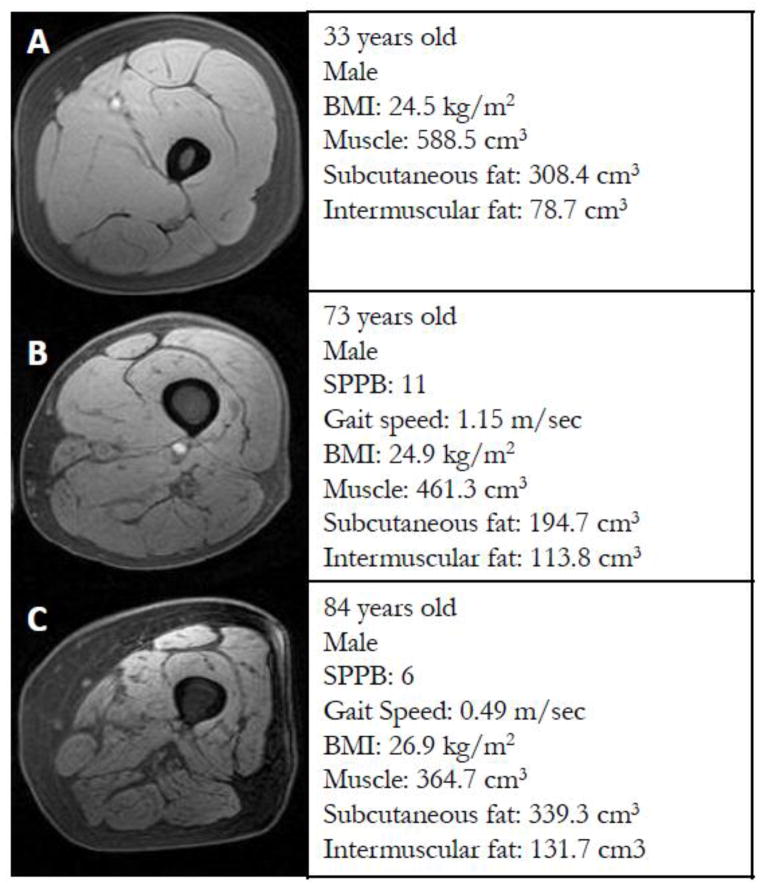
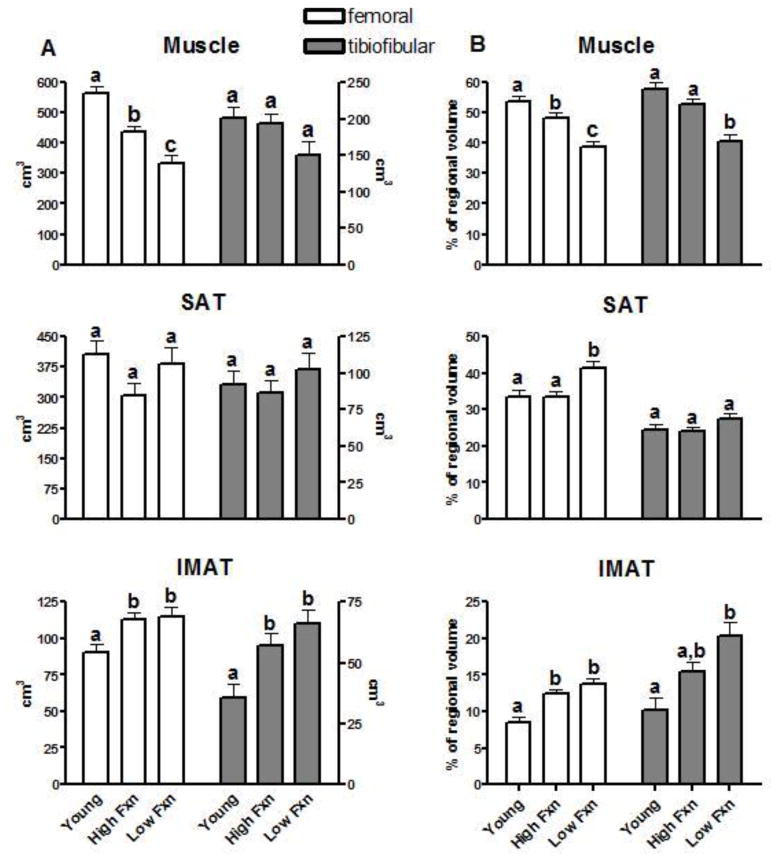
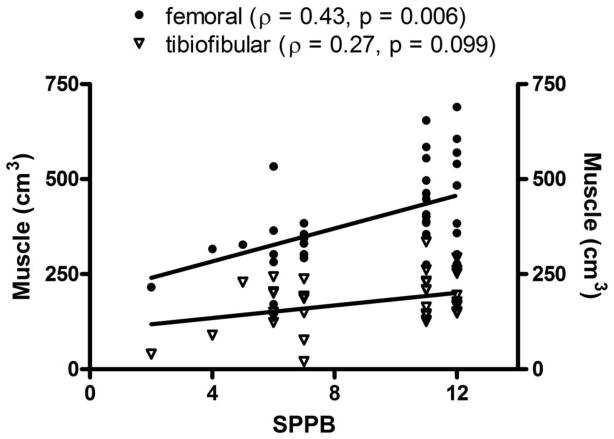
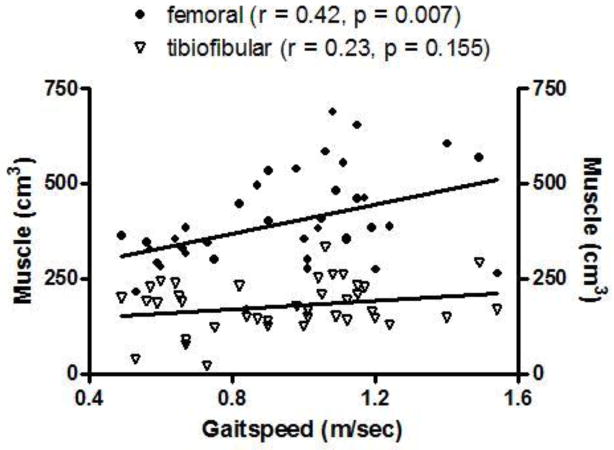
The lower extremities are important to performing physical activities of daily life. This study investigated lower extremity tissue composition, i.e. muscle and fat volumes, in young and older adults and the relative importance of individual tissue compartments to the physical function of older adults. A total of 43 older (age 78.3±5.6 years) and 20 younger (age 23.8±3.9 years) healthy men and women participated in the study. Older participants were further classified as either high- (HF) or low-functioning (LF) according to the Short Physical Performance Battery (SPPB). Magnetic resonance images were used to determine the volumes of skeletal muscle, subcutaneous fat (SAT), and intermuscular fat (IMAT) in the thigh (femoral) and calf (tibiofibular) regions. After adjusting for the sex of participants, younger participants had more femoral muscle mass than older adults (p<0.001 for between group differences) as well as less femoral IMAT (p=0.008) and tibiofibular IMAT (p<0.001). Femoral muscle was the only tissue compartment demonstrating a significant difference between the two older groups, with HF participants having 31% more femoral muscle mass than LF participants (mean difference=103.0±34.0 cm(3); p=0.011). In subsequent multiple regression models including tissue compartments and demographic confounders, femoral muscle was the primary compartment associated with both SPPB score (r(2)=0.264, p=0.001) and 4-meter gait speed (r(2)=0.187, p=0.007). These data suggest that aging affects all lower extremity compartments, but femoral muscle mass is the major compartment associated with physical function in older adults.
Copyright © 2011 Elsevier Inc. All rights reserved.
Figures
References
-
- Centers for Disease Control and Prevention (CDC) Prevalence and most common causes of disability among adults--united states, 2005. MMWR Morb Mortal Wkly Rep. 2009;58:421–426. - PubMed
-
- US Department of Health and Human Services. The surgeon general’s call to action to improve the health and wellness of persons with disabilities. 2005. - PubMed
-
- Janssen I, Heymsfield SB, Ross R. Low relative skeletal muscle mass (sarcopenia) in older persons is associated with functional impairment and physical disability. J Am Geriatr Soc. 2002;50:889–896. - PubMed
-
- Visser M, Kritchevsky SB, Goodpaster BH, Newman AB, Nevitt M, Stamm E, Harris TB. Leg muscle mass and composition in relation to lower extremity performance in men and women aged 70 to 79: The health, aging and body composition study. J Am Geriatr Soc. 2002;50:897–904. - PubMed
-
- Visser M, Goodpaster BH, Kritchevsky SB, Newman AB, Nevitt M, Rubin SM, Simonsick EM, Harris TB. Muscle mass, muscle strength, and muscle fat infiltration as predictors of incident mobility limitations in well-functioning older persons. J Gerontol A Biol Sci Med Sci. 2005;60:324–333. - PubMed
Publication types
MeSH terms
Grants and funding
LinkOut - more resources
Full Text Sources
Medical
Research Materials
Miscellaneous
