Spatial patterns and socioecological drivers of dengue fever transmission in Queensland, Australia
- PMID: 22015625
- PMCID: PMC3279430
- DOI: 10.1289/ehp.1003270
Spatial patterns and socioecological drivers of dengue fever transmission in Queensland, Australia
Abstract
Background: Understanding how socioecological factors affect the transmission of dengue fever (DF) may help to develop an early warning system of DF.
Objectives: We examined the impact of socioecological factors on the transmission of DF and assessed potential predictors of locally acquired and overseas-acquired cases of DF in Queensland, Australia.
Methods: We obtained data from Queensland Health on the numbers of notified DF cases by local government area (LGA) in Queensland for the period 1 January 2002 through 31 December 2005. Data on weather and the socioeconomic index were obtained from the Australian Bureau of Meteorology and the Australian Bureau of Statistics, respectively. A Bayesian spatial conditional autoregressive model was fitted at the LGA level to quantify the relationship between DF and socioecological factors.
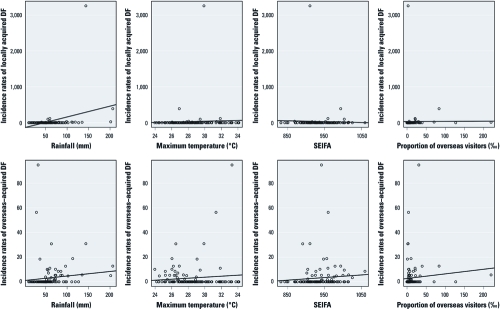
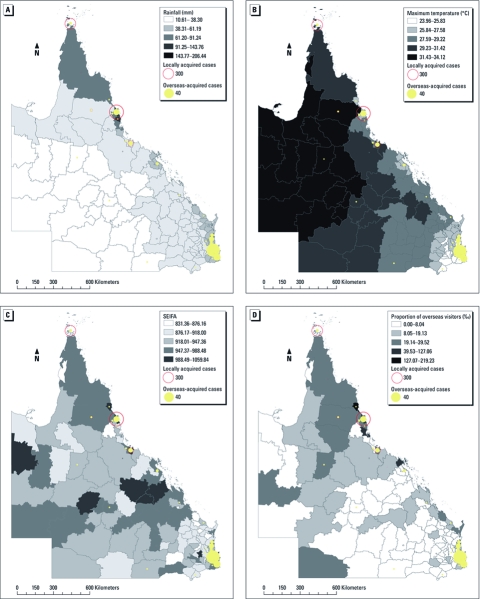
Results: Our estimates suggest an increase in locally acquired DF of 6% [95% credible interval (CI): 2%, 11%] and 61% (95% CI: 2%, 241%) in association with a 1-mm increase in average monthly rainfall and a 1°C increase in average monthly maximum temperature between 2002 and 2005, respectively. By contrast, overseas-acquired DF cases increased by 1% (95% CI: 0%, 3%) and by 1% (95% CI: 0%, 2%) in association with a 1-mm increase in average monthly rainfall and a 1-unit increase in average socioeconomic index, respectively.
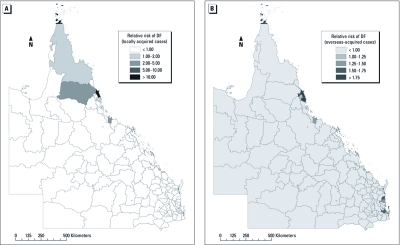
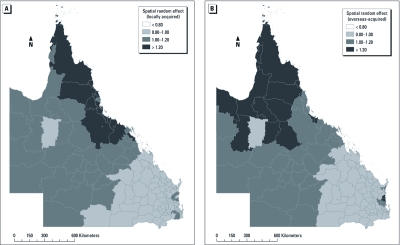
Conclusions: Socioecological factors appear to influence the transmission of DF in Queensland, but the drivers of locally acquired and overseas-acquired DF may differ. DF risk is spatially clustered with different patterns for locally acquired and overseas-acquired cases.
Conflict of interest statement
The authors declare they have no actual or potential competing financial interests.
Figures
References
-
- Australian Bureau of Statistics. 2010. Census Data. Available http://www.abs.gov.au/CDataOnline [accessed 10 August 2010].
-
- Australian Department of Health and Aged Care. National Notifiable Diseases Surveillance System. 2010. Available: http://www1.health.gov.au/cda/Source/CDA-index.cfm [accessed 20 May 2010]
-
- Banu S, Hu WB, Hurst C, Tong SL. Dengue transmission in the Asia-Pacific region: impact of climate change and socio-environmental factors. Trop Med Int Health. 2011;16:598–607. - PubMed
-
- Best N, Richardson S, Thomson A. A comparison of Bayesian spatial models for disease mapping. Stat Methods Med Res. 2005;14:35–39. - PubMed
Publication types
MeSH terms
LinkOut - more resources
Full Text Sources
Medical
Miscellaneous