


Visual hallucinations in dementia with Lewy bodies: transcranial magnetic stimulation study
- PMID: 22016436
- PMCID: PMC3227808
- DOI: 10.1192/bjp.bp.110.090373
Visual hallucinations in dementia with Lewy bodies: transcranial magnetic stimulation study
Abstract
Background: The aetiology of visual hallucinations is poorly understood in dementia with Lewy bodies. Pathological alterations in visual cortical excitability may be one contributory mechanism.
Aims: To determine visual cortical excitability in people with dementia with Lewy bodies compared with aged-matched controls and also the relationship between visual cortical excitability and visual hallucinations in dementia with Lewy bodies.
Method: Visual cortical excitability was determined by using transcranial magnetic stimulation (TMS) applied to the occiput to elicit phosphenes (transient subjective visual responses) in 21 patients with dementia with Lewy bodies and 19 age-matched controls.
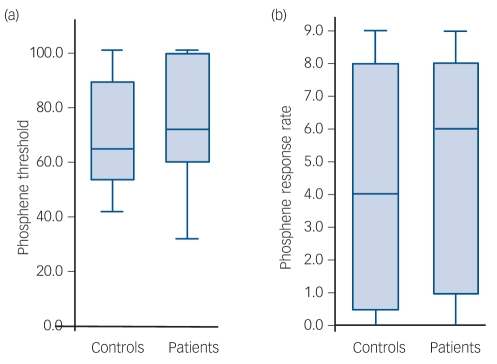
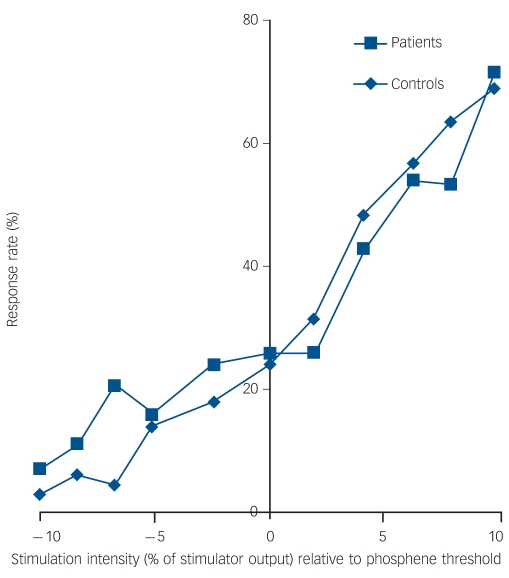
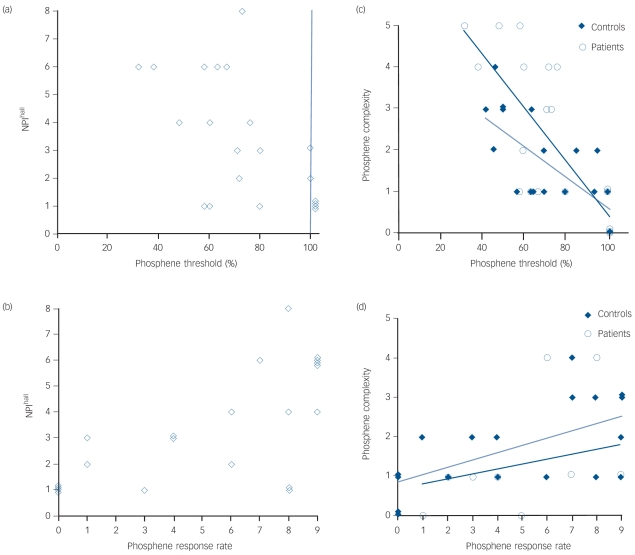
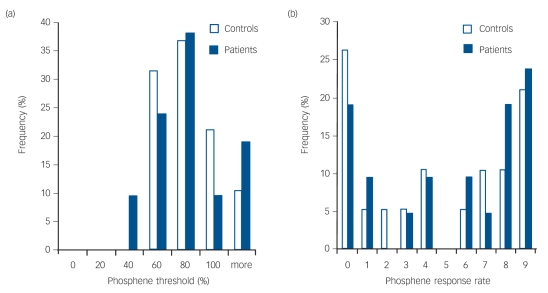
Results: Phosphene parameters were similar between both groups. However, in the patients with dementia with Lewy bodies, TMS measures of visual cortical excitability correlated strongly with the severity of visual hallucinations (P = 0.005). Six patients with dementia with Lewy bodies experienced visual hallucination-like phosphenes (for example, seeing people or figures on stimulation) compared with none of the controls (P = 0.02).
Conclusions: Increased visual cortical excitability in dementia with Lewy bodies does not appear to explain visual hallucinations but it may be a marker for their severity.
Conflict of interest statement
None.
Figures
Comment in
-
Occipital transcranial magnetic stimulation in dementia with Lewy bodies.Br J Psychiatry. 2012 Apr;200(4):345; author reply 345-6. doi: 10.1192/bjp.200.4.345. Br J Psychiatry. 2012. PMID: 22474236 No abstract available.
References
-
- Aarsland D, Ballard C, Larsen JP, McKeith I. A comparative study of psychiatric symptoms in dementia with Lewy bodies and Parkinson’s disease with and without dementia. Int J Geriatr Psychiatry 2001; 16: 528–36 - PubMed
-
- Bostrom F, Jonsson L, Minthon L, Londos E. Patients with dementia with Lewy bodies have more impaired quality of life than patients with Alzheimer disease. Alzheimer Dis & Assoc Disord 2007; 21: 150–4 - PubMed
-
- Ricci M, Guidoni SV, Sepe-Monti M, Bomboi G, Antonini G, Blundo C, et al. Clinical findings, functional abilities and caregiver distress in the early stage of dementia with Lewy bodies (DLB) and Alzheimer’s disease (AD). Arch Gerontol Geriatr 2009; 49: e101–4 - PubMed
-
- Collerton D, Perry E, McKeith I. Why people see things that are not there: a novel perception and attention deficit model for recurrent complex visual hallucinations. Behav Brain Sci 2005; 28: 737–57 - PubMed
-
- Diederich NJ, Goetz CG, Stebbins GT. Repeated visual hallucinations in Parkinson’s disease as disturbed external/internal perceptions: focused review and a new integrative model. Movement Disord 2005; 20: 130–40 - PubMed
Publication types
MeSH terms
Substances
Grants and funding
LinkOut - more resources
Full Text Sources
Other Literature Sources
Medical
