Use of mobile phones and risk of brain tumours: update of Danish cohort study
- PMID: 22016439
- PMCID: PMC3197791
- DOI: 10.1136/bmj.d6387
Use of mobile phones and risk of brain tumours: update of Danish cohort study
Abstract
Objective: To investigate the risk of tumours in the central nervous system among Danish mobile phone subscribers.
Design: Nationwide cohort study.
Setting: Denmark.
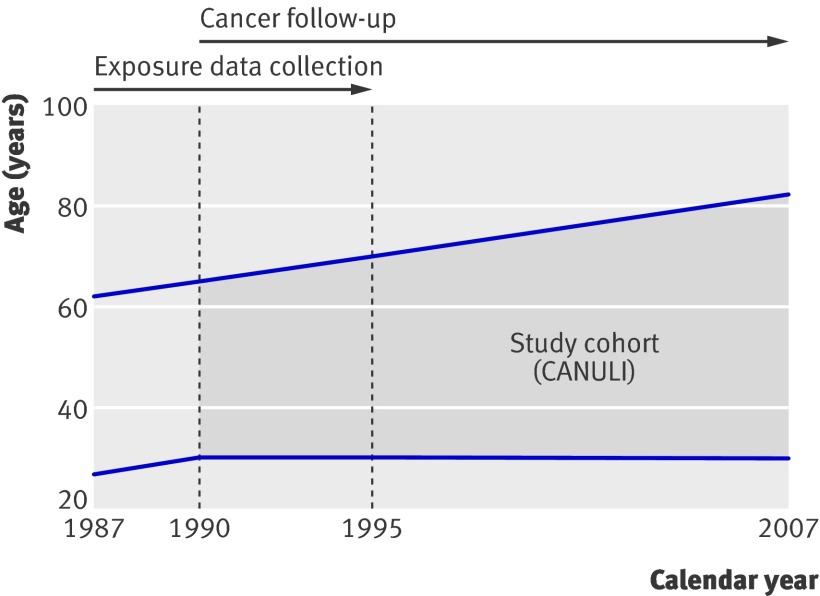
Participants: All Danes aged ≥ 30 and born in Denmark after 1925, subdivided into subscribers and non-subscribers of mobile phones before 1995.
Main outcome measures: Risk of tumours of the central nervous system, identified from the complete Danish Cancer Register. Sex specific incidence rate ratios estimated with log linear Poisson regression models adjusted for age, calendar period, education, and disposable income.
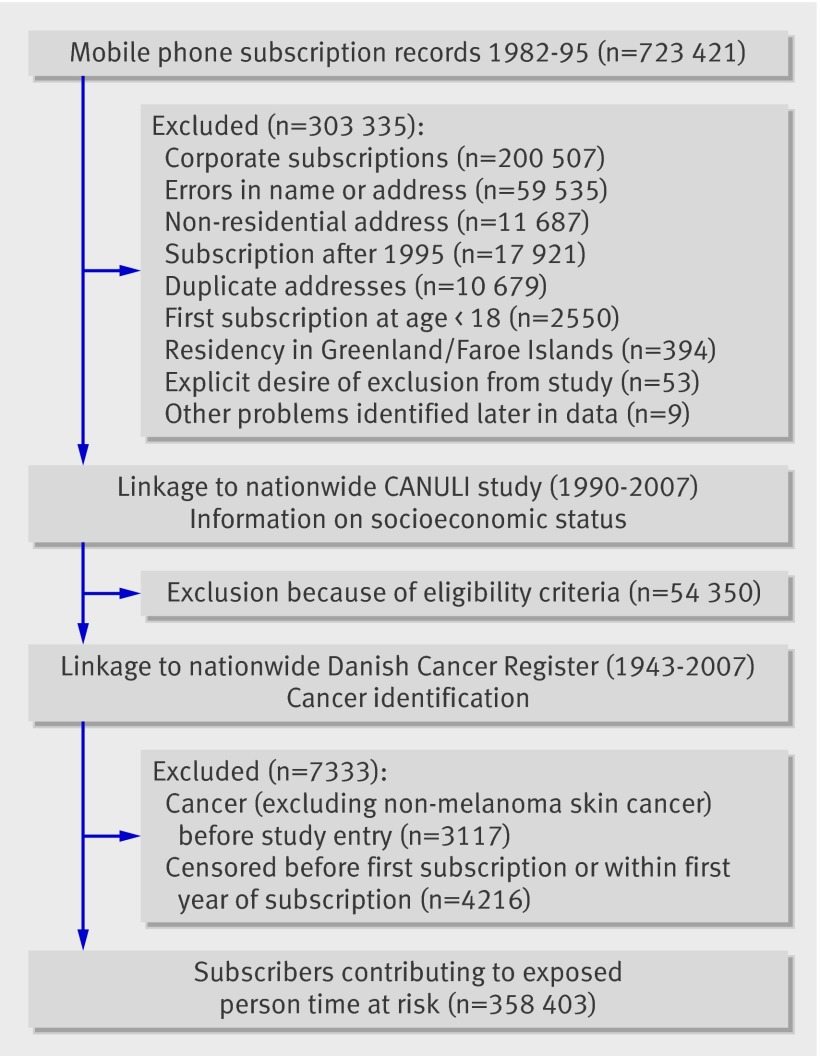
Results: 358,403 subscription holders accrued 3.8 million person years. In the follow-up period 1990-2007, there were 10,729 cases of tumours of the central nervous system. The risk of such tumours was close to unity for both men and women. When restricted to individuals with the longest mobile phone use--that is, ≥ 13 years of subscription--the incidence rate ratio was 1.03 (95% confidence interval 0.83 to 1.27) in men and 0.91 (0.41 to 2.04) in women. Among those with subscriptions of ≥ 10 years, ratios were 1.04 (0.85 to 1.26) in men and 1.04 (0.56 to 1.95) in women for glioma and 0.90 (0.57 to 1.42) in men and 0.93 (0.46 to 1.87) in women for meningioma. There was no indication of dose-response relation either by years since first subscription for a mobile phone or by anatomical location of the tumour--that is, in regions of the brain closest to where the handset is usually held to the head.
Conclusions: In this update of a large nationwide cohort study of mobile phone use, there were no increased risks of tumours of the central nervous system, providing little evidence for a causal association.
Conflict of interest statement
Competing interests: All authors have completed the ICMJE uniform disclosure form at
Figures
Comment in
-
Mobile telephones and brain tumours.BMJ. 2011 Oct 19;343:d6605. doi: 10.1136/bmj.d6605. BMJ. 2011. PMID: 22016440 No abstract available.
-
Questions about selection, exposure, and tumour incidence.BMJ. 2011 Dec 6;343:d7893; author reply d7912. doi: 10.1136/bmj.d7893. BMJ. 2011. PMID: 22146653 No abstract available.
-
Updated study contains poor science and should be disregarded.BMJ. 2011 Dec 6;343:d7899; author reply d7912. doi: 10.1136/bmj.d7899. BMJ. 2011. PMID: 22146654 No abstract available.
-
Failure to detect a link between mobile phone use and brain tumours in a large Danish cohort study: but findings may be due to bias.Evid Based Med. 2012 Oct;17(5):165-6. doi: 10.1136/ebmed-2011-100479. Epub 2012 Feb 18. Evid Based Med. 2012. PMID: 22345040 No abstract available.
References
-
- International Telecommunication Union (ITU). Key global telecom indicators for the world telecommunication service sector. 2010. www.itu.int/ITU-D/ict/statistics/at_glance/KeyTelecom.html.
-
- Scientific Committee on Emerging and Newly Identified Health Risks. Health effects of exposure to EMF. European Commission, 2009.
-
- INTERPHONE Study Group. Brain tumour risk in relation to mobile telephone use: results of the INTERPHONE international case-control study. Int J Epidemiol 2010;39:675-94. - PubMed
-
- Ahlbom A, Feychting M, Green A, Kheifets L, Savitz DA, Swerdlow AJ. Epidemiologic evidence on mobile phones and tumor risk: a review. Epidemiology 2009;20:639-52. - PubMed
-
- Vrijheid M, Deltour I, Krewski D, Sanchez M, Cardis E. The effects of recall errors and of selection bias in epidemiologic studies of mobile phone use and cancer risk. J Expo Sci Environ Epidemiol 2006;16:371-84. - PubMed
Publication types
MeSH terms
LinkOut - more resources
Full Text Sources
Medical