


Double dissociation of stimulus-value and action-value learning in humans with orbitofrontal or anterior cingulate cortex damage
- PMID: 22016538
- PMCID: PMC6623552
- DOI: 10.1523/JNEUROSCI.3164-11.2011
Double dissociation of stimulus-value and action-value learning in humans with orbitofrontal or anterior cingulate cortex damage
Abstract
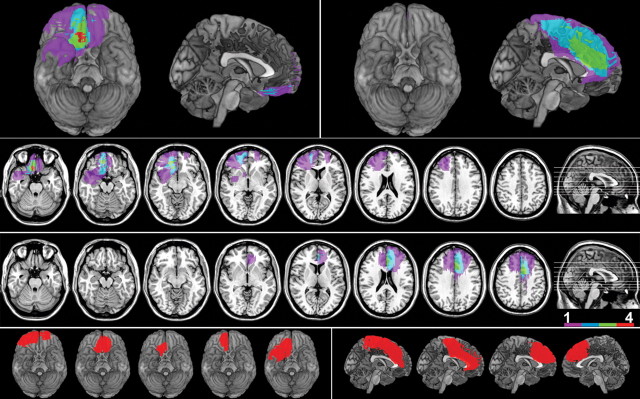
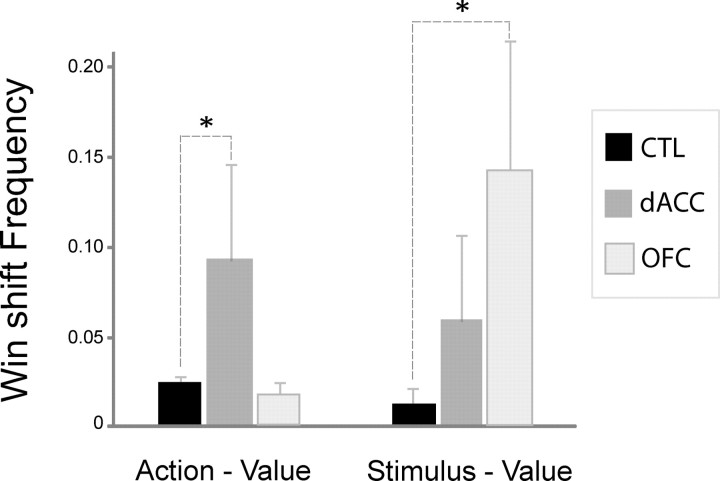
Adaptive decision making involves selecting the most valuable option, typically by taking an action. Such choices require value comparisons, but there is debate about whether these comparisons occur at the level of stimuli (goods-based) value, action-based value, or both. One view is that value processes occur in series, with stimulus value informing action value. However, lesion work in nonhuman primates suggests that these two kinds of choice are dissociable. Here, we examined action-value and stimulus-value learning in humans with focal frontal lobe damage. Orbitofrontal damage disrupted the ability to sustain the correct choice of stimulus, but not of action, after positive feedback, while damage centered on dorsal anterior cingulate cortex led to the opposite deficit. These findings argue that there are distinct, domain-specific mechanisms by which outcome value is applied to guide subsequent decisions, depending on whether the choice is between stimuli or between actions.
Figures
References
-
- Buckley MJ, Mansouri FA, Hoda H, Mahboubi M, Browning PG, Kwok SC, Phillips A, Tanaka K. Dissociable components of rule-guided behavior depend on distinct medial and prefrontal regions. Science. 2009;325:52–58. - PubMed
-
- Fellows LK. The role of orbitofrontal cortex in decision making: a component process account. Ann N Y Acad Sci. 2007;1121:421–430. - PubMed
-
- Gehring WJ, Willoughby AR. The medial frontal cortex and the rapid processing of monetary gains and losses. Science. 2002;295:2279–2282. - PubMed
Publication types
MeSH terms
Grants and funding
LinkOut - more resources
Full Text Sources
Other Literature Sources
