. 2011 Oct 19;31(42):15144-53.
doi: 10.1523/JNEUROSCI.1013-11.2011.

Identification of neural feedback for upright stance in humans: stabilization rather than sway minimization

Affiliations

Identification of neural feedback for upright stance in humans: stabilization rather than sway minimization

Tim Kiemel et al. J Neurosci. .

Abstract

A fundamental issue in motor control is how to determine the task goals for a given behavior. Here, we address this question by separately identifying the musculoskeletal and feedback components of the human postural control loop. Eighteen subjects were perturbed by two mechanical perturbations (gentle pulling from behind at waist and shoulder levels) and one sensory perturbation (movement of a virtual visual scene). Body kinematics was described by the leg and trunk segment angles in the sagittal plane. Muscle activations were described by ankle and hip EMG signals, with each EMG signal computed as a weighted sum of rectified EMG signals from multiple muscles at the given joint. The mechanical perturbations were used to identify feedback, defined as the mapping from the two segment angles to the two EMG signals. The sensory perturbation was used to estimate parameters in a mechanistic model of the plant, defined as the mapping from the two EMG signals to the two segment angles. Using the plant model and optimal control theory, we compared identified feedback to optimal feedback for a range of cost functions. Identified feedback was similar to feedback that stabilizes upright stance with near-minimum muscle activation, but was not consistent with feedback that substantially increases muscle activation to reduce movements of the body's center of mass or center of pressure. The results suggest that the common assumption of reducing sway may not apply to musculoskeletal systems that are inherently unstable.


Figures

Figure 1.
Figure 1.
Schematic diagram of the postural control feedback loop. The plant is operationally defined as the process that maps ankle and hip EMG signals to leg and trunk angles. Neural feedback is defined as the process that maps leg and trunk angles to ankle and hip EMG signals. The signals used to identify the plant and feedback are labeled in italics.
Figure 2.
Figure 2.
An example of a 10 s section of a trial showing the signals used to identify the plant and feedback: one sensory perturbation (A), two mechanical perturbations (B, C), two weighted EMG signals (D, E), and two segment angles (F, G).
Figure 3.
Figure 3.
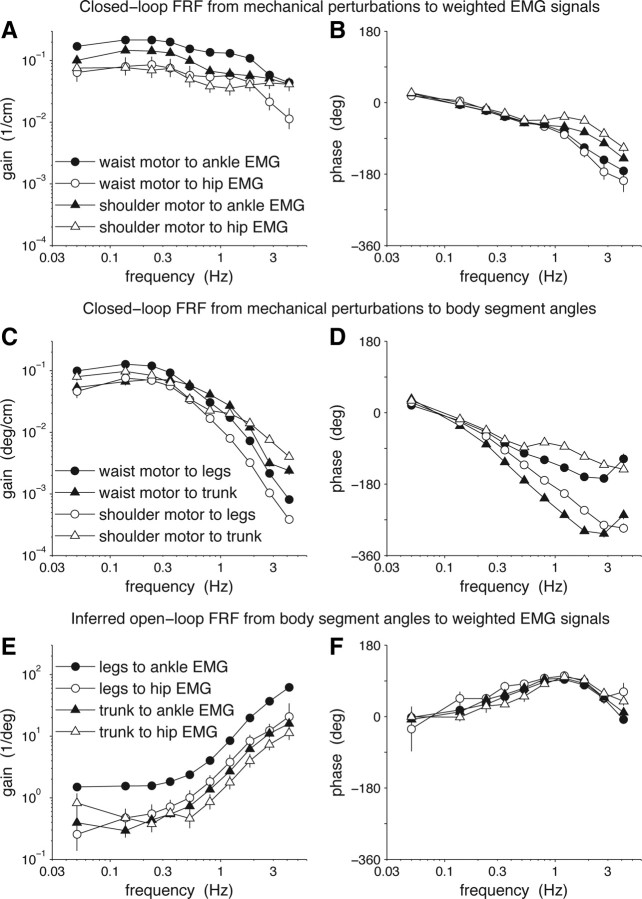
FRFs of closed-loop responses to mechanical perturbations (A–D) and identified feedback (E, F). Error bars denote bootstrap SEs.
Figure 4.
Figure 4.
FRFs of closed-loop responses to visual perturbation (A–D) and fitted plant model (E, F). Error bars denote bootstrap SEs. Fitted plant model parameters are ω01 = 9.9 rad/s, ω02 = 12.1 rad/s, η1 = 1.50, η2 = 1.65, γ1 = 6.58 Nm, γ2 = 4.55 Nm, k1 = 286 Nm/rad, k2 = 149 Nm/rad, α1 = 65.6 Nms/rad, and α2 = 24.8 Nms/rad.
Figure 5.
Figure 5.
FRFs of optimal feedback under for three different cost functions. A, B, Fitted cost function. Cost function penalizes the sway variable ymin, a linear combination of leg and trunk angles and their velocities. C, D, Same cost function except that the penalty on ymin is reduced by a factor of 104. The resulting feedback is the feedback that stabilizes upright stance with (virtually) the minimum muscle activation. E, F, Cost function with a large penalty on COM deviations. The COM penalty is μCOM = 40 rad−1cm−1.
Figure 6.
Figure 6.
Additional muscle activation in the optimal control model necessary to reduce deviations in a specified output variable. Results are shown for feedback designed to reduce deviations in either ymin, the COM, or the COP. In all three cases, as the penalty on the output variable approaches zero, feedback approaches the minimum-activation feedback (open circle). As the penalty on the output variable increases, the RMS of the output variable decreases while the muscle activation cost increases. The filled circle corresponds to the cost function whose resulting optimal feedback was most similar to identified feedback. Feedback reduces the RMS of ymin, a linear combination of segment angles and velocities, while requiring only a 1.6% increase in muscle activation.

References

    1. Asai Y, Tasaka Y, Nomura K, Nomura T, Casadio M, Morasso P. A model of postural control in quiet standing: robust compensation of delay-induced instability using intermittent activation of feedback control. PLoS One. 2009;4:e6169. - PMC - PubMed
    1. Barin K. Dynamic posturography: analysis of error in force plate measurement of postural sway. IEEE Eng Med Biol Mag. 1992;11:52–56.
    1. Bendat JS, Piersol AG. Random data: analysis and measurement procedures. Ed 3. New York: Wiley; 2000.
    1. Bernstein N. The co-ordination and regulation of movements. Oxford: Pergamon; 1967.
    1. Bryson AE, Ho YC. Applied optimal control: optimization, estimation, and control. New York: Wiley; 1975.

Publication types