


The dynamics and evolutionary potential of domain loss and emergence
- PMID: 22016574
- PMCID: PMC3258042
- DOI: 10.1093/molbev/msr250
The dynamics and evolutionary potential of domain loss and emergence
Abstract
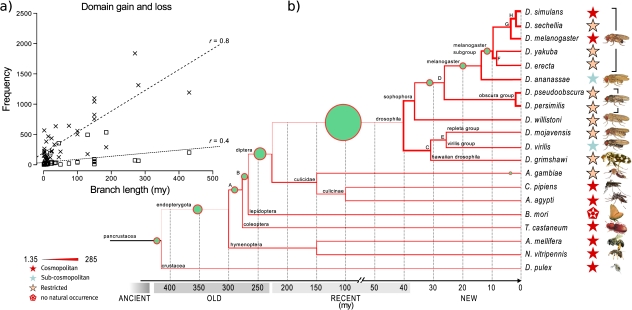
The wealth of available genomic data presents an unrivaled opportunity to study the molecular basis of evolution. Studies on gene family expansions and site-dependent analyses have already helped establish important insights into how proteins facilitate adaptation. However, efforts to conduct full-scale cross-genomic comparisons between species are challenged by both growing amounts of data and the inherent difficulty in accurately inferring homology between deeply rooted species. Proteins, in comparison, evolve by means of domain rearrangements, a process more amenable to study given the strength of profile-based homology inference and the lower rates with which rearrangements occur. However, adapting to a constantly changing environment can require molecular modulations beyond reach of rearrangement alone. Here, we explore rates and functional implications of novel domain emergence in contrast to domain gain and loss in 20 arthropod species of the pancrustacean clade. Emerging domains are more likely disordered in structure and spread more rapidly within their genomes than established domains. Furthermore, although domain turnover occurs at lower rates than gene family turnover, we find strong evidence that the emergence of novel domains is foremost associated with environmental adaptation such as abiotic stress response. The results presented here illustrate the simplicity with which domain-based analyses can unravel key players of nature's adaptational machinery, complementing the classical site-based analyses of adaptation.
Figures
References
-
- Alexa A, Rahnenführer J, Lengauer T. Improved scoring of functional groups from gene expression data by decorrelating go graph structure. Bioinformatics. 2006;22:1600–1607. - PubMed
-
- Apic G, Gough J, Teichmann SA. Domain combinations in archaeal, eubacterial and eukaryotic proteomes. J Mol Biol. 2001;310:311–325. - PubMed
-
- Björklund AK, Ekman D, Light S, Frey-Skött J, Elofsson A. Domain rearrangements in protein evolution. J Mol Biol. 2005;353:911–923. - PubMed
-
- Bornberg-Bauer E, Huylmans AK, Sikosek T. How do new proteins arise? Curr Opin Struct Biol. 2010;20:390–396. - PubMed
Publication types
MeSH terms
Substances
LinkOut - more resources
Full Text Sources
