


Nanoparticles and neurotoxicity
- PMID: 22016657
- PMCID: PMC3189781
- DOI: 10.3390/ijms12096267
Nanoparticles and neurotoxicity
Abstract
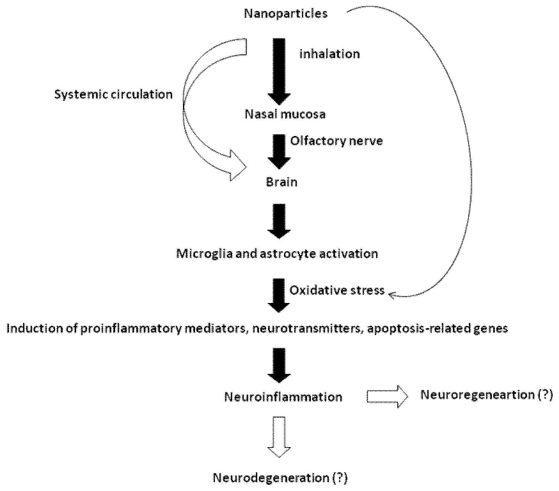
Humans are exposed to nanoparticles (NPs; diameter < 100 nm) from ambient air and certain workplaces. There are two main types of NPs; combustion-derived NPs (e.g., particulate matters, diesel exhaust particles, welding fumes) and manufactured or engineered NPs (e.g., titanium dioxide, carbon black, carbon nanotubes, silver, zinc oxide, copper oxide). Recently, there have been increasing reports indicating that inhaled NPs can reach the brain and may be associated with neurodegeneration. It is necessary to evaluate the potential toxic effects of NPs on brain because most of the neurobehavioral disorders may be of environmental origin. This review highlights studies on both combustion-derived NP- and manufactured or engineered NP-induced neuroinflammation, oxidative stress, and gene expression, as well as the possible mechanism of these effects in animal models and in humans.
Keywords: brain; nanoparticles; neuroinflammation; neurotoxicity; oxidative stress.
Figures
References
-
- Dockery DW, Pope CA, III, Xu X, Spengler JD, Ware JH, Fay ME, Ferris BG, Jr, Speizer FE. An association between air pollution and mortality in six US cities. N Engl J Med. 1993;329:1753–1759. - PubMed
-
- Peters A, Döring A, Wichmann HE, Koenig W. Increased plasma viscosity during an air pollution episode: A link to mortality? Lancet. 1997;349:1582–1587. - PubMed
-
- Penttinen P, Timonen KL, Tittanen P, Mirme A, Ruuskanen J, Pekkanen J. Ultrafine particles in urban air and respiratory health among adult asthmatics. Euro Respir J. 2001;17:428–435. - PubMed
Publication types
MeSH terms
LinkOut - more resources
Full Text Sources
Medical
Miscellaneous
