


Effect of surfaces on amyloid fibril formation
- PMID: 22016789
- PMCID: PMC3189948
- DOI: 10.1371/journal.pone.0025954
Effect of surfaces on amyloid fibril formation
Abstract
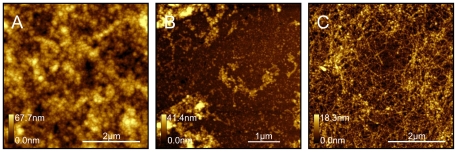
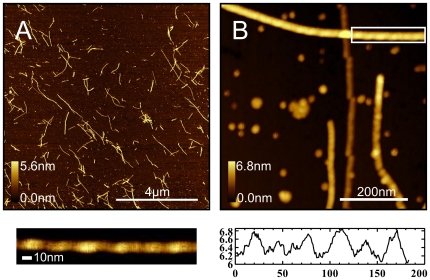
Using atomic force microscopy (AFM) we investigated the interaction of amyloid beta (Aβ) peptide with chemically modified surfaces in order to better understand the mechanism of amyloid toxicity, which involves interaction of amyloid with cell membrane surfaces. We compared the structure and density of Aβ fibrils on positively and negatively charged as well as hydrophobic chemically-modified surfaces at physiologically relevant conditions. We report that due to the complex distribution of charge and hydrophobicity amyloid oligomers bind to all types of surfaces investigated (CH₃, COOH, and NH₂) although the charge and hydrophobicity of surfaces affected the structure and size of amyloid deposits as well as surface coverage. Hydrophobic surfaces promote formation of spherical amorphous clusters, while charged surfaces promote protofibril formation. We used the nonlinear Poisson-Boltzmann equation (PBE) approach to analyze the electrostatic interactions of amyloid monomers and oligomers with modified surfaces to complement our AFM data.
Conflict of interest statement
Figures



References
-
- Lashuel HA, Lai Z, Kelly JW. Characterization of the Transthyretin Acid Denaturation Pathway by Analytical Ultracentrifugation: Implications for wild type, V30M and L55P Amyloid Fibril Formation. Biochem. 1998;37:17851–17864. - PubMed
-
- Lansbury P, Rochet J. Amyloid fibrillogenesis: themes and variations. Curr Opin Struct Biol. 2000;10:60–68. - PubMed
-
- Chiti F, Dobson CM. Protein misfolding, functional amyloid, and human disease. Annu Rev Biochem. 2006;75:333–366. - PubMed
-
- Johansson J. Molecular determinants for amyloid fibril formation: lessons from lung surfactant protein C. Swiss Med Wkly. 2003;133:275–282. - PubMed
Publication types
MeSH terms
Substances
LinkOut - more resources
Full Text Sources
Other Literature Sources
Miscellaneous
