. 2011 May;1(1):55-65.
doi: 10.4161/mge.1.1.16432.

The influence of the accessory genome on bacterial pathogen evolution

Affiliations

The influence of the accessory genome on bacterial pathogen evolution

Robert W Jackson et al. Mob Genet Elements. 2011 May.

Abstract

Bacterial pathogens exhibit significant variation in their genomic content of virulence factors. This reflects the abundance of strategies pathogens evolved to infect host organisms by suppressing host immunity. Molecular arms-races have been a strong driving force for the evolution of pathogenicity, with pathogens often encoding overlapping or redundant functions, such as type III protein secretion effectors and hosts encoding ever more sophisticated immune systems. The pathogens' frequent exposure to other microbes, either in their host or in the environment, provides opportunities for the acquisition or interchange of mobile genetic elements. These DNA elements accessorize the core genome and can play major roles in shaping genome structure and altering the complement of virulence factors. Here, we review the different mobile genetic elements focusing on the more recent discoveries and highlighting their role in shaping bacterial pathogen evolution.


Figures
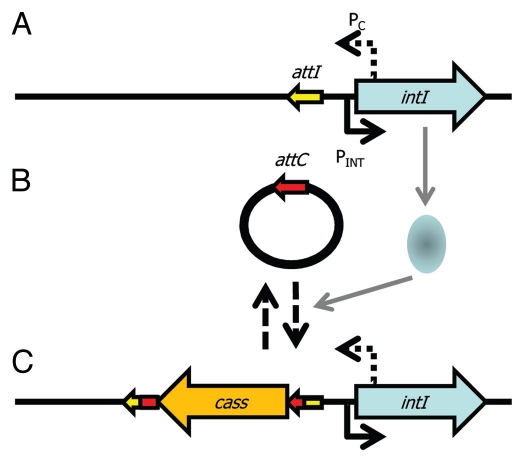
Figure 1
Figure 1
Capture of DNA by an integron. The integron core unit (A) is composed of an integrase (intI) gene, a promoter (PINT) to drive expression of intI, a promoter (PC) to drive expression of captured genes and a site for integration of genes (attI). (B) Expression of the integrase occurs during the SOS response and the integrase protein (pale blue oval) catalyses site-specific recombination of circularised gene cassettes with an attC site that matches attI so that (C) cassettes (cass) are incorporated into the integron. More cassettes can be integrated into attI and cassettes can also excise. PC can drive expression of the captured cassettes.
Figure 2
Figure 2
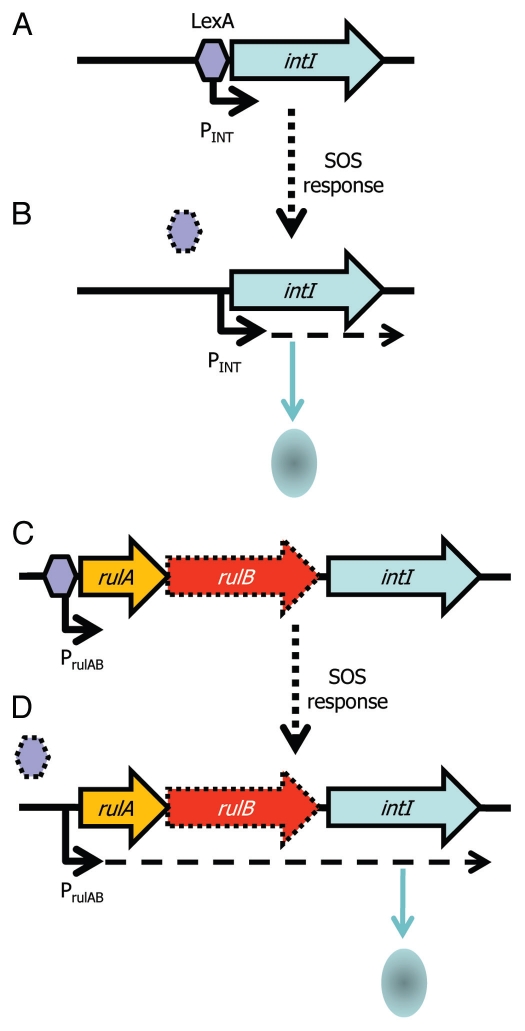
Integron integrase expression is regulated by LexA and the SOS response. (A) The integrase (intI) gene of many integrons is preceded by a cis encoded LexA box, allowing the LexA repressor (purple hexagon) to bind upstream of intI and prevent expression of the gene. (B) Activation of the SOS response leads to derepression of intI by release and degradation of LexA (signified by dotted hexagon) and production of IntI and potential capture of gene cassettes. (C) An association of integrase genes with rulAB DNA repair genes (rulB is usually truncated, signified by dotted outline) may indicate that intI expression is controlled by the rulAB promoter (PrulAB), which is repressed by LexA and (D) relieved under SOS conditions.
Figure 3
Figure 3
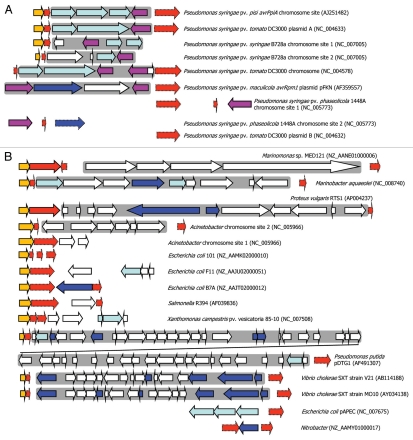
Integron-like elements associated with DNA repair genes. (A) Type III protein secretion effector (T3SE) integron-like elements are associated with rulA (orange) and/or rulB (red) genes in various Pseudomonas syringae genomes; truncated rulB genes have a dotted edge. T3SE (purple) are found in many cases to be associated with an integrase gene (light blue) or sometimes transposases (dark blue). Other genes are shown in white. A “complete” integron insertion within rulAB is observed in Pseudomonas syringae pv. pisi (Ppi) and P. syringae pv. tomato (Pto), whereas there is evidence of erosion of the rulA and rulB genes in other strains. A grey background is used to highlight the more complete integron elements. The accession numbers refer to the source used for identifying these genes and for orientation, the locus tag for the first gene on the left of each diagram is: Ppi (ORFG); Pto DC3000 plasmid A (rulA); P. syringae pv. syringae B728a chromosomal site 1 (Psyr_0735) and site 2 (Psyr_1884); Pto DC3000 chromosome (intergenic rulB fragment between PSPTO_0585 and PSPTO_0586); P. syringae pv. maculicola (Orf2); P. syringae pv. phaseolicola chromosomal site 1 (PSPPH_0782) and 2 (avrB4-1). (B) Evidence of current or ancient integron associations with DNA repair genes such as umuDC and rumAB are seen in a wider range of bacterial genomes. The accession numbers refer to the source used for identifying these genes and for orientation, the locus tag or gene name of the first gene on the left of each diagram is: Marinomonas (MED121_22332); Marinobacter aquaeolei (1208); Proteus vulgaris (orf79); Acinetobacter chr. site 2 (umuD) and site 1 (ruvA); Escherichia coli 101 (samA), F11 (impA), B7A (EcB7A_1674); Salmonella R394 (mucA); Xanthomonas campestris (XCV3904); Pseudomonas putida (ruvA); Vibrio cholerae V21 (rumA) and MO10 (rumA); Escherichia coli pAPEC (O2ColV155); Nitrobacter (NB311A_19467). Note that differences in arrow lengths and a dotted edging for rulB-like genes (red) represent either truncated coding sequences or orphan non-coding sequences.

References

    1. Lipps HJ. Archaeal Plasmids. In: Lipps G, editor. Plasmids: Current Research and Future Trends. Norfolk: Caister Academic Press; 2008.
    1. Sundin GW. Genomic insights into the contribution of phytopathogenic bacterial plasmids to the evolutionary history of their hosts. Annu Rev Phytopathol. 2007;45:129–151. - PubMed
    1. Halary S, Leigh JW, Cheaib B, Lopez P, Bapteste E. Network analyses structure genetic diversity in independent genetic worlds. Proc Natl Acad Sci USA. 2010;107:127–132. - PMC - PubMed
    1. Heinemann JA, Sprague GF. Bacterial conjugative plasmids mobilize DNA transfer between bacteria and yeast. Nature. 1989;340:205–209. - PubMed
    1. Grillot-Courvalin C, Goussard S, Huetz F, Ojcius DM, Courvalin P. Functional gene transfer from intracellular bacteria to mammalian cells. Nat Biotech. 1998;16:862–866. - PubMed

LinkOut - more resources