Review
. 2012 Jul 1;17(1):58-67.
doi: 10.1089/ars.2011.4351. Epub 2011 Dec 15.

Hydrogen sulfide: an endogenous mediator of resolution of inflammation and injury

Affiliations
Review

Hydrogen sulfide: an endogenous mediator of resolution of inflammation and injury

John L Wallace et al. Antioxid Redox Signal. .

Abstract

Significance: Hydrogen sulfide is emerging as an important mediator of many aspects of inflammation, and perhaps most importantly as a factor promoting the resolution of inflammation and repair of injury.

Recent advances: In the gastrointestinal tract, H(2)S has been shown to promote healing of ulcers and the resolution of mucosal inflammation. On the other hand, suppression of endogenous H(2)S synthesis impairs mucosal defense and leads to increased granulocyte infiltration. H(2)S has been exploited in the design of more effective and safe anti-inflammatory drugs.

Critical issues: Enteric bacteria can be a significant source of H(2)S, which could affect mucosal integrity; indeed, luminal H(2)S can serve as an alternative to oxygen as a metabolic substrate for mitochondrial respiration in epithelial cells. Enterocytes and colonocytes thereby represent a "metabolic barrier" to the diffusion of bacteria-derived H(2)S into the subepithelial space. A compromise of this barrier could result in modulation of mucosal function and integrity by bacterial H(2)S.

Future directions: Improvements in methods for measurement of H(2)S and development of more selective inhibitors are crucial for gaining a better understanding of the pathophysiological importance of this mediator. Results from animal studies suggest that H(2)S-releasing agents are promising therapeutic agents for many indications, but these compounds need to be assessed in a clinical setting.


Figures
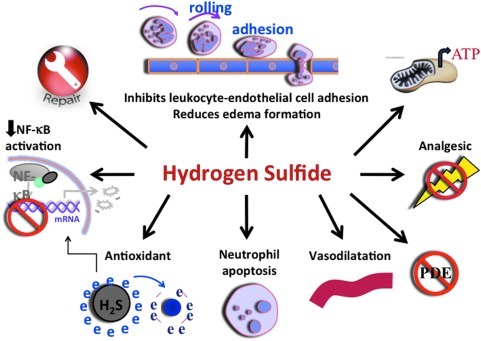
FIG. 1.
FIG. 1.
Anti-inflammatory effects of H2S. This figure illustrates some of the key ways in which H2S can reduce inflammation. H2S suppresses leukocyte adherence to the vascular endothelium and migration of leukocytes into the subendothelial space, as well as reducing plasma exudation. H2S has been shown to reduce expression of many pro-inflammatory cytokines, chemokines, and enzymes, most likely related to its ability to suppress activation of nuclear transcription factor-κB (NF-κB). H2S is also a potent anti-oxidant and can induce apoptosis in neutrophils (which can lead to their phagocytosis by macrophages). Promotion of tissue repair by H2S is likely mediated in part by its vasodilatory actions and enhancement of cyclooxygenase-2 (COX-2) expression and through promotion of angiogenesis. Inhibition of phosphodiesterases (PDE) by H2S leads to elevated cyclic AMP and/or cyclic GMP levels, which can contribute to its anti-inflammatory effects. H2S exhibits anti-nociceptive effects in the viscera, likely due, at least in part, to activation of ATP-sensitive potassium channels. In many cells in the body, and in particular in gastrointestinal epithelial cells, H2S can act as an energy source (generating ATP), substituting for oxygen in mitochondrial respiration. This appears to contribute significantly to protection and repair of tissue injury.
FIG. 2.
FIG. 2.
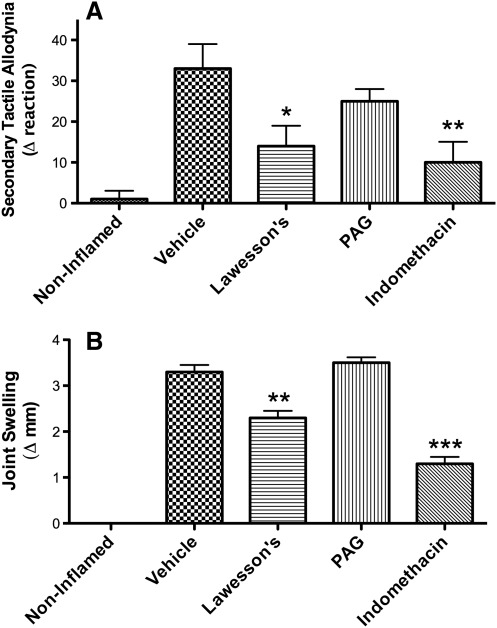
Anti-nociceptive and anti-inflammatory effects of hydrogen sulfide in experimental (carrageenan-induced) synovitis in rats. (A) Pain responses and (B) joint swelling. Pretreatment with an H2S donor (Lawesson's reagent; 3.6 μmol intra-articularly), markedly reduced secondary tactile allodynia, while an inhibitor of H2S synthesis (D/L-propargylglycine [PAG], 53 μmol intra-articularly) had no significant effect. Indomethacin (6 mg/kg intraperitoneally) was used as a positive control. *p<0.05, **p<0.01, ***p<0.001 versus the vehicle-treated group. Adapted from previously published data (17).
FIG. 3.
FIG. 3.
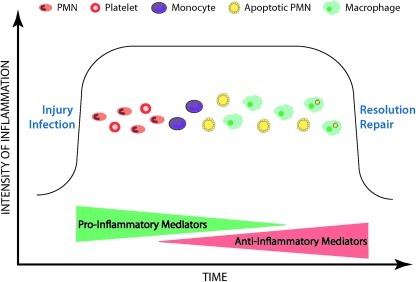
Resolution of inflammation. Inflammatory reactions to injury or infection are largely coordinated by soluble mediators (pro-inflammatory and anti-inflammatory). In the early stages of an inflammatory reaction, the pro-inflammatory mediators predominate, resulting in the recruitment of inflammatory cells (such as neutrophils) and platelets to the site of injury/infection. Monocyte recruitment follows, with the subsequent transformation to macrophages, which are crucial for tissue repair. In part driven by anti-inflammatory mediators such as H2S, the infiltrated neutrophils begin to undergo apoptosis, which causes macrophages to shift their phenotype from pro-inflammatory to anti-inflammatory. Engulfment of apoptotic neutrophils (polymorphonuclear leukocytes [PMN]) by macrophages is a key event in resolution of inflammation.
FIG. 4.
FIG. 4.
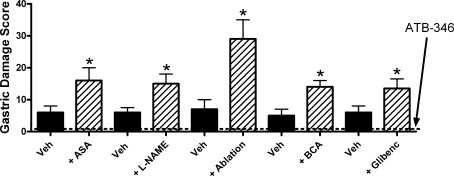
Acute damage to the stomach in rats treated with naproxen or an equimolar dose (60 μmol/kg) of an H2S-releasing derivative of naproxen (ATB-346). In rats pretreated with vehicle, naproxen induced a low level of gastric damage, while no damage was observed in rats treated with ATB-346 (n≥5 per group). Pretreatment with low-dose aspirin (10 mg/kg; ASA), an inhibitor of nitric oxide synthase (L-NAME; 15 mg/kg), ablation with capsaicin of sensory afferent nerves, pretreatment with an inhibitor of cystathionine β-synthase (β-cyanoalanine [BCA], 50 mg/kg) or an antagonist of ATP-sensitive K+ channels (glibenclamide; 10 mg/kg) each significantly increased the severity of naproxen-induced gastric damage (*p<0.05 vs. corresponding vehicle-treated group). However, ATB-346 did not produce significant gastric damage in any of the rats receiving these treatments (dotted line). Adapted from previously published data (55).
FIG. 5.
FIG. 5.
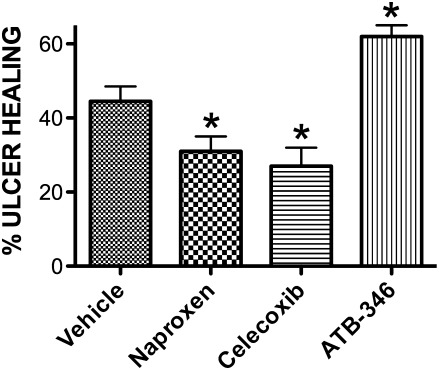
Experimental gastric ulcer healing with ATB-346, an H2S-releasing derivative of naproxen. The extent of healing of gastric ulcers in mice treated twice daily over a 4-day period with one of three NSAIDs or vehicle was examined. Gastric ulcers were induced by brief serosal application of acetic acid (55). Beginning 3 days later, the mice began treatment with naproxen, ATB-346 (each at 60 μmol/kg), celecoxib (at 30 μmol/kg), or vehicle. The ulcer area at the end of the treatment period was compared to that in mice euthanized 3 days after ulcer induction (no drug treatment), and the “percent ulcer healing” was calculated. *p<0.05 versus the vehicle-treated group (n≥5 per group). Adapted from previously published data (55).
FIG. 6.
FIG. 6.
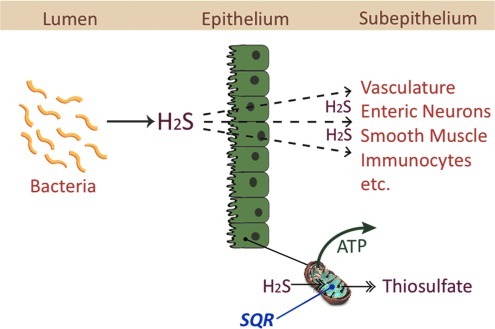
The colonic epithelium as a metabolic barrier to bacteria-derived H2S. Many species of bacteria can produce H2S but most is bound to fecal material. The small amount that is free to diffuse across the epithelium is rapidly metabolized, primarily via mitochondrial sulfide quinone reductase (SQR) to thiosulfate, generating adenosine triphosphate (ATP) in the process. Thus, H2S is an important energy source for colonocytes. When the epithelium is damaged or dysfunctional, more H2S may escape metabolism and reach the subepithelial space, where it can affect many functions, including epithelial secretion, blood flow, smooth muscle contractility, and mucosal defense.
FIG. 7.
FIG. 7.
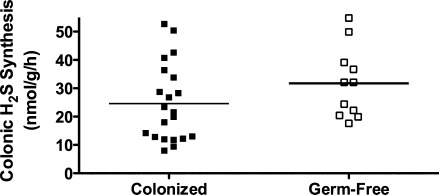
Colonic hydrogen sulfide synthesis, as measured by the zinc acetate–trapping method, does not include significant “contamination” by bacterial H2S synthesis. Mice that were colonized by Altered Schaedler Flora were compared with mice that were raised germ-free. There was considerable variation from mouse to mouse in terms of colonic H2S synthesis, but there was no significant difference between the colonized and germ-free mice. Adapted from previously published data (20).
FIG. 8.
FIG. 8.
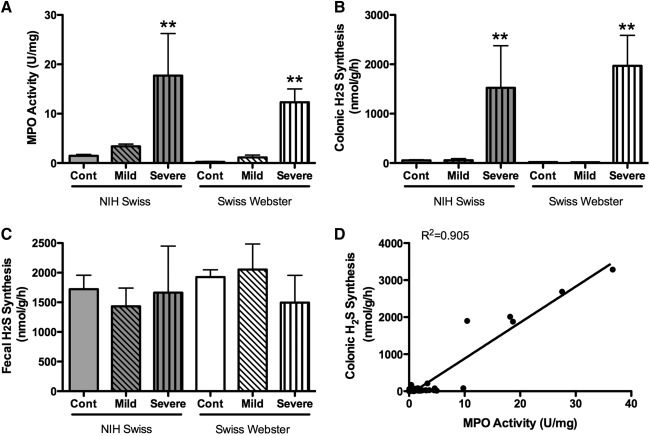
Colonic hydrogen sulfide synthesis (as measured by the zinc acetate–trapping method) is markedly up-regulated during injury/inflammation, and there is negligible bacterial contribution. Colitis was induced via intrarectal administration of trinitrobenzene sulfonic acid (20). (A) Colonic myeloperoxidase (MPO) activity, a biochemical marker of granulocyte infiltration. In both strains of mice examined, MPO activity increased with the severity of the colitis. (B) Colonic H2S synthesis, which similarly increased in parallel with the severity of colitis. (C) In contrast, fecal hydrogen sulfide synthesis did not differ between healthy mice and mice with mild or severe colitis, suggesting negligible contribution of bacteria to what was measured as “colonic” H2S. (D) There was a strong correlation between the extent of inflammation (MPO activity) and colonic H2S synthesis. There was no such correlation between fecal H2S synthesis and colonic MPO activity. **p<0.01 versus the corresponding control (cont) group. Adapted from previously published data (20).

References

    1. Abe K. Kimura H. The possible role of hydrogen sulfide as an endogenous neuromodulator. J Neurosci. 1996;16:1066–1071. - PMC - PubMed
    1. Andruski B. McCafferty DM. Ignacy T. Millen B. McDougall JJ. Leukocyte trafficking and pain behavioral responses to a hydrogen sulfide donor in acute monoarthritis. Am J Physiol Regul Integr Comp Physiol. 2008;295:R814–R820. - PubMed
    1. Asfaha S. MacNaughton WK. Appleyard CB. Chadee K. Wallace JL. Persistent epithelial dysfunction and bacterial translocation after resolution of intestinal inflammation. Am J Physiol. 2001;281:G635–G644. - PubMed
    1. Attene-Ramos MS. Wagner ED. Plewa MJ, et al. Evidence that hydrogen sulfide is a genotoxic agent. Mol Cancer Res. 2006;4:9–14. - PubMed
    1. Babidge W. Millard S. Roediger W. Sulfides impair short chain fatty acid beta-oxidation at acyl-CoA dehydrogenase level in colonocytes: implications for ulcerative colitis. Mol Cell Biochem. 1998;181:117–124. - PubMed

Publication types

Substances

LinkOut - more resources