


Safety and tolerability of magnetic resonance imaging-guided convection-enhanced delivery of AAV2-hAADC with a novel delivery platform in nonhuman primate striatum
- PMID: 22017504
- PMCID: PMC3277736
- DOI: 10.1089/hum.2011.162
Safety and tolerability of magnetic resonance imaging-guided convection-enhanced delivery of AAV2-hAADC with a novel delivery platform in nonhuman primate striatum
Abstract
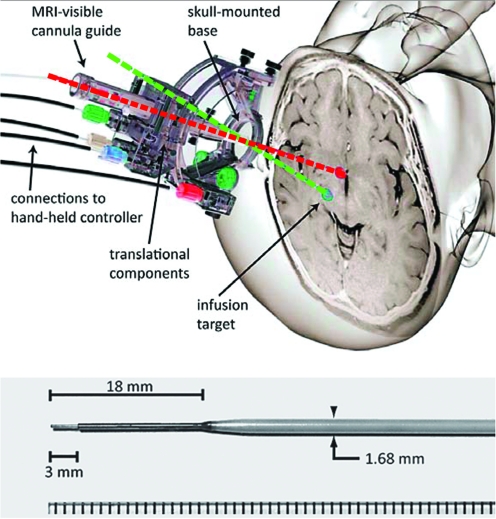
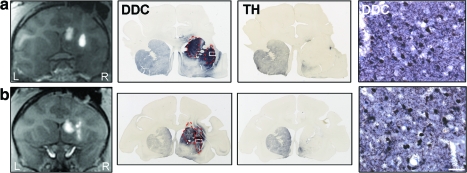
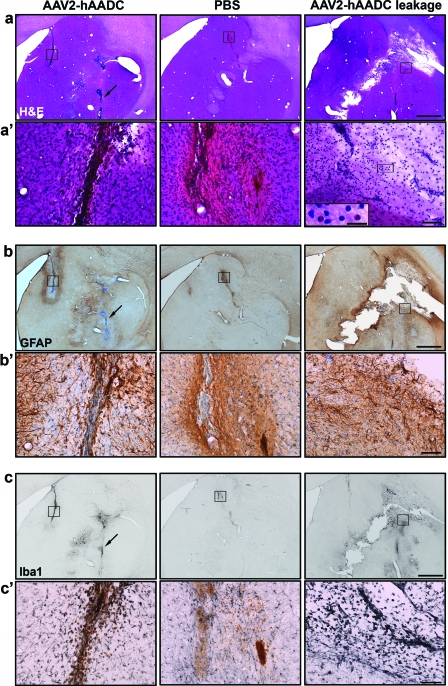
Degeneration of nigrostriatal neurons in Parkinson's disease (PD) causes progressive loss of aromatic l-amino acid decarboxylase (AADC), the enzyme that converts levodopa (l-DOPA) into dopamine in the striatum. Because loss of this enzyme appears to be a major driver of progressive impairment of response to the mainstay drug, l-DOPA, one promising approach has been to use gene therapy to restore AADC activity in the human putamen and thereby restore normal l-DOPA response in patients with PD. An open-label phase I clinical trial of this approach in patients with PD provided encouraging signs of improvement in Unified Parkinson's Disease Rating Scale scores and reductions in antiparkinsonian medications. However, such improvement was modest compared with the results previously reported in parkinsonian rhesus macaques. The reason for this discrepancy may have been that the relatively small volume of vector infused in the clinical study restricted the distribution of AADC expression, such that only about 20% of the postcommissural putamen was covered, as revealed by l-[3-(18)F]-α-methyltyrosine-positron emission tomography. To achieve more quantitative distribution of vector, we have developed a visual guidance system for parenchymal infusion of AAV2. The purpose of the present study was to evaluate the combined magnetic resonance imaging-guided delivery system with AAV2-hAADC under conditions that approximate the intended clinical protocol. Our data indicate that this approach directed accurate cannula placement and effective vector distribution without inducing any untoward effects in nonhuman primates infused with a high dose of AAV2-hAADC.
Figures
References
-
- Bankiewicz K.S. Oldfield E.H. Chiueh C.C., et al. Hemiparkinsonism in monkeys after unilateral internal carotid artery infusion of 1-methyl-4-phenyl-1,2,3,6-tetrahydropyridine (MPTP) Life Sci. 1986;39:7–16. - PubMed
-
- Bankiewicz K.S. Eberling J.L. Kohutnicka M., et al. Convection-enhanced delivery of AAV vector in parkinsonian monkeys: In vivo detection of gene expression and restoration of dopaminergic function using pro-drug approach. Exp. Neurol. 2000;164:2–14. - PubMed
-
- Bankiewicz K.S. Forsayeth J. Eberling J.L., et al. Long-term clinical improvement in MPTP-lesioned primates after gene therapy with AAV-hAADC. Mol. Ther. 2006;14:564–570. - PubMed
-
- Binder D.K. Rau G.M. Starr P.A. Risk factors for hemorrhage during microelectrode-guided deep brain stimulator implantation for movement disorders. Neurosurgery. 2005;56:722–732. discussion 722–732. - PubMed
MeSH terms
Substances
LinkOut - more resources
Full Text Sources
Other Literature Sources
