


The use of plasma aldosterone and urinary sodium to potassium ratio as translatable quantitative biomarkers of mineralocorticoid receptor antagonism
- PMID: 22017794
- PMCID: PMC3305907
- DOI: 10.1186/1479-5876-9-180
The use of plasma aldosterone and urinary sodium to potassium ratio as translatable quantitative biomarkers of mineralocorticoid receptor antagonism
Abstract
Background: Accumulating evidence supports the role of the mineralocorticoid receptor (MR) in the pathogenesis of diabetic nephropathy. These findings have generated renewed interest in novel MR antagonists with improved selectivity against other nuclear hormone receptors and a potentially reduced risk of hyperkalemia. Characterization of novel MR antagonists warrants establishing translatable biomarkers of activity at the MR receptor. We assessed the translatability of urinary sodium to potassium ratio (Na+/K+) and plasma aldosterone as biomarkers of MR antagonism using eplerenone (Inspra®), a commercially available MR antagonist. Further we utilized these biomarkers to demonstrate antagonism of MR by PF-03882845, a novel compound.
Methods: The effect of eplerenone and PF-03882845 on urinary Na+/K+ and plasma aldosterone were characterized in Sprague-Dawley rats and spontaneously hypertensive rats (SHR). Additionally, the effect of eplerenone on these biomarkers was determined in healthy volunteers. Drug exposure-response data were modeled to evaluate the translatability of these biomarkers from rats to humans.
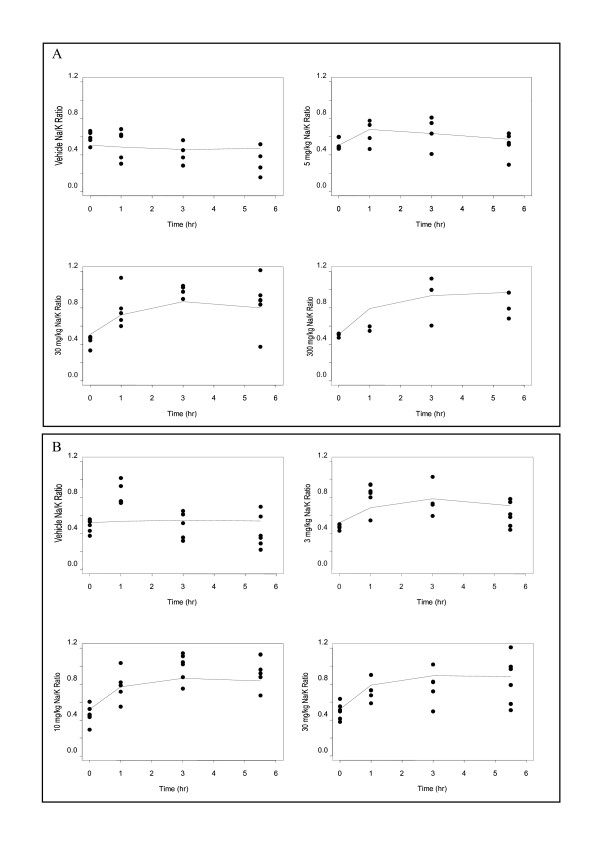
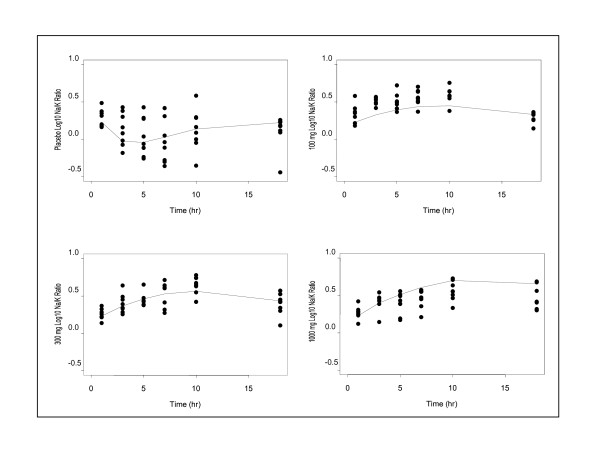
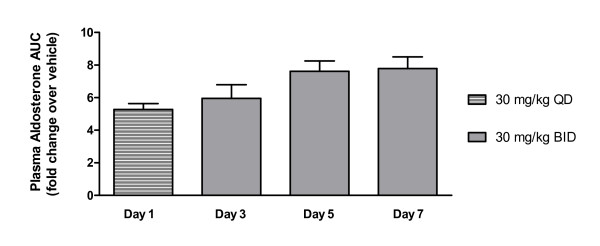
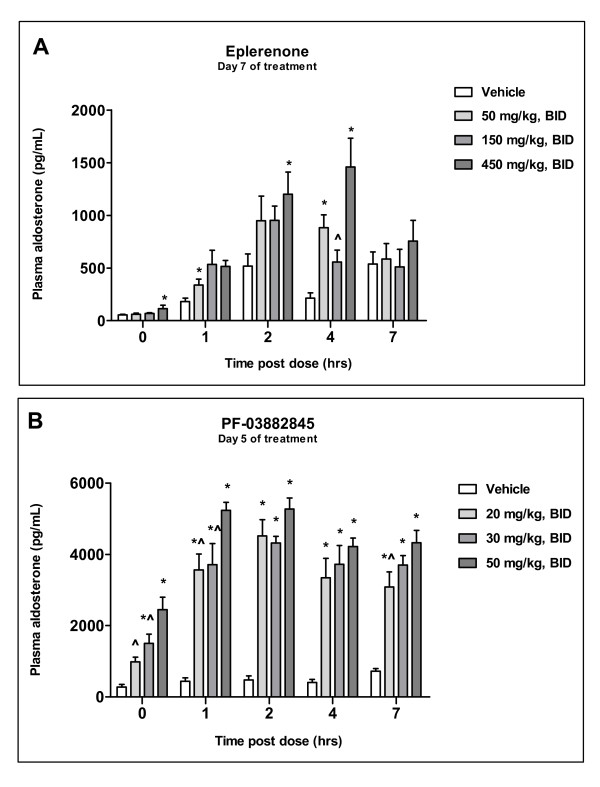
Results: In Sprague-Dawley rats, eplerenone elicited a rapid effect on urinary Na+/K+ yielding an EC50 that was within 5-fold of the functional in vitro IC50. More importantly, the effect of eplerenone on urinary Na+/K+ in healthy volunteers yielded an EC50 that was within 2-fold of the EC50 generated in Sprague-Dawley rats. Similarly, the potency of PF-03882845 in elevating urinary Na+/K+ in Sprague-Dawley rats was within 3-fold of its in vitro functional potency. The effect of MR antagonism on urinary Na+/K+ was not sustained chronically; thus we studied the effect of the compounds on plasma aldosterone following chronic dosing in SHR. Modeling of drug exposure-response data for both eplerenone and PF-03882845 yielded EC50 values that were within 2-fold of that estimated from modeling of drug exposure with changes in urinary sodium and potassium excretion. Importantly, similar unbound concentrations of eplerenone in humans and SHR rats yielded the same magnitude of elevations in aldosterone, indicating a good translatability from rat to human.
Conclusions: Urinary Na+/K+ and plasma aldosterone appear to be translatable biomarkers of MR antagonism following administration of single or multiple doses of compound, respectively.
Trial registration: For clinical study reference EE3-96-02-004, this study was completed in 1996 and falls out scope for disclosure requirements. Clinical study reference A6141115: http://clinicaltrials.gov, http://NIHclinicaltrails.gov; NCTID: NCT00990223.
Figures
References
-
- Gomez-Sanchez EP, Fort CM, Gomez-Sanchez CE. Intracerebroventricular infusion of RU28318 blocks aldosterone-salt hypertension. Am J Physiol Endocrinol Metab. 1990;258:E482–484. - PubMed
-
- Rickard AJ, Morgan J, Tesch G, Funder JW, Fuller PJ, Young MJ. Deletion of mineralocorticoid receptors from macrophages protects against deoxycorticosterone/salt-induced cardiac fibrosis and increased blood pressure. Hypertension. 2009;54:537–543. doi: 10.1161/HYPERTENSIONAHA.109.131110. - DOI - PubMed
-
- Epple HJ, Amasheh A, Mankertz J, Goltz M, Schulzke JD, Fromm M. Early aldosterone effect in distal colon by transcriptional regulation of ENaC. Am J Physiol Gastrointest Liver Physiol. 2000;27:G718–724. - PubMed
Publication types
MeSH terms
Substances
Associated data
LinkOut - more resources
Full Text Sources
Medical
