


Comment
doi: 10.1016/j.molcel.2011.10.005.
Mitochondrial SIRT3: a new potential therapeutic target for metabolic syndrome
Affiliations
- PMID: 22017865
- PMCID: PMC3215590
- DOI: 10.1016/j.molcel.2011.10.005
Item in Clipboard
Comment
Mitochondrial SIRT3: a new potential therapeutic target for metabolic syndrome
Mol Cell.
.
Abstract
In this issue of Molecular Cell, Hirschey et al. demonstrate that loss of the NAD(+)-dependent deacetylase SIRT3 and resultant mitochondrial protein hyperacetylation play a critical role in the pathogenesis of metabolic syndrome, providing new insights into the therapeutic potential of SIRT3.
Copyright © 2011 Elsevier Inc. All rights reserved.
Figures
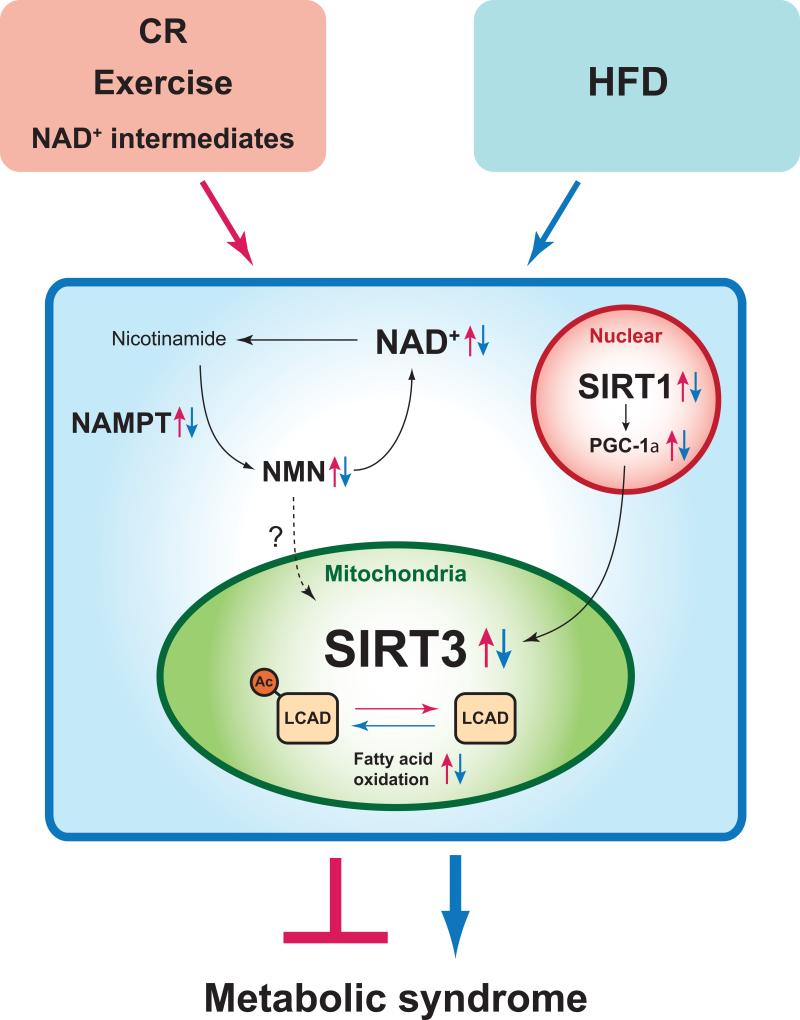
High-fat diet (HFD) feeding suppresses SIRT3 activity and NAMPT-mediated NAD+ biosynthesis (Yoshino et al., 2011), contributing to the pathogenesis of metabolic syndrome (blue arrows). SIRT3 activation is expected to protect against metabolic syndrome by deacetylating key mitochondrial enzymes such as long-chain acyl-CoA dehydrogenase (LCAD). Calorie restriction (CR), exercise, and key NAD+ intermediates are likely able to enhance SIRT3 dosage/activity (red arrows). Of note, Hirschey et al. (2011) also point out an interesting possibility that nuclear SIRT1 positively regulates SIRT3 expression levels through modulating the activity of PGC-1α.
Comment on
-
SIRT3 deficiency and mitochondrial protein hyperacetylation accelerate the development of the metabolic syndrome.Mol Cell. 2011 Oct 21;44(2):177-90. doi: 10.1016/j.molcel.2011.07.019. Mol Cell. 2011. PMID: 21856199 Free PMC article.
References
Publication types
Grants and funding
LinkOut - more resources
Full Text Sources
