


DEPTOR, an mTOR inhibitor, is a physiological substrate of SCF(βTrCP) E3 ubiquitin ligase and regulates survival and autophagy
- PMID: 22017876
- PMCID: PMC3216641
- DOI: 10.1016/j.molcel.2011.08.029
DEPTOR, an mTOR inhibitor, is a physiological substrate of SCF(βTrCP) E3 ubiquitin ligase and regulates survival and autophagy
Abstract
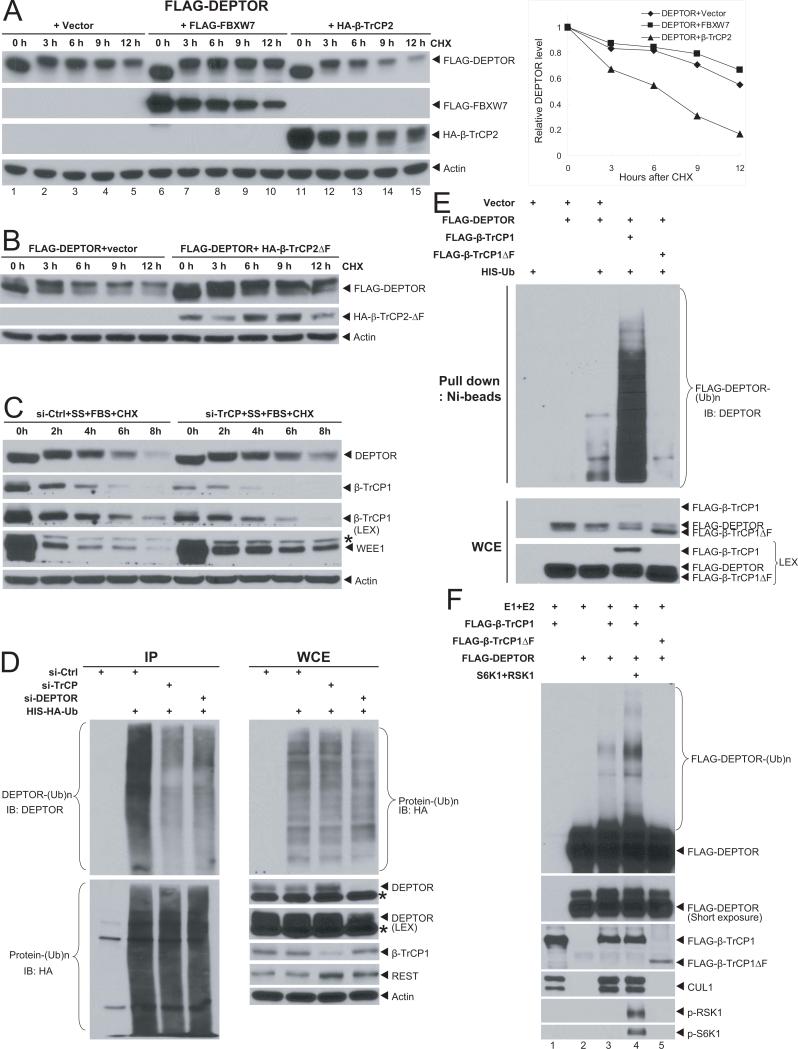
DEPTOR, an inhibitor of mTORC1 and mTORC2, is degraded via ubiquitin-proteasome pathway by an unknown E3 ubiquitin ligase. Here we report that DEPTOR is a physiological substrate of SCF(βTrCP) E3 ligase for targeted degradation. Upon growth factor stimulation, RSK1 and S6K1 kinases are activated to phosphorylate DEPTOR, which is then recognized by the F box protein, βTrCP, via its degron sequence for subsequent ubiquitination and degradation by SCF E3. Endogenous DEPTOR levels are negatively regulated by βTrCP. DEPTOR half-life is shortened by βTrCP but extended by a dominant-negative mutant of βTrCP, by RSK1/S6K1 inhibition, and by βTrCP degron site mutations. Biologically, DEPTOR accumulation upon βTrCP knockdown inactivates mTORC1 and activates AKT in cancer cells to confer resistance to rapamycin and paclitaxel. Furthermore, DEPTOR accumulates upon glucose deprivation and mTOR inhibition to induce autophagy. Thus, βTrCP-DEPTOR-mTOR intertwine to regulate cell survival and autophagy.
Copyright © 2011 Elsevier Inc. All rights reserved.
Figures



Comment in
-
Cell signalling: mTOR targets its own inhibitor.Nat Rev Mol Cell Biol. 2011 Nov 9;12(12):769. doi: 10.1038/nrm3229. Nat Rev Mol Cell Biol. 2011. PMID: 22068633 No abstract available.
References
Publication types
MeSH terms
Substances
Grants and funding
LinkOut - more resources
Full Text Sources
Other Literature Sources
Molecular Biology Databases
Miscellaneous
