


Two genetic loci control syllable sequences of ultrasonic courtship vocalizations in inbred mice
- PMID: 22018021
- PMCID: PMC3215659
- DOI: 10.1186/1471-2202-12-104
Two genetic loci control syllable sequences of ultrasonic courtship vocalizations in inbred mice
Abstract
Background: The ultrasonic vocalizations (USV) of courting male mice are known to possess a phonetic structure with a complex combination of several syllables. The genetic mechanisms underlying the syllable sequence organization were investigated.
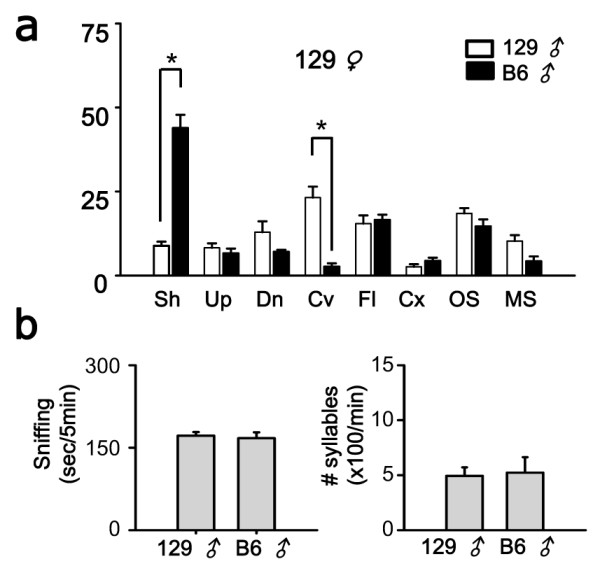
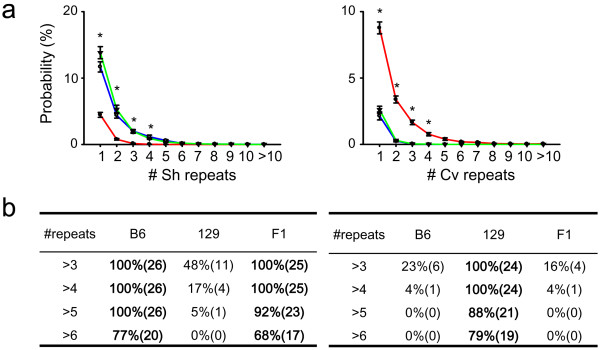
Results: This study compared syllable sequence organization in two inbred strains of mice, 129S4/SvJae (129) and C57BL6J (B6), and demonstrated that they possessed two mutually exclusive phenotypes. The 129S4/SvJae (129) strain frequently exhibited a "chevron-wave" USV pattern, which was characterized by the repetition of chevron-type syllables. The C57BL/6J strain produced a "staccato" USV pattern, which was characterized by the repetition of short-type syllables. An F1 strain obtained by crossing the 129S4/SvJae and C57BL/6J strains produced only the staccato phenotype. The chevron-wave and staccato phenotypes reappeared in the F2 generations, following the Mendelian law of independent assortment.
Conclusions: These results suggest that two genetic loci control the organization of syllable sequences. These loci were occupied by the staccato and chevron-wave alleles in the B6 and 129 mouse strains, respectively. Recombination of these alleles might lead to the diversity of USV patterns produced by mice.
Figures


References
-
- D'Amato FR. Courtship ultrasonic vocalizations and social status in mice. Animal Behaviour. 1991;41(5):875–885. doi: 10.1016/S0003-3472(05)80354-9. - DOI
Publication types
MeSH terms
LinkOut - more resources
Full Text Sources
Miscellaneous
