


Acceptance of long-acting reversible contraceptive methods by adolescent participants in the Contraceptive CHOICE Project
- PMID: 22018123
- PMCID: PMC3505875
- DOI: 10.1016/j.contraception.2011.03.001
Acceptance of long-acting reversible contraceptive methods by adolescent participants in the Contraceptive CHOICE Project
Abstract
Background: Adolescent women have a high risk of unintended pregnancy. Currently, there are little data about their choice to initiate long-acting reversible contraception (LARC).
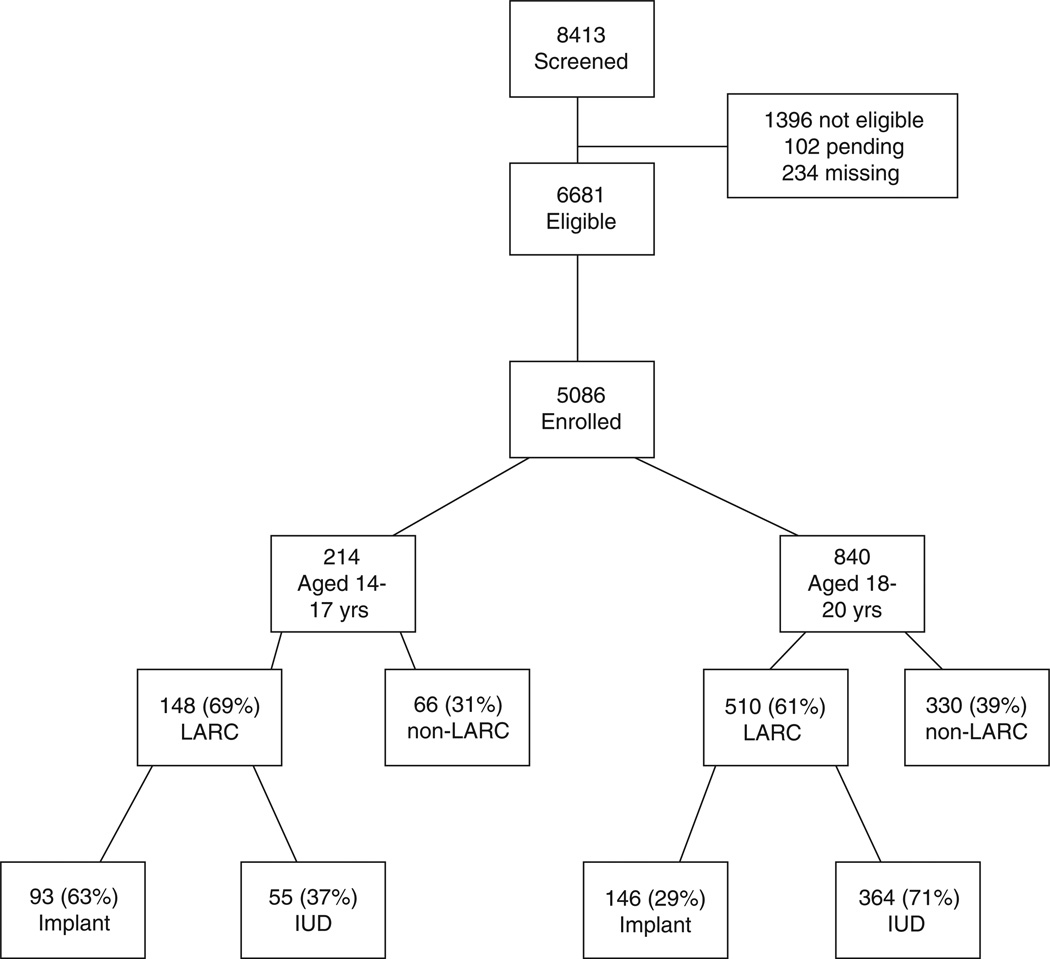
Study design: We evaluated the association of age and preference for a LARC vs. a non-LARC method among adolescent participants in the Contraceptive CHOICE Project, comparing those aged 14-17 years to adolescents aged 18-20 years. We then analyzed the association between age and choice of the implant vs. the intrauterine device (IUD) among adolescents.
Results: Of the 5086 women enrolled, 70% (n=3557) of participants chose a LARC method. Among adolescents aged 14-20 years, 69% of 14-17-year-olds chose LARC, while 61% of 18-20-year-olds chose LARC (relative risk 1.16, 95% confidence interval 1.03-1.30). Among adolescents choosing a LARC method, 63% (n=93/148) of the 14-17-year-olds chose the implant, whereas 71% (n=364/510) of the 18-20-year-olds chose the IUD.
Conclusion: Long-acting reversible contraception use is clearly acceptable and common among adolescents enrolled in the Contraceptive CHOICE Project, with the younger group being most interested in the implant.
Copyright © 2011 Elsevier Inc. All rights reserved.
References
-
- Hatcher RA, Trussell J, Nelson AL, Cates W, Stewart FH, Kowal D, editors. Contraceptive technology. 19th ed. New York: Ardent Media, Inc; 2007.
-
- Stanwood NL, Bradley KA. Young pregnant women’s knowledge of modern intrauterine devices. Obstet Gynecol. 2006;108:1417–1422. - PubMed
-
- Grady WR, Klepinger DH, Nelson-Wally A. Contraceptive characteristics: the perceptions and priorities of men and women. Fam Plan Perspect. 1999;31:168–175. - PubMed
-
- Li CFI, Lee SSN, Pun TC. A pilot study on the acceptability of levonorgestrel-releasing intrauterine device by young, single, nullip-arous Chinese females following surgical abortion. Contraception. 2004;69:247–250. - PubMed
-
- Toma A, Jamieson MA. Revisiting the intrauterine contraceptive device in adolescents. J Pediat Adolesc Gynecol. 2006;19:291–296. - PubMed
Publication types
MeSH terms
Substances
Grants and funding
LinkOut - more resources
Full Text Sources
Medical
