


Varied overground walking-task practice versus body-weight-supported treadmill training in ambulatory adults within one year of stroke: a randomized controlled trial protocol
- PMID: 22018267
- PMCID: PMC3229453
- DOI: 10.1186/1471-2377-11-129
Varied overground walking-task practice versus body-weight-supported treadmill training in ambulatory adults within one year of stroke: a randomized controlled trial protocol
Abstract
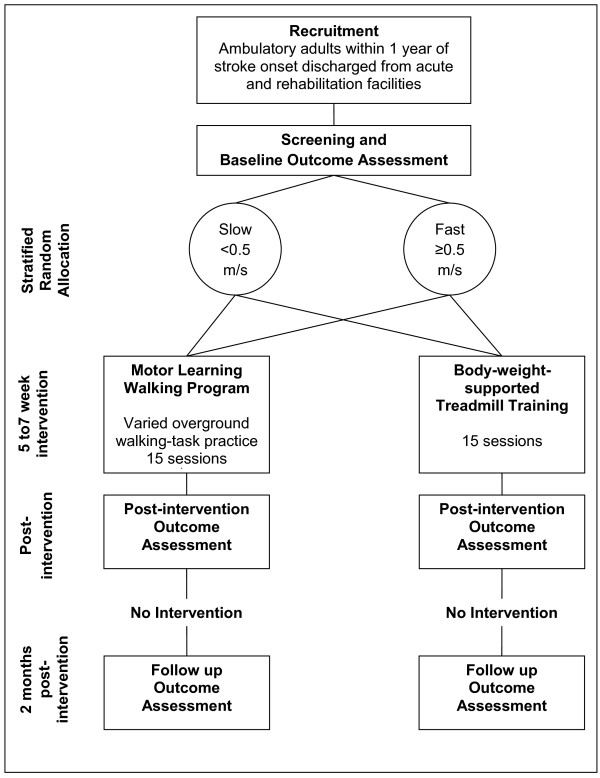
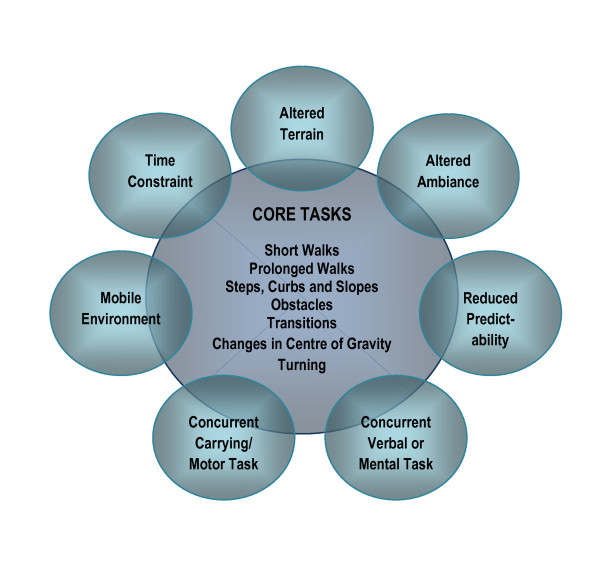
Background: Although task-oriented training has been shown to improve walking outcomes after stroke, it is not yet clear whether one task-oriented approach is superior to another. The purpose of this study is to compare the effectiveness of the Motor Learning Walking Program (MLWP), a varied overground walking task program consistent with key motor learning principles, to body-weight-supported treadmill training (BWSTT) in community-dwelling, ambulatory, adults within 1 year of stroke.
Methods/design: A parallel, randomized controlled trial with stratification by baseline gait speed will be conducted. Allocation will be controlled by a central randomization service and participants will be allocated to the two active intervention groups (1:1) using a permuted block randomization process. Seventy participants will be assigned to one of two 15-session training programs. In MLWP, one physiotherapist will supervise practice of various overground walking tasks. Instructions, feedback, and guidance will be provided in a manner that facilitates self-evaluation and problem solving. In BWSTT, training will emphasize repetition of the normal gait cycle while supported over a treadmill, assisted by up to three physiotherapists. Outcomes will be assessed by a blinded assessor at baseline, post-intervention and at 2-month follow-up. The primary outcome will be post-intervention comfortable gait speed. Secondary outcomes include fast gait speed, walking endurance, balance self-efficacy, participation in community mobility, health-related quality of life, and goal attainment. Groups will be compared using analysis of covariance with baseline gait speed strata as the single covariate. Intention-to-treat analysis will be used.
Discussion: In order to direct clinicians, patients, and other health decision-makers, there is a need for a head-to-head comparison of different approaches to active, task-related walking training after stroke. We hypothesize that outcomes will be optimized through the application of a task-related training program that is consistent with key motor learning principles related to practice, guidance and feedback.
Trial registration: ClinicalTrials.gov # NCT00561405.
Figures
References
-
- World Health Organization. The Global Burden of Disease: World Health Organization. 2008. http://www.who.int/healthinfo/global_burden_disease/GBD_report_2004updat...
-
- Moreland J, DePaul V, DeHueck A, Pagliuso S, Yip D, Pollock B, Wilkins S. Needs assessment of individuals with stroke after discharge from hospital stratified by acute Functional Independence Measure score. Disability and Rehabilitation. 2009;31(26):2185–95. doi: 10.3109/09638280902951846. - DOI - PubMed
-
- Olney S, Richards C. Hemiparetic gait following stroke. Part I: Characteristics. Gait and Posture. 1996;4:136–48. doi: 10.1016/0966-6362(96)01063-6. - DOI
Publication types
MeSH terms
Associated data
Grants and funding
LinkOut - more resources
Full Text Sources
Medical
