


Synapse adhesion: a dynamic equilibrium conferring stability and flexibility
- PMID: 22019151
- PMCID: PMC3492943
- DOI: 10.1016/j.conb.2011.09.011
Synapse adhesion: a dynamic equilibrium conferring stability and flexibility
Abstract
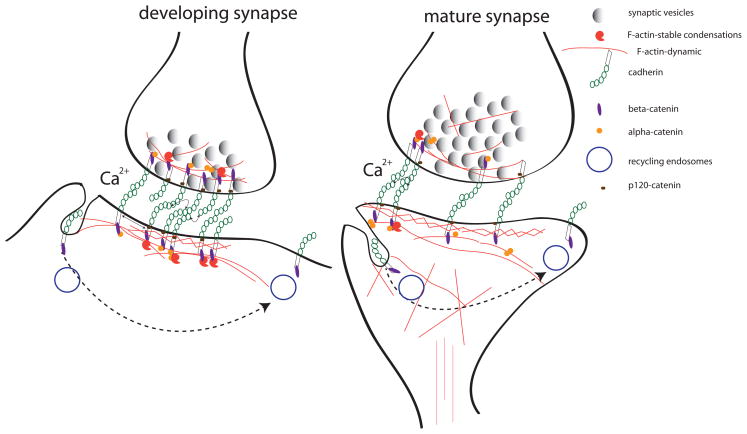
Cell adhesion molecules (CAMs) linked to cytoskeleton generate stable cell-cell junctions. Cadherins provide a canonical example, but paradoxically, they participate in a multitude of transient and regulatable interactions. Their extracellular binding generates weak adhesion that is modified by clustering; interactions with F-actin are regulated, can be transient, and can alter F-actin dynamics. Additionally, cadherin recycling from the cell surface can modify the size and location of junctions and strength of adhesion. In epithelial cells, this ongoing dynamic behavior is important for maintaining stable junctions. Recent work supports that cadherins act similarly at synapses where their actions are likely to be shared by integrins and other actin-linked CAMs. Together the collaborative activities of such CAMs provide a stable, but flexible structure that can promote and support changes in synapse shape and size while maintaining stable junctions to permit information flow.
Copyright © 2011 Elsevier Ltd. All rights reserved.
Figures
References
-
- Zhou Q, Homma KJ, Poo MM. Shrinkage of dendritic spines associated with long-term depression of hippocampal synapses. Neuron. 2004;44:749–757. These two papers (2, 3) were the first to describe lasting changes in spine shape that precisely correlated with changes in synapse activity. - PubMed
-
- Biederer T, Scheiffele P. Mixed-culture assays for analyzing neuronal synapse formation. Nat Protoc. 2007;2:670–676. - PubMed
Publication types
MeSH terms
Substances
Grants and funding
LinkOut - more resources
Full Text Sources
