. 2012 Mar;26(3):407-13.
doi: 10.1016/j.bbi.2011.10.001. Epub 2011 Oct 13.

Circadian expression of clock genes in mouse macrophages, dendritic cells, and B cells

Affiliations

Circadian expression of clock genes in mouse macrophages, dendritic cells, and B cells

Adam C Silver et al. Brain Behav Immun. 2012 Mar.

Abstract

In mammals, circadian and daily rhythms influence nearly all aspects of physiology, ranging from behavior to gene expression. Functional molecular clocks have been described in the murine spleen and splenic NK cells. The aim of our study was to investigate the existence of molecular clock mechanisms in other immune cells. Therefore, we measured the circadian changes in gene expression of clock genes (Per1, Per2, Bmal1, and Clock) and clock-controlled transcription factors (Rev-erbα and Dbp) in splenic enriched macrophages, dendritic cells, and B cells in both mice entrained to a light-dark cycle and under constant environmental conditions. Our study reveals the existence of functional molecular clock mechanisms in splenic macrophages, dendritic cells, and B cells.


Conflict of interest statement

Conflict of Interest Statement

All authors declare that there are no conflicts of interest.

Figures
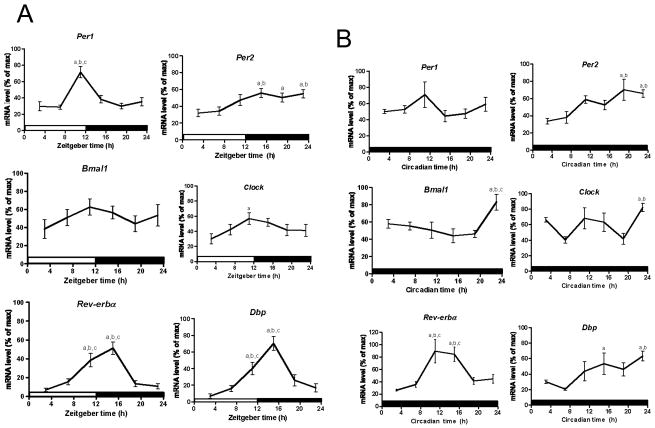
Fig. 1
Fig. 1
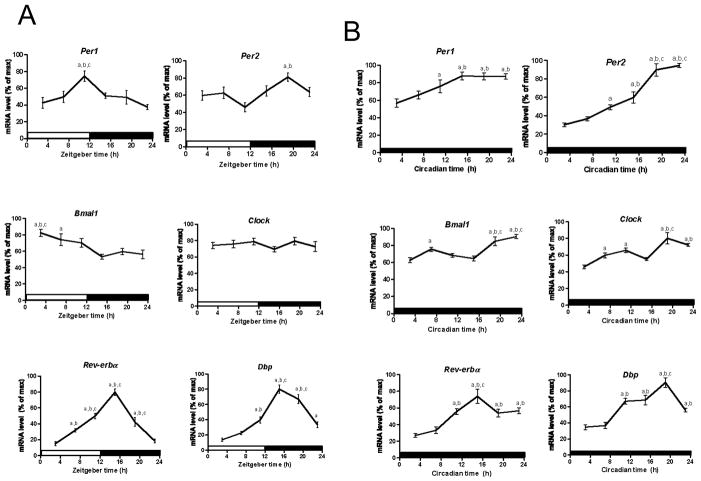
Circadian rhythms of mRNA levels in macrophages enriched from mouse spleen. Daily oscillations in canonical clock gene expression in macrophages enriched from mouse spleen collected every 4 h (ZT3/CT3 = 10 a.m.) (A) under LD conditions and (B), under DD conditions. Relative mRNA levels at each time point were determined by qPCR and calculated as the percentage of the maximum value over the 24-h period. Data are mean ± SEM of 14 or 15 animals per time point, compiled from 3 independent experiments under LD conditions (except n = 10 for Per1, Clock, and Dbp, compiled from 2 independent experiments) and 4 or 5 animals per time point under DD conditions. a, Significantly different (p < 0.05) from the lowest value; b, significantly different (p < 0.05) from the second lowest value; c, significantly different (p < 0.05) from the third lowest value. Open bar indicates light period, while colored bar indicates dark period.
Fig. 2
Fig. 2
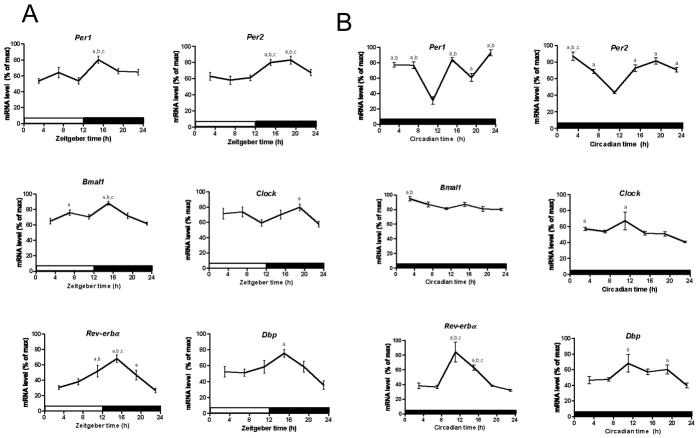
Circadian rhythms of mRNA levels in dendritic cells enriched from mouse spleen. Daily oscillations in canonical clock gene expression in dendritic cells enriched from mouse spleen collected every 4 h (ZT3/CT3 = 10 a.m.) (A) under LD conditions and (B) under DD conditions. Relative mRNA levels at each time point were determined by qPCR and calculated as the percentage of the maximum value over the 24-h period. Data are mean ± SEM of 9 or 10 animals per time point, compiled from 2 independent experiments under LD conditions (except n = 13 or 15 for Rev-erbα, compiled from 3 independent experiments) and 4 or 5 animals per time point under DD conditions. a, Significantly different (p < 0.05) from the lowest value; b, significantly different (p < 0.05) from the second lowest value; c, significantly different (p < 0.05) from the third lowest value. Open bar indicates light period, while colored bar indicates dark period.
Fig. 3
Fig. 3
Circadian rhythms of mRNA levels in B cells enriched from mouse spleen. Daily oscillations in canonical clock gene expression in B cells enriched from mouse spleen collected every 4 h (ZT3/CT3 = 10 a.m.) (A) under LD conditions and (B) under DD conditions. Relative mRNA levels at each time point were determined by qPCR and calculated as the percentage of the maximum value over the 24-h period. Data are mean ± SEM of 14 or 15 animals per time point, compiled from 3 independent experiments under LD conditions (except n = 9 or 10 for Per1, Clock, and Dbp, compiled from 2 independent experiments) and 4 or 5 animals per time point under DD conditions. a, Significantly different (p < 0.05) from the lowest value; b, significantly different (p < 0.05) from the second lowest value; c, significantly different (p < 0.05) from the third lowest value. Open bar indicates light period, while colored bar indicates dark period.

References

    1. Arjona A, Sarkar DK. Circadian oscillations of clock genes, cytolytic factors, and cytokines in rat NK cells. J Immunol. 2005;174:7618–7624. - PubMed
    1. Arjona A, Sarkar DK. The circadian gene mPer2 regulates the daily rhythm of IFN-gamma. J Interferon Cytokine Res. 2006;26:645–649. - PubMed
    1. Bell-Pedersen D, Cassone VM, Earnest DJ, Golden SS, Hardin PE, Thomas TL, Zoran MJ. Circadian rhythms from multiple oscillators: lessons from diverse organisms. Nat Rev Genet. 2005;6:544–556. - PMC - PubMed
    1. Berson DM. Phototransduction in ganglion-cell photoreceptors. Pflugers Arch. 2007;454:849–855. - PubMed
    1. Boorman GA, Blackshear PE, Parker JS, Lobenhofer EK, Malarkey DE, Vallant MK, Gerken DK, Irwin RD. Hepatic gene expression changes throughout the day in the Fischer rat: implications for toxicogenomic experiments. Toxicol Sci. 2005;86:185–193. - PubMed

Publication types

MeSH terms