. 2011 Oct 24;11(11):775-91.
doi: 10.1038/nrc3151.

Targeting protein prenylation for cancer therapy

Affiliations

Targeting protein prenylation for cancer therapy

Norbert Berndt et al. Nat Rev Cancer. .

Abstract

Protein farnesylation and geranylgeranylation, together referred to as prenylation, are lipid post-translational modifications that are required for the transforming activity of many oncogenic proteins, including some RAS family members. This observation prompted the development of inhibitors of farnesyltransferase (FT) and geranylgeranyl-transferase 1 (GGT1) as potential anticancer drugs. In this Review, we discuss the mechanisms by which FT and GGT1 inhibitors (FTIs and GGTIs, respectively) affect signal transduction pathways, cell cycle progression, proliferation and cell survival. In contrast to their preclinical efficacy, only a small subset of patients responds to FTIs. Identifying tumours that depend on farnesylation for survival remains a challenge, and strategies to overcome this are discussed. One GGTI has recently entered the clinic, and the safety and efficacy of GGTIs await results from clinical trials.


Conflict of interest statement

Competing interests statement

The authors declare competing financial interests. See Web version for details.

Figures
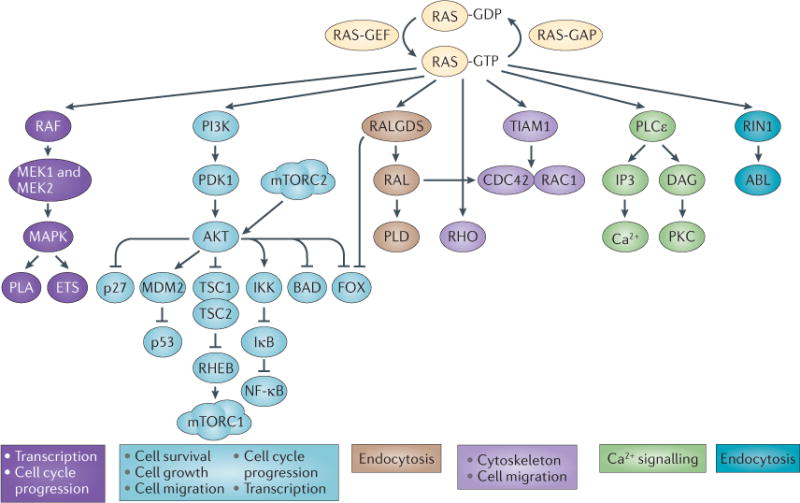
Figure 1
Figure 1. RAS signalling pathways in mammalian cells
Active (farnesylated, membrane-bound and GTP-bound) RAS modulates a number of signalling pathways. Oncogenic RAS mutations tend to lock RAS in its GTP-bound state, resulting in constitutive RAS signalling. The major RAS effector pathways are shown. The two best-studied pathways that are activated by RAS are the RAF–MEK–MAPK signalling cascade and the PI3K–AKT pathway. The RAF–MEK–MAPK pathway ultimately activates the ETS family of transcription factors, which induce multiple genes that promote cell cycle progression and cell migration. Likewise, AKT phosphorylates multiple cellular proteins, leading to the inhibition of several tumour suppressors (such as p27, p53, tuberous sclerosis 1 (TSC1), TSC2 and BCL-2 antagonist of cell death (BAD)) or leading to the activation of several oncogene products. RAS also activates other small GTPases such as RALA and RALB, which have recently been shown to mediate RAS transformation in human pancreatic tumours, for example. Farnesyltransferase inhibitors (FTIs) were originally developed to block the function of RAS. However, as numerous studies in vitro and in vivo have shown, their antitumour activity is not correlated to the mutation status of KRAS isoforms. This suggests that the antitumour activity of FTIs relies on blocking the activity of other prenylated proteins. However, the inhibition of RAS protein function may still be important, particularly for tumours with mutant HRAS and tumours addicted to wild-type RAS. CDC42, cell division cycle 42; DAG, diacylglycerol; FOX, forkhead transcription factor; GAP, GTPase-activating protein; GEF, guanine nucleotide exchange factor; IKK, IκB kinase; IP3, inositol-1,4,5-trisphosphate; mTORC, mTOR complex; NF-κB, nuclear factor-κB; PDK1, phosphoinositide-dependent kinase 1; PKC, protein kinase C; PLA, phospholipase A; PLCε, phospholipase Cε; PLD, phospholipase D; RALGDS, RAL guanine nucleotide dissociation stimulator; RHEB, RAS homologue enriched in brain; RIN1, RAS and RAB interactor 1; TIAM1, T cell lymphoma invasion and metastasis 1.
Timeline
Timeline
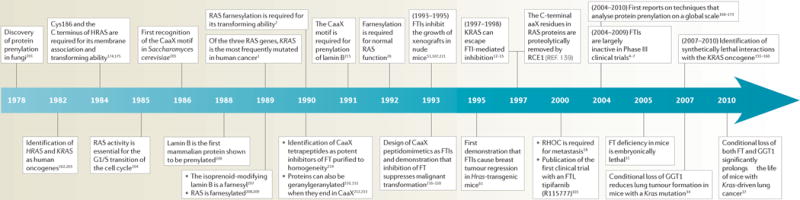
Protein prenylation and human cancer FT, farnesyltransferase; FTI, FT inhibitor; GGT1, geranylgeranyl transferase 1; RCE1, RAS-converting enzyme 1.
None
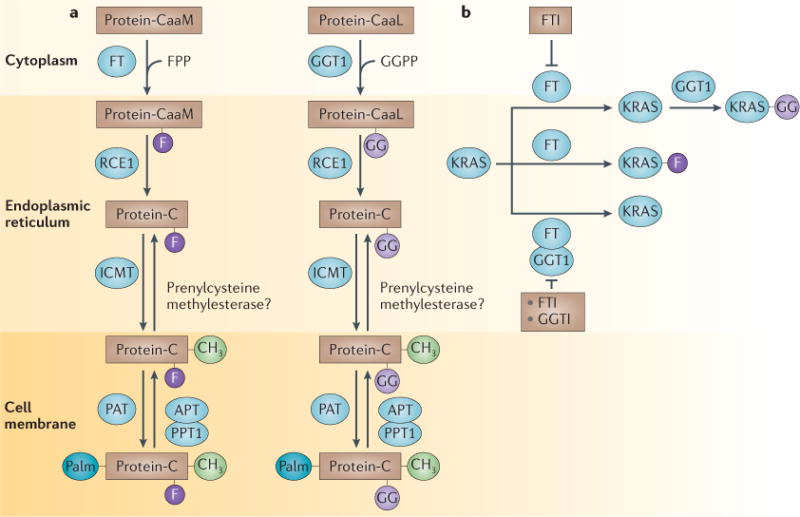
APT, acylprotein thioesterase; ICMT, isoprenylcysteine methyltransferase; PAT, protein acyltransferase; PPT1, palmitoylthioesterase 1; RCE1, RAS-converting enzyme 1.

References

    1. Bos JL. ras oncogenes in human cancer: a review. Cancer Res. 1989;49:4682–4689. - PubMed
    1. Jackson JH, et al. Farnesol modification of Kirstenras exon 4B protein is essential for transformation. Proc Natl Acad Sci USA. 1990;87:3042–3046. - PMC - PubMed
    1. Bommi-Reddy A, Kaelin WG. Slaying RAS with a synthetic lethal weapon. Cell Res. 2010;20:119–121. - PubMed
    1. Van Cutsem E, et al. Phase III trial of gemcitabine plus tipifarnib compared with gemcitabine plus placebo in advanced pancreatic cancer. J Clin Oncol. 2004;22:1430–1438. - PubMed
    1. Rao S, et al. Phase III double-blind placebo-controlled study of farnesyl transferase inhibitor R115777 in patients with refractory advanced colorectal cancer. J Clin Oncol. 2004;22:3950–3957. - PubMed

Publication types

MeSH terms