


doi: 10.1126/science.1209609.
Epub 2011 Oct 20.
Wolbachia enhance Drosophila stem cell proliferation and target the germline stem cell niche
Affiliations
- PMID: 22021671
- PMCID: PMC4030408
- DOI: 10.1126/science.1209609
Item in Clipboard
Wolbachia enhance Drosophila stem cell proliferation and target the germline stem cell niche
Science.
.
Abstract
Wolbachia are widespread maternally transmitted intracellular bacteria that infect most insect species and are able to alter the reproduction of innumerous hosts. The cellular bases of these alterations remain largely unknown. Here, we report that Drosophila mauritiana infected with a native Wolbachia wMau strain produces about four times more eggs than the noninfected counterpart. Wolbachia infection leads to an increase in the mitotic activity of germline stem cells (GSCs), as well as a decrease in programmed cell death in the germarium. Our results suggest that up-regulation of GSC division is mediated by a tropism of Wolbachia for the GSC niche, the cellular microenvironment that supports GSCs.
Figures

(A) Drosophila ovariole with the germline shown in light blue and the somatic follicle cells in white. Egg chambers are formed in the germarium (left) and mature into the egg. The upward-pointing green arrow indicates germline stem cell (GSC, dark blue) division, which positively affects egg production [see inset A’: GSC divides asymmetrically and one daughter cell exits the germline stem cell niche (GSCN , green) and forms the egg’s germline (light blue)]. The downward-pointing red arrows indicate developmental points where the onset of programmed cell death (PCD) reduces egg production, either in the germarium or in previtellogenic egg chambers. (Lower left) A magnified view of the germarium shows both the somatic stem cell niche (SSCN, green arrowhead) and the GSCN (yellow bracket), formed by the terminal filament (light green) and the cap cells (dark green), which contact the GSCs (blue arrowhead). (B) Electron micrographs of a GSCN (green) and the GSC (blue) in infected D. mauritiana. Most of the cytoplasm of the cap cells (GSCN) is occupied by Wolbachia wMau (red asterisk, see also Sup. Movie). Scale bar = 1μm. The inset shows a magnified view of the GSCN, red asterisk highlighting a single Wolbachia wMau. (C) Fold change of total amount of eggs laid per infected female (W+, green) under different conditions normalized to non-infected (W-, yellow). Relative egg production was measured in triplicate for each condition: room temperature (RT, 20 days and 46 days, light green) or at 25ºC (20 days, dark green). Wolbachia significantly induced fecundity gains at all conditions (Student’s t-test, PRT 20 days = 6.5 × 10⁻⁴, PRT 46 days = 3.9 × 10⁻⁴ and P 25ºC 20 days = 1.7 × 10⁻²). See table S1 and (12).
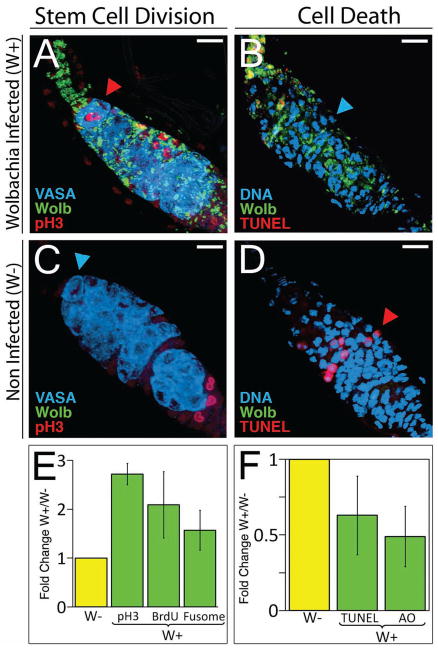
Representative confocal images of D. mauritiana germaria infected [W+, Wolbachia shown in green (A and B)] and non-infected [W-, (C and D)]. Arrowheads indicate the presence (red arrowhead) or absence (blue arrowhead) of GSC division [pH3 (phospho-Histone H3), red in A and C] or PCD (TUNEL, red in B and D). Germline is labeled with anti-Vasa (blue), Scale bar = 10μm. (E and F). Average fold difference for each marker indicated below graphs, normalized to W- (mean of triplicates, 15 independent experiments total). Infection significantly affects GSC mitosis (E) and PCD (F) for all markers (Logistic regression, PpH3 = 5.4 × 10⁻³, N = 621; PBrdU = 2.0 × 10⁻², N = 1061; PFusome = 4.3 × 10⁻³, N = 695; PTUNEL = 8.0 × 10⁻³, N = 802; PAcridine Orange = 1.2 × 10⁻⁷, N = 754, N = number of germaria,). See also tables S2, S4 and (12).

(A – B) Niches (yellow brackets) from infected flies are classified as highly infected (HN, A) and with low infection (LN, B). Fusome staining (red) shows GSC in the HN dividing (“!” morphology in A). Scale bar = 5 μm. (C) Frequency of HN (solid green) and LN (hatched green) in four independent experiments. The numbers in each category and the total number of germaria analyzed are indicated for each experiment. (D) For each germarium counted in graph D, the frequency of GSC division was determined by either fusome morphology (Exp. 1 and 2) or BrdU incorporation (Exp. 3 and 4). HN significantly increases GSC mitosis (logistic regression, P= 2.4 × 10⁻²). (E and F) In infected testes of D. mauritiana, Wolbachia also target the stem cell niche (aka hubs, yellow arrowhead) at high (HN, E) and low levels (LN, F). (F) pH3 staining (white) labels a dividing testis stem cell adjacent to an HN niche. Scale bar = 5 μm.
References
-
- Werren JH, Baldo L, Clark ME. Wolbachia: master manipulators of invertebrate biology. Nat Rev Microbiol. 2008 Oct;6:741. - PubMed
-
- Pfarr KM, Hoerauf AM. Antibiotics which target the Wolbachia endosymbionts of filarial parasites: a new strategy for control of filariasis and amelioration of pathology. Mini reviews in medicinal chemistry. 2006 Feb;6:203. - PubMed
-
- Bourtzis K. Wolbachia-based technologies for insect pest population control. Advances in experimental medicine and biology. 2008;627:104. - PubMed
-
- McMeniman CJ, et al. Stable introduction of a life-shortening Wolbachia infection into the mosquito Aedes aegypti. Science. 2009 Jan 2;323:141. - PubMed
Publication types
MeSH terms
Grants and funding
LinkOut - more resources
Full Text Sources
Other Literature Sources
Medical
Molecular Biology Databases
Research Materials
