


Epidemiological study of severe febrile reactions in young children in Western Australia caused by a 2010 trivalent inactivated influenza vaccine
- PMID: 22021725
- PMCID: PMC3191393
- DOI: 10.1136/bmjopen-2010-000016
Epidemiological study of severe febrile reactions in young children in Western Australia caused by a 2010 trivalent inactivated influenza vaccine
Abstract
Background: The 2010 influenza vaccination program for children aged 6 months to 4 years in Western Australia (WA) was suspended following reports of severe febrile reactions, including febrile convulsions, following vaccination with trivalent inactivated influenza vaccine (TIV).
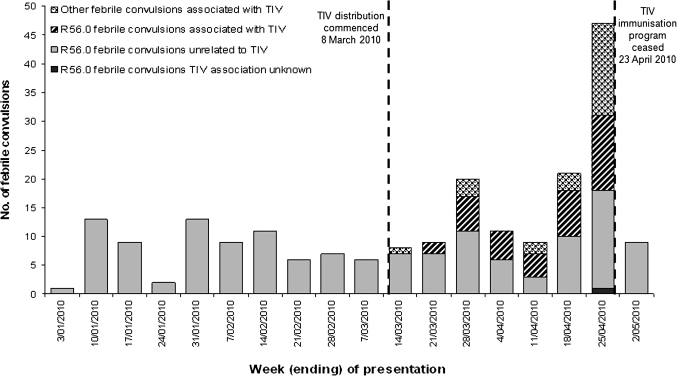
Methods: To investigate the association between severe febrile reactions and TIV, three studies were conducted: (i) rates of febrile convulsions within 72 h of receiving TIV in 2010 were estimated by vaccine formulation and batch; (ii) numbers of children presenting to hospital emergency departments with febrile convulsions from 2008 to 2010 were compared; and (iii) a retrospective cohort study of 360 children was conducted to compare the reactogenicity of available TIV formulations.
Findings: In 2010, an estimated maximum of 18,816 doses of TIV were administered and 63 febrile convulsions were recorded, giving an estimated rate of 3.3 (95% CI 2.6 to 4.2) per 1000 doses of TIV administered. The odds of a TIV-associated febrile convulsion was highly elevated in 2010 (p<0.001) and was associated with the vaccine formulations of one manufacturer-Fluvax and Fluvax Junior (CSL Biotherapies). The risk of both febrile convulsions (p<0.0001) and other febrile reactions (p<0.0001) was significantly greater for Fluvax formulations compared to the major alternate brand. The risk of febrile events was not associated with prior receipt of TIV or monovalent 2009 H1N1 pandemic vaccine. The biological cause of the febrile reactions is currently unknown.
Interpretation: One brand of influenza vaccine was responsible for the increase in febrile reactions, including febrile convulsions. Until the biological reason for this is determined and remediation undertaken, childhood influenza vaccination programs should not include Fluvax-type formulations and enhanced surveillance for febrile reactions in children receiving TIV should be undertaken.
Conflict of interest statement
Figures
References
-
- Poehling KA, Edwards KM, Weinberg GA, et al. The underrecognized burden of influenza in young children. N Engl J Med 2006;355:31–40 - PubMed
-
- Izurieta HS, Thompson WW, Kramarz P, et al. Influenza and the rates of hospitalization for respiratory disease among infants and young children. N Engl J Med 2000;342:232–9 - PubMed
-
- Fiore AE, Uyeki TM, Broder K, et al. Centers for Disease Control and Prevention. Prevention and control of seasonal influenza with vaccines: recommendations of the Advisory Committee on Immunization Practices (ACIP), 2010. MMWR Recomm Rep 2010;59:1–62 - PubMed
-
- Australia Government Department of Health and Ageing, Immunise Australia Program. Influenza Vaccination for Individuals aged 6 months and over with medical conditions predisposing to severe influenza. http://www.immunise.health.gov.au/internet/immunise/publishing.nsf/Conte... (accessed 20 Jun 2010).
-
- France EK, Glanz JM, Xu S, et al. Safety of the trivalent inactivated influenza vaccine among children: a population-based study. Arch Pediatr Adolesc Med 2004;158:1031–6 - PubMed
Publication types
LinkOut - more resources
Full Text Sources
