


Population-based trends in pregnancy hypertension and pre-eclampsia: an international comparative study
- PMID: 22021762
- PMCID: PMC3191437
- DOI: 10.1136/bmjopen-2011-000101
Population-based trends in pregnancy hypertension and pre-eclampsia: an international comparative study
Abstract
Objective: The objective of this study was to compare international trends in pre-eclampsia rates and in overall pregnancy hypertension rates (including gestational hypertension, pre-eclampsia and eclampsia).
Design: Population data (from birth and/or hospital records) on all women giving birth were available from Australia (two states), Canada (Alberta), Denmark, Norway, Scotland, Sweden and the USA (Massachusetts) for a minimum of 6 years from 1997 to 2007. All countries used the 10th revision of the International Classification of Diseases, except Massachusetts which used the 9th revision. There were no major changes to the diagnostic criteria or methods of data collection in any country during the study period. Population characteristics as well as rates of pregnancy hypertension and pre-eclampsia were compared.
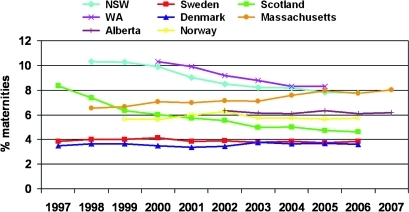
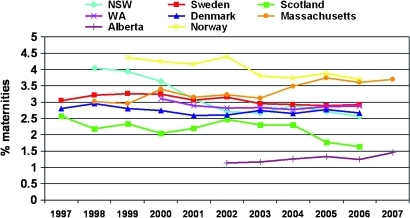
Results: Absolute rates varied across the populations as follows: pregnancy hypertension (3.6% to 9.1%), pre-eclampsia (1.4% to 4.0%) and early-onset pre-eclampsia (0.3% to 0.7%). Pregnancy hypertension and/or pre-eclampsia rates declined over time in most populations. This was unexpected given that factors associated with pregnancy hypertension such as pre-pregnancy obesity and maternal age are generally increasing. However, there was also a downward shift in gestational age with fewer pregnancies reaching 40 weeks.
Conclusion: The rate of pregnancy hypertension and pre-eclampsia decreased in northern Europe and Australia from 1997 to 2007, but increased in Massachusetts. The use of a different International Classification of Diseases coding version in Massachusetts may contribute to the difference in trend. Elective delivery prior to the due date is the most likely explanation for the decrease observed in Europe and Australia. Also, the use of interventions that reduce the risk of pregnancy hypertension and/or progression to pre-eclampsia (low-dose aspirin, calcium supplementation and early delivery for mild hypertension) may have contributed to the decline.
Conflict of interest statement
Figures
References
-
- Duley L. The global impact of pre-eclampsia and eclampsia. Semin Perinatol 2009;33:130–7 - PubMed
-
- Steegers EA, von Dadelszen P, Duvekot JJ, et al. Pre-eclampsia. Lancet 2010;376:631–44 - PubMed
-
- Brown MA, Lindheimer MD, de Swiet M, et al. The classification and diagnosis of the hypertensive disorders of pregnancy: statement from the International Society for the Study of Hypertension in Pregnancy (ISSHP). Hypertens Pregnancy 2001;20:IX–XIV - PubMed
-
- . Report of the National High Blood Pressure Education Program Working Group on High Blood Pressure in Pregnancy. Am J Obstet Gynecol 2000;183:S1–22 - PubMed
-
- Brown MA, Hague WM, Higgins J, et al. Australasian Society of the Study of Hypertension in Pregnancy The detection, investigation and management of hypertension in pregnancy: full consensus statement. Aust N Z J Obstet Gynaecol 2000;40:139–55 - PubMed
Publication types
Grants and funding
LinkOut - more resources
Full Text Sources
