


Repetitive Transcranial Magnetic Stimulation in the Treatment of depression: A Randomized, Double-blind, Placebo-controlled Trial
- PMID: 22021951
- PMCID: PMC3195152
- DOI: 10.4103/0253-7176.85393
Repetitive Transcranial Magnetic Stimulation in the Treatment of depression: A Randomized, Double-blind, Placebo-controlled Trial
Abstract
Background: The efficacy of repetitive transcranial magnetic stimulation (rTMS) in the treatment of depression has never been reported as yet in the Indian literature.
Aims: To study the efficacy of rTMS in the treatment of depression and to evaluate its safety and tolerability.
Settings and design: A randomized, double-blind, sham-controlled trial was conducted at the Department of Psychiatry, National Institute of Mental Health and Neurosciences, Bangalore.
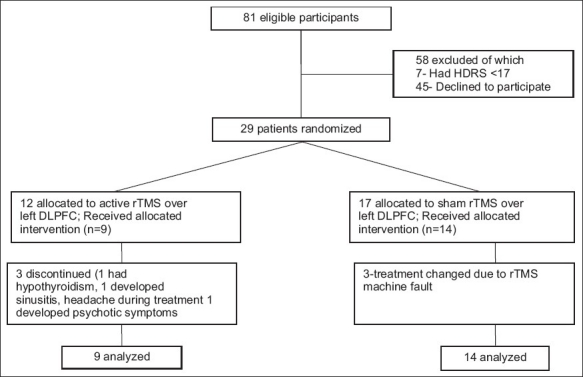
Materials and methods: 23 patients with depression were randomized to receive either active (n=9) or sham (n=14) treatment with rTMS. Treatment consisted of six sessions of rTMS for 2 weeks (10 trains of pulses, intensity equal to motor threshold, 10 Hz frequency, train duration of 5 seconds, 1 minute inter-train duration). Response was assessed using Hamilton Depression Rating Scale (HDRS), Montgomery Åsberg Depression Rating Scale (MADRS) and Clinical Global Index (CGI). The safety and tolerability was assessed with side-effect checklist for electroconvulsive therapy. 50% reduction in HDRS scores from baseline was defined as treatment response. Outcome measures were analyzed by repeated measures analysis of variance. Chi-square test was used to analyze the categorical variables.
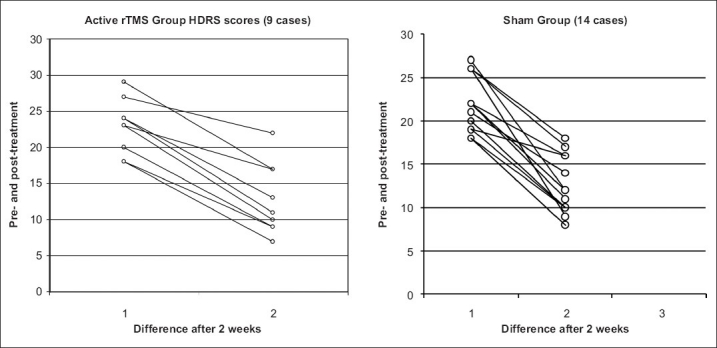
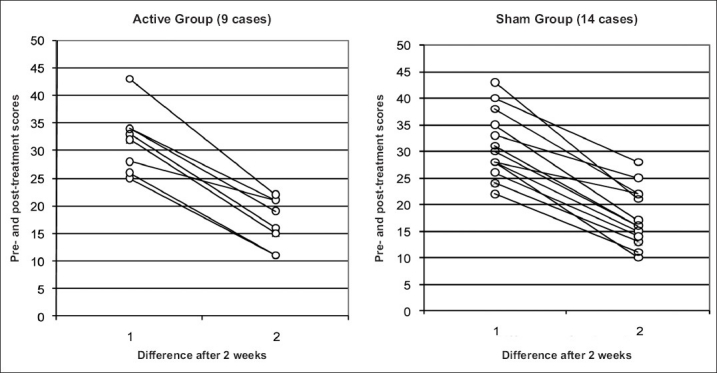
Results: No statistical significance was seen on the baseline socio-demographic and illness characteristics (Pearson's Chi-square=0.5). Although HDRS (sham 22.0-12.4; active 22.8-12.7) and MADRS (sham 30.7-17.3; active 31.8-16.7) scores reduced by the end of 2 weeks treatment, it was not statistically significant. One patient developed manic symptoms early in the treatment.
Conclusions: Treatment with rTMS did not show improvement at the end of 2 weeks. More studies with larger sample size and with higher rTMS dosages need to be done.
Keywords: Depression; electroconvulsive therapy; transcranial magnetic stimulation.
Conflict of interest statement
Figures
References
-
- Bortolomasi M, Minelli A, Fuggetta G, Perini M, Comencini S, Fiaschi A, et al. Long-lasting effects of high frequency repetitive transcranial magnetic stimulation in major depressed patients. Psychiatry Res. 2007;150:181–6. - PubMed
-
- Prikryl R, Kasparek T, Skotakova S, Ustohal L, Kucerova H, Ceskova E. Treatment of negative symptoms of schizophrenia using repetitive transcranial magnetic stimulation in a double-blind, randomized controlled study. Schizophr Res. 2007;95:151–7. - PubMed
-
- Goyal N, Nizamie SH, Desarkar P. Efficacy of adjuvant high frequency repetitive transcranial magnetic stimulation on negative and positive symptoms of schizophrenia: preliminary results of a double-blind sham-controlled study. J Neuropsychiatry Clin Neurosci. 2007;19:464–7. - PubMed
-
- Saba G, Rocamora JF, Kalalou K, Benadhira R, Plaze M, Lipski H, et al. Repetitive transcranial magnetic stimulation as an add-on therapy in the treatment of mania: A case series of eight patients. Psychiatry Res. 2004;128:199–202. - PubMed
-
- Praharaj SK, Ram D, Arora A. Efficacy of high frequency (rapid) suprathreshold repetitive transcranial magnetic stimulation of right prefrontal cortex in bipolar mania: A randomized sham controlled study. J Affect Disord. 2009;117:146–50. - PubMed
LinkOut - more resources
Full Text Sources