


Standardised herbal extract of chlorogenic acid from leaves of Etlingera elatior (Zingiberaceae)
- PMID: 22022166
- PMCID: PMC3193618
- DOI: 10.4103/0974-8490.85003
Standardised herbal extract of chlorogenic acid from leaves of Etlingera elatior (Zingiberaceae)
Abstract
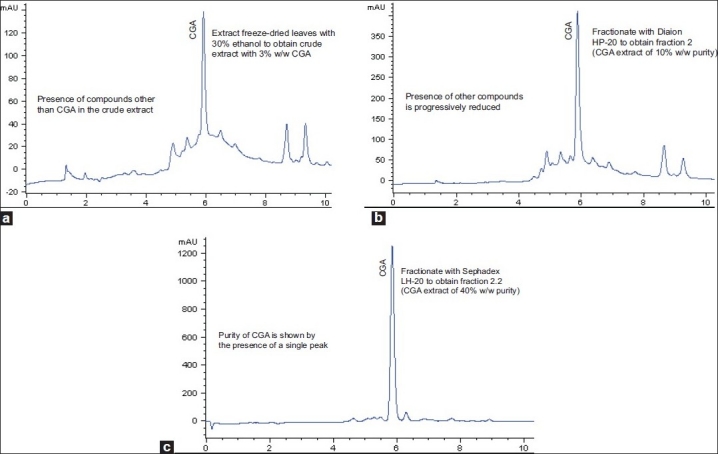
Background: Chlorogenic acid (CGA) or 5-caffeoylquinic acid, was found to be the dominant phenolic compound in leaves of Etlingera elatior (Zingiberaceae). The CGA content of E. elatior leaves was significantly higher than flowers of Lonicera japonica (honeysuckle), the commercial source. In this study, a protocol to produce a standardised herbal CGA extract from leaves of E. elatior using column chromatography was developed.
Materials and methods: Freeze-dried leaves of E. elatior were extracted with 30% ethanol, and sequentially fractionated using Diaion HP-20 and Sephadex LH-20.
Results: The CGA fractions, which yielded extracts of 10% and 40% w/w purity, possessed antioxidant, tyrosinase inhibition, and antibacterial properties. The entire fractionation process took only 6.5 hours, using gravity flow. From 50 g of leaves, the final yield of CGA extract was 0.2 g (0.4%). The CGA content of the standardised herbal extract from leaves of E. elatior (40%) is 1.6 times that of commercial extracts from honeysuckle flowers (25%).
Conclusion: With high CGA content, the standardised herbal extract has a great potential to be developed into functional food and other health products. Leaves of E. elatior, which currently have no economic value, could serve as an alternative source of CGA. Leaves are large, available in abundance, and harvesting is non-destructive to the plants.
Keywords: Chlorogenic acid; column chromatography; fractionation; standardised extract.
Conflict of interest statement
Figures
Similar articles
-
Caffeoylquinic acids in leaves of selected Apocynaceae species: Their isolation and content.Pharmacognosy Res. 2014 Jan;6(1):67-72. doi: 10.4103/0974-8490.122921. Pharmacognosy Res. 2014. PMID: 24497746 Free PMC article.
-
Anti-inflammatory Activity of Etlingera elatior (Jack) R.M. Smith Flower on Gastric Ulceration-induced Wistar Rats.Pak J Biol Sci. 2020 Jan;23(9):1193-1200. doi: 10.3923/pjbs.2020.1193.1200. Pak J Biol Sci. 2020. PMID: 32981250
-
Comparison of Artificial Neural Networks and Response Surface Methodology towards an Efficient Ultrasound-Assisted Extraction of Chlorogenic Acid from Lonicera japonica.Molecules. 2019 Jun 21;24(12):2304. doi: 10.3390/molecules24122304. Molecules. 2019. PMID: 31234365 Free PMC article.
-
Chlorogenic acid (CGA): A pharmacological review and call for further research.Biomed Pharmacother. 2018 Jan;97:67-74. doi: 10.1016/j.biopha.2017.10.064. Epub 2017 Nov 6. Biomed Pharmacother. 2018. PMID: 29080460 Review.
-
The Biological Activity Mechanism of Chlorogenic Acid and Its Applications in Food Industry: A Review.Front Nutr. 2022 Jun 29;9:943911. doi: 10.3389/fnut.2022.943911. eCollection 2022. Front Nutr. 2022. PMID: 35845802 Free PMC article. Review.
Cited by
-
Pharmacognostic Specification, Chlorogenic Acid Content, and In vitro Antioxidant Activities of Lonicera japonica Flowering Bud.Pharmacognosy Res. 2017 Apr-Jun;9(2):128-132. doi: 10.4103/pr.pr_117_16. Pharmacognosy Res. 2017. PMID: 28539735 Free PMC article.
-
Aldose reductase inhibitor form Cassia glauca: A comparative study of cytotoxic activity with Ag nanoparticles (NPs) and molecular docking evaluation.PLoS One. 2020 Oct 16;15(10):e0240856. doi: 10.1371/journal.pone.0240856. eCollection 2020. PLoS One. 2020. PMID: 33064762 Free PMC article.
-
Mammillaria Species-Polyphenols Studies and Anti-Cancer, Anti-Oxidant, and Anti-Bacterial Activities.Molecules. 2019 Dec 29;25(1):131. doi: 10.3390/molecules25010131. Molecules. 2019. PMID: 31905725 Free PMC article.
-
Systematic Review of Herbal Tea (a Traditional Chinese Treatment Method) in the Therapy of Chronic Simple Pharyngitis and Preliminary Exploration about Its Medication Rules.Evid Based Complement Alternat Med. 2019 Sep 19;2019:9458676. doi: 10.1155/2019/9458676. eCollection 2019. Evid Based Complement Alternat Med. 2019. PMID: 31662783 Free PMC article. Review.
References
-
- Lim CK. Taxonomic notes on Etlingera Giseke (Zingiberaceae) in Peninsular Malaysia: The “Nicolaia” taxa. Folia Malay. 2000;1:1–12.
-
- Lim CK. Taxonomic notes on Etlingera Giseke (Zingiberaceae) in Peninsular Malaysia: The “Achasma” taxa and supplementary notes on the “Nicolaia” taxa. Folia Malay. 2001;2:141–78.
-
- Noweg T, Abdullah AR, Nidang D. Forest plants as vegetables for communities bordering the Crocker Range National Park. ASEAN Rev Biodiv Environ Conser. 2003 Jan-Mar;:1–18.
-
- Ibrahim H, Setyowati FM. Etlingera. In: De Guzman CC, Siemonsma JS, editors. Plant Resources of South-east Asia. Vol. 13. Leiden, Netherlands: Backhuys Publisher; 1999. pp. 123–6.
-
- Chan EW, Lim YY, Wong LF, Lianto FS, Wong SK, Lim KK, et al. Antioxidant and tyrosinase inhibition properties of leaves and rhizomes of ginger species. Food Chem. 2008;109:477–83.
LinkOut - more resources
Full Text Sources
Research Materials
Miscellaneous