. 2011 Oct;7(10):e1002317.
doi: 10.1371/journal.ppat.1002317. Epub 2011 Oct 13.

The anti-sigma factor TcdC modulates hypervirulence in an epidemic BI/NAP1/027 clinical isolate of Clostridium difficile

Affiliations

The anti-sigma factor TcdC modulates hypervirulence in an epidemic BI/NAP1/027 clinical isolate of Clostridium difficile

Glen P Carter et al. PLoS Pathog. 2011 Oct.

Abstract

Nosocomial infections are increasingly being recognised as a major patient safety issue. The modern hospital environment and associated health care practices have provided a niche for the rapid evolution of microbial pathogens that are well adapted to surviving and proliferating in this setting, after which they can infect susceptible patients. This is clearly the case for bacterial pathogens such as Methicillin Resistant Staphylococcus aureus (MRSA) and Vancomycin Resistant Enterococcus (VRE) species, both of which have acquired resistance to antimicrobial agents as well as enhanced survival and virulence properties that present serious therapeutic dilemmas for treating physicians. It has recently become apparent that the spore-forming bacterium Clostridium difficile also falls within this category. Since 2000, there has been a striking increase in C. difficile nosocomial infections worldwide, predominantly due to the emergence of epidemic or hypervirulent isolates that appear to possess extended antibiotic resistance and virulence properties. Various hypotheses have been proposed for the emergence of these strains, and for their persistence and increased virulence, but supportive experimental data are lacking. Here we describe a genetic approach using isogenic strains to identify a factor linked to the development of hypervirulence in C. difficile. This study provides evidence that a naturally occurring mutation in a negative regulator of toxin production, the anti-sigma factor TcdC, is an important factor in the development of hypervirulence in epidemic C. difficile isolates, presumably because the mutation leads to significantly increased toxin production, a contentious hypothesis until now. These results have important implications for C. difficile pathogenesis and virulence since they suggest that strains carrying a similar mutation have the inherent potential to develop a hypervirulent phenotype.


Conflict of interest statement

The authors have declared that no competing interests exist.

Figures
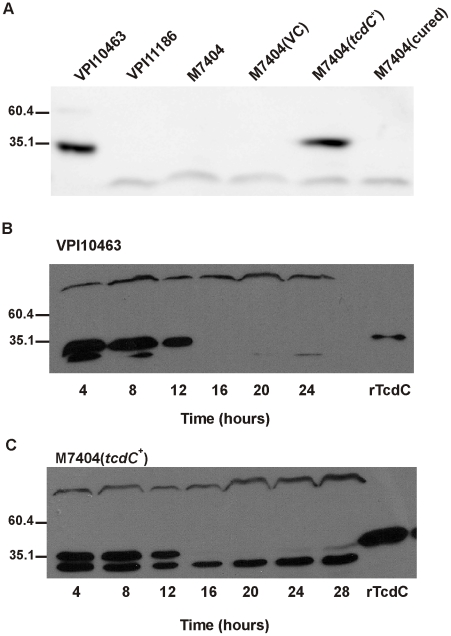
Figure 1
Figure 1. Western blot analysis of TcdC production by wild-type and complemented C. difficile strains.
(A) Qualitative analysis of TcdC production. VPI10463 is the positive control strain; VPI11186 is the negative control strain; M7404 is a wild-type Canadian BI/NAP1/027 strain; M7404(VC) is the wild-type strain carrying the shuttle plasmid pDLL4; M7404(tcdC +) is the wild-type strain carrying the tcdC expression plasmid pDLL17 and M7404(cured) is the M7404(tcdC +) strain cured of pDLL17. (B) Time course analysis of TcdC production by the positive control strain C. difficile VPI10463. Samples were taken at the indicated times shown in hours. 60 ng of purified recombinant his-tagged TcdC protein (rTcdC) was used as the positive reference sample. (C) Time course analysis of TcdC production by C. difficile strain M7404(tcdC +). Samples were taken at the indicated times shown in hours. 300 ng of purified recombinant his-tagged TcdC protein (rTcdC) was used as the positive reference sample. Western blots were performed with rabbit TcdC-specific antibodies. Size standards are shown (kDa).
Figure 2
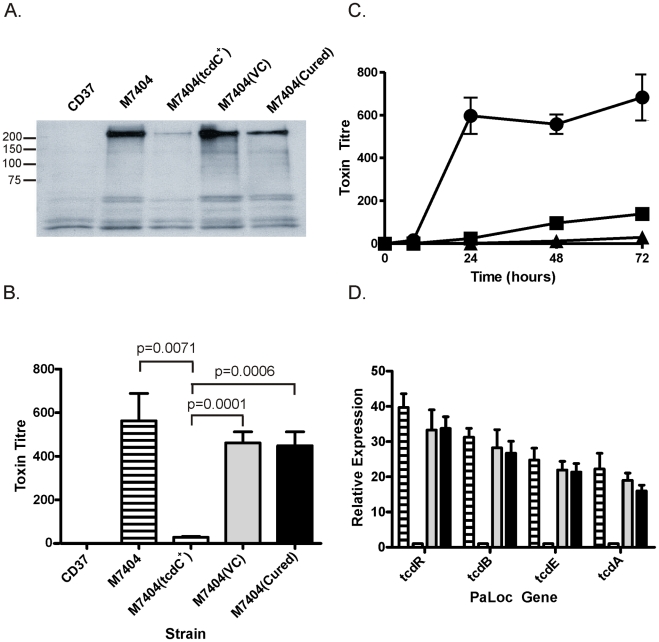
Figure 2. Analysis of the effect of TcdC complementation on toxin production and PaLoc gene expression by C. difficile.
CD37 is the negative control strain; M7404 is the wild-type BI/NAPI/027 strain; M7404(tcdC +) is the wild-type strain carrying the tcdC expression vector pDLL17; M7404(VC) is the wild-type strain carrying shuttle plasmid pDLL4 and M7404(cured) is the M7404(tcdC +) strain cured of pDLL17. JIR8094 is a derivative of strain 630. (A) Western blot using toxin-A-specific antibodies. Size standards are shown (kDa) (B) Toxin cytotoxicity assays using Vero cells. Strains are as described above. Lined bars represent the wild-type strain M7404; white bars represent M7404(tcdC +); grey bars represent M7404(VC) and black bars represent M7404(cured). Data represent the mean ± s.e.m. (n = 3). (C) Time course of toxin production measured using Vero cell cytotoxicity assays. Strains are as described above and are represented as follows: M7404(tcdC +) (▪), M7404(VC) (•) and JIR8094 (▴). Note that CD37 was included in this analysis but displayed no toxin production; the line representing this strain is therefore not visible. Data represent the mean ± s.e.m. (n = 3). (D) PaLoc gene specific qRT-PCR. Bars correspond to strains as before and PaLoc genes are indicated. Data represent the mean fold-expression ± s.e.m. (n = 3), compared to the M7404(tcdC +) strain.
Figure 3
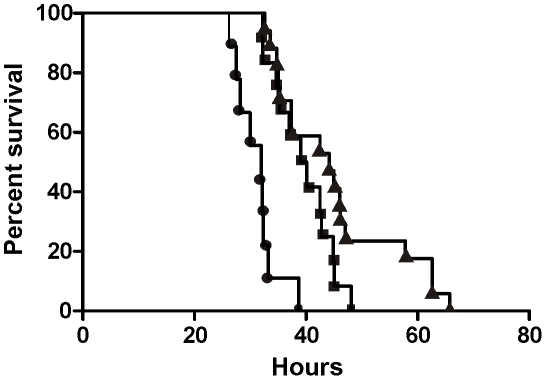
Figure 3. Virulence of C. difficile wild-type and tcdC-complemented strains in hamsters.
Kaplan-Meier survival curve demonstrating time from infection with C. difficile to death. M7404(VC), wild-type M7404 carrying shuttle plasmid pDLL4 (•); M7404(tcdC +), wild-type M7404 carrying tcdC expression plasmid pDLL17 (▪); and strain 630, a C. difficile isolate with known low virulence (▴). Hamsters were infected intragastrically with 10,000 spores from each strain; M7404(VC) (n = 9), M7404(tcdC +) (n = 12) and strain 630 (n = 14).
Figure 4
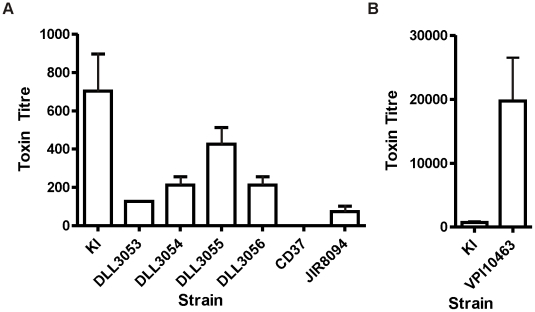
Figure 4. Comparative analysis of toxin production by naturally occurring tcdC clinical isolates.
Vero cell cytotoxicity assays were used to determine toxin production levels. (A) Strain JIR8094 is a tcdC + control strain, CD37 is a PaLoc-negative control strain and KI is an Australian BI/NAPI/027 isolate . All other strains (DLL3053-DLL3056) are clinical isolates carrying naturally occurring tcdC mutations, collected from Australian hospitals. (B) Toxin production by the tcdC + control strain VPI10463 is shown on a separate bar chart due to the much higher levels of toxin produced. For comparative purposes strain KI is represented on both bar charts. Data represent the mean±s.e.m. (n = 3).

References

    1. Borriello SP. Pathogenesis of Clostridium difficile infection. J Antimicrob Chemother. 1998;41:13–19. - PubMed
    1. Warny M, Pepin J, Fang A, Killgore G, Thompson A, et al. Toxin production by an emerging strain of Clostridium difficile associated with outbreaks of severe disease in North America and Europe. Lancet. 2005;366:1079–1084. - PubMed
    1. McDonald LC, Killgore GE, Thompson A, Owens RC, Kazakova SV, et al. An epidemic, toxin gene–variant strain of Clostridium difficile. N Engl J Med. 2005;353:2433–2441. - PubMed
    1. Stabler RA, He M, Dawson L, Martin M, Valiente E, et al. Comparative genome and phenotypic analysis of Clostridium difficile 027 strains provides insight into the evolution of a hypervirulent bacterium. Genome Biol. 2009;10:R102. - PMC - PubMed
    1. Loo VG, Poirier L, Miller MA, Oughton M, Libman MD, et al. A predominantly clonal multi-institutional outbreak of Clostridium difficile-associated diarrhea with high morbidity and mortality. N Engl J Med. 2005;353:2442–2449. - PubMed

Publication types

MeSH terms