The primary patency of percutaneous transluminal angioplasty in hemodialysis patients with vascular access failure
- PMID: 22022326
- PMCID: PMC3193042
- DOI: 10.4070/kcj.2011.41.9.512
The primary patency of percutaneous transluminal angioplasty in hemodialysis patients with vascular access failure
Abstract
Background and objectives: Dysfunction of arteriovenous fistulas (AVFs) and arteriovenous grafts (AVGs) contributes significantly to morbidity and hospitalization in the dialysis population. We evaluated the primary patency of AVFs following percutaneous transluminal angioplasty (PTA) in haemodialysis patients.
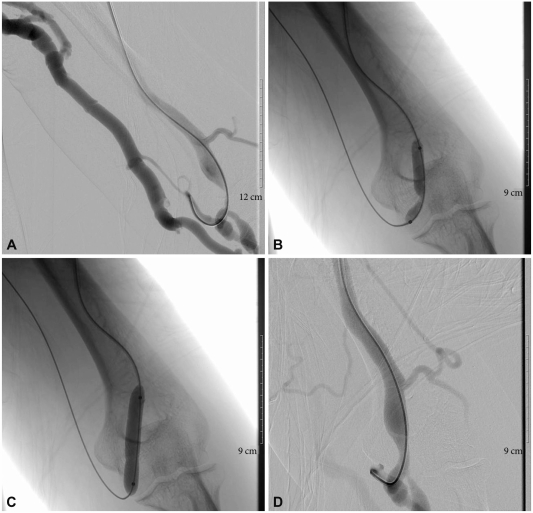
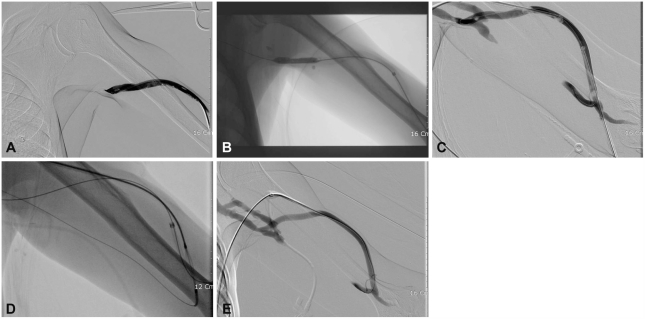
Subjects and methods: We performed 231 interventions in 118 patients with a mean age of 62.1±12.9 years. We performed 122 interventions in 53 AVG patients (44.9%), and 109 interventions in 65 AVF patients (55.1%). If there was thrombosis of the vascular access, urokinase was administered and/or thrombus aspiration was performed. The stent was inserted when balloon dilatation did not expand sufficiently or elastic recoil occurred.
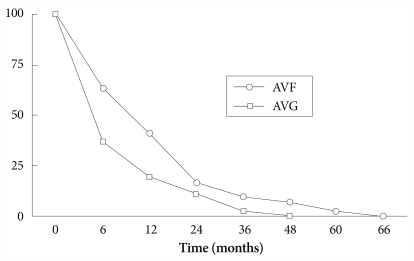
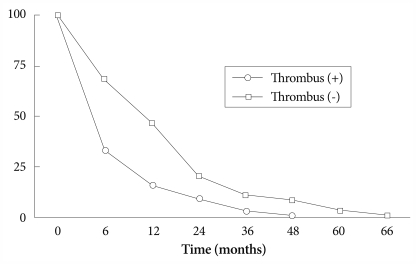
Results: For the 118 patients, the median patency time was 10.45±10.29 months at 92 months of follow-up. The primary patencies for stenotic AVFs at 6, 12, 24, 36, 48, and 60 months were 63.4%, 41.4%, 17.0%, 9.7%, 7.3%, and 2.4%, respectively. The primary patencies for AVGs at 6, 12, 24, and 36 months were 36.9%, 19.5%, 10.8%, 2.1%, respectively, and were obtained by means of the Kaplan-Meier analysis (log rank=6.42, p<0.05). The median patency time was 11.0 months and 4.45 months in the non-thrombus and thrombus groups, respectively. The complication rate was 1.73% (4/231); two cases of pseudoaneurysms and two cases of extravasation were detected. All therapy failures (5/231) occurred in thrombotic lesions of AVGs and were treated surgically.
Conclusion: PTA is an efficacious method for the correction of stenosis of AVFs for hemodialysis, thus prolonging the patency of the fistulas.
Keywords: Arteriovenous fistulas; Dialysis; Percutaneous transluminal angioplasty.
Conflict of interest statement
The authors have no financial conflicts of interest.
Figures
References
-
- Surlan M, Popovic P. The role of interventional radiology in management of patients with end-stage renal disease. Eur J Radiol. 2003;46:96–114. - PubMed
-
- Haage P, Gunther RW. Radiological intervention to maintain vascular access. Eur J Vasc Endovasc Surg. 2006;32:84–89. - PubMed
-
- Dougherty MJ, Calligaro KD, Schindler N, Raviola CA, Ntoso A. Endovascular versus surgical treatment for thrombosed hemodialysis grafts: a prospective, randomized study. J Vasc Surg. 1999;30:1016–1023. - PubMed
-
- Guerra A, Raynaud A, Beyssen B, Pagny JY, Sapoval M, Angel C. Arterial percutaneous angioplasty in upper limbs with vascular access devices for haemodialysis. Nephrol Dial Transplant. 2002;17:843–851. - PubMed
-
- Tang S, Lo CY, Tso WK, Li FK, Chan TM. Percutaneous transluminal angioplasty for stenosis of arteriovenous fistulae: a review of local experience. Hong Kong Med J. 1998;4:36–41. - PubMed
LinkOut - more resources
Full Text Sources