. 2011;6(10):e24602.
doi: 10.1371/journal.pone.0024602. Epub 2011 Oct 12.

Murine gammaretrovirus group G3 was not found in Swedish patients with myalgic encephalomyelitis/chronic fatigue syndrome and fibromyalgia

Affiliations

Murine gammaretrovirus group G3 was not found in Swedish patients with myalgic encephalomyelitis/chronic fatigue syndrome and fibromyalgia

Amal Elfaitouri et al. PLoS One. 2011.

Abstract

Background: The recent report of gammaretroviruses of probable murine origin in humans, called xenotropic murine retrovirus related virus (XMRV) and human murine leukemia virus related virus (HMRV), necessitated a bioinformatic search for this virus in genomes of the mouse and other vertebrates, and by PCR in humans.

Results: Three major groups of murine endogenous gammaretroviruses were identified. The third group encompassed both exogenous and endogenous Murine Leukemia Viruses (MLVs), and most XMRV/HMRV sequences reported from patients suffering from myalgic encephalomyelitis/chronic fatigue syndrome (ME/CFS). Two sensitive real-time PCRs for this group were developed. The predicted and observed amplification range for these and three published XMRV/HMRV PCRs demonstrated conspicuous differences between some of them, partly explainable by a recombinatorial origin of XMRV. Three reverse transcription real-time PCRs (RTQPCRs), directed against conserved and not overlapping stretches of env, gag and integrase (INT) sequences of XMRV/HMRV were used on human samples. White blood cells from 78 patients suffering from ME/CFS, of which 30 patients also fulfilled the diagnostic criteria for fibromyalgia (ME/CFS/FM) and in 7 patients with fibromyalgia (FM) only, all from the Gothenburg area of Sweden. As controls we analyzed 168 sera from Uppsala blood donors. We controlled for presence and amplifiability of nucleic acid and for mouse DNA contamination. To score as positive, a sample had to react with several of the XMRV/HMRV PCRs. None of the samples gave PCR reactions which fulfilled the positivity criteria.

Conclusions: XMRV/HMRV like proviruses occur in the third murine gammaretrovirus group, characterized here. PCRs developed by us, and others, approximately cover this group, except for the INT RTQPCR, which is rather strictly XMRV specific. Using such PCRs, XMRV/HMRV could not be detected in PBMC and plasma samples from Swedish patients suffering from ME/CFS/FM, and in sera from Swedish blood donors.


Conflict of interest statement

Competing Interests: The authors have declared that no competing interests exist.

Figures

Figure 1
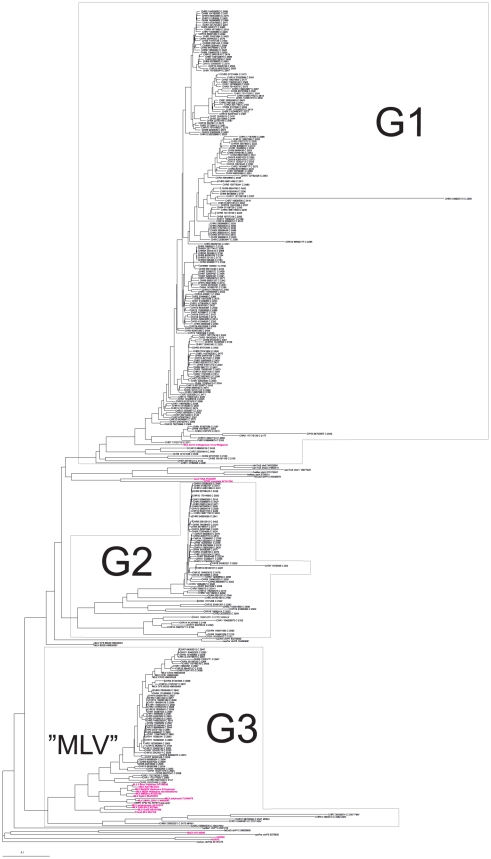
Figure 1. gag sequences of 300 high scoring mouse gammaretroviral sequences were aligned together with reference sequences.
The tree was rooted with a rabbit sequence. Sequences in red are from ME patients, published in the paper of Lo et al . Two short blood donor (“BD”) sequences from the Lo et al study came out at the beginning of group G2, in most other trees in group G3. “HMRV” corresponds to group G3 in the tree. A higher resolution version is shown in Information S1). (genomic ERV sequences taken from the prototype of RetroBank were named as oryCun = rabbit, cavPor = guinea pig, felCat = Cat, panTro = Chimpanzee or rheMac = Rhesus macaque. Mouse sequences from the mm8 assembly are just shown with their chromosomal location). MLV sequences of known tropism, from GenBank, were also added. The separation of xeno-, modified polytropic and polytropic G3 sequences was not clear in this tree. It was more clear in other trees (Information S1).
Figure 2
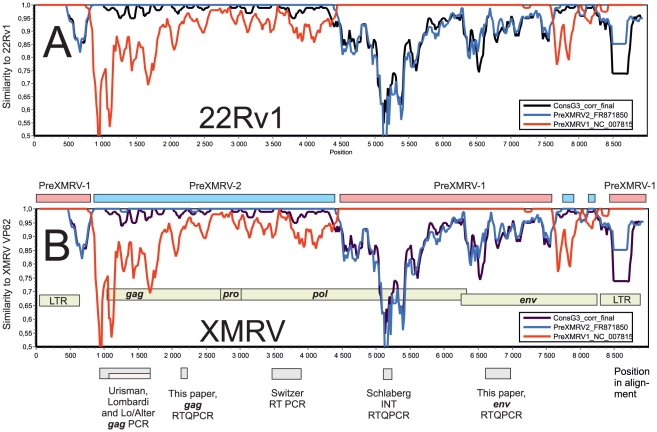
Figure 2. Relation between the XMRV/HMRV PCRs considered in this paper, and the recombinant origin of XMRV/22Rv1.
Similarity plots from a Clustal alignment with 22RV1 (Fig. 2A) and XMRV (Fig. 2B) as references, and with PreXMRV-1, PreXMRV-2 and the G3 consensus (from this paper) as queries, were made with Simplot v1.3 (1998, kindly provided by dr S. Ray, dpt of Infectious Diseases, Johns Hopkins University, US) with a window size of 100 and a step size of 20 nucleotides, inclusion of gaps and Kimura transition/transversion scoring. The 22Rv1 virus was 99.9% identical to XMRV over the entire alignment, and yielded an identical similarity plot with the probable ancestors and the G3 consensus. The mosaic nature of XMRV, and its consequences for the detection range of the PCRs considered in this paper, as well as the exact match between 22Rv1 and XMRV, is evident. It is highly unlikely that the same recombination could have occurred by chance independently, outside of the 22Rv1 cell line. Additional material is found in Information S2.
Figure 3
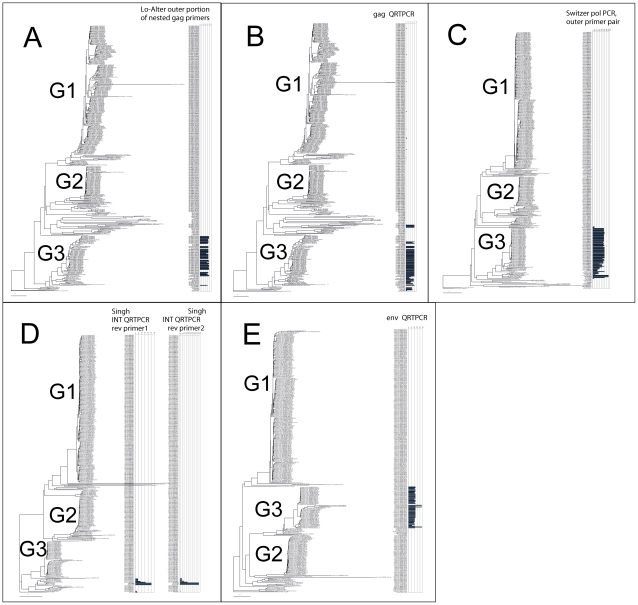
Figure 3. Estimated PCR detection range in an alignment of 300 high-scoring gammaretroviruslike proviruses found by RetroTector in the mm8 assembly.
Predictions were mapped onto NJ trees of alignments of gag, pol, integrase and env nucleotide sequences. A PCR detection score (shown as horizontal bars) was calculated by multiplying the fit of primers and probe (if present) to the target sequences for each provirus in the alignment. The degree of fit (match) was estimated using a modified NucZip algorithm . A more complete treatment of this subject will be published separately (Danielsson et al, in preparation). The trees and alignments are further presented, and shown in higher resolution together with trees made with several algorithms, with bootstrap figures, in Information S1. A. A gag nt alignment assessed with outer primers of the nested Lo/Alter PCR (HMRV sequences from that paper are shown in red), and B. the same tree with the prediction for the primers and probe of the gag RTQPCR presented in this paper. C. A pol tree, with the prediction for the outer primer pair of the nested RT-based PCR of Switzer et al is shown. D. A tree based on the 3′ (mainly integrase) portion of pol. Predictions based on the Singh RTQPCR, with its two reverse primers , are shown. XMRV sequences are shown in red. E. An env tree. The prediction of the detection range of the env RTQPCR presented in this paper is shown. A higher resolution picture is shown in Information S1.
Figure 4
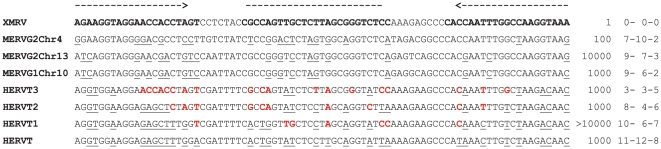
Figure 4. Alignment of endogenous group G1 (chr10) and G2 (chr4 and 13) MERV sequences, HERV-T and artificial hybrid HERV-T/XMRV target sequences used to test the detection range of the gag RTQPCR.
The HERV-T sequence was gradually changed (red nucleotides) to become more XMRV-like. The detection limit was determined by running PCR with tenfold dilutions giving 1–100 000 molecules per PCR reaction. The lowest positive concentration, in molecules per PCR reaction of the respective constructs, is written to the right of the alignment. The number of mismatches (underlined) between forward primer, probe and reverse primer, respectively, is shown at the far right.
Figure 5
Figure 5. Test of detection range of the env RTQPCR using synthetic target sequences.
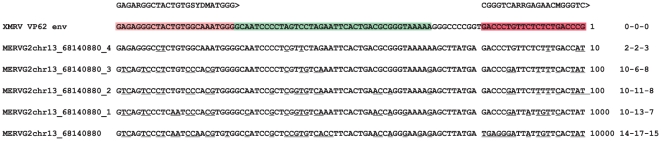
Alignment of primer (mauve and red) and probe (green) target sequences with a synthetic PCR target sequence used to evaluate approximate detection width of the env QPCR. The detection limit was determined by running PCR with tenfold dilutions giving 1–100 000 molecules per PCR reaction. The lowest positive dilution in the series, in molecules per PCR reaction of the respective constructs, is written to the right of the alignment. The number of mismatches (underlined) between forward primer, probe and reverse primer, respectively, is shown in the far right. chr13_68140880 is a group G2 MERV.
Figure 6
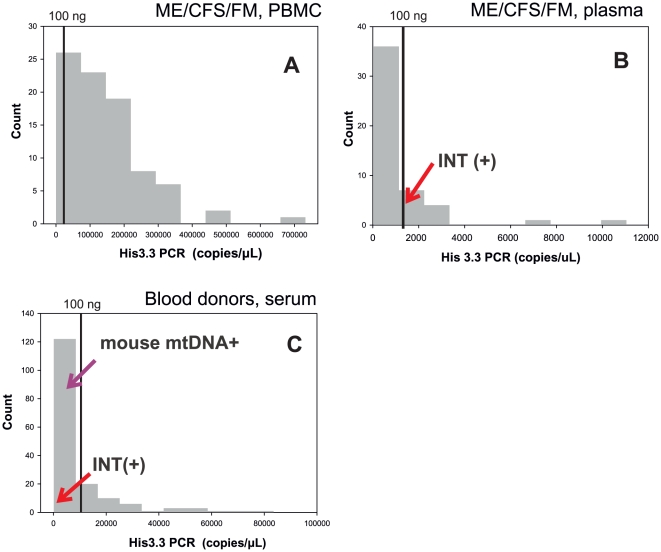
Figure 6. Histograms based on the histone 3.3 RTQPCR results for the three sample sets are shown.
A. Data from PBMCs of ME/CFS/FM patients. B. Data from plasma of ME/CFS/FM/patients. C. Data from blood donor sera.

References

    1. Urisman A, Molinaro RJ, Fischer N, Plummer SJ, Casey G, et al. Identification of a novel Gammaretrovirus in prostate tumors of patients homozygous for R462Q RNASEL variant. PLoS Pathog. 2006;2:e25. - PMC - PubMed
    1. Lombardi VC, Ruscetti FW, Das Gupta J, Pfost MA, Hagen KS, et al. Detection of an infectious retrovirus, XMRV, in blood cells of patients with chronic fatigue syndrome. Science. 2009;326:585–589. - PubMed
    1. Lo SC, Pripuzova N, Li B, Komaroff AL, Hung GC, et al. Detection of MLV-related virus gene sequences in blood of patients with chronic fatigue syndrome and healthy blood donors. Proc Natl Acad Sci U S A. 2010;107:15874–15879. - PMC - PubMed
    1. Paprotka T, Delviks-Frankenberry KA, Cingoz O, Martinez A, Kung HJ, et al. Recombinant Origin of the Retrovirus XMRV. Science. 2011;333:97–101. - PMC - PubMed
    1. Switzer WM, Jia H, Hohn O, Zheng H, Tang S, et al. Absence of evidence of xenotropic murine leukemia virus-related virus infection in persons with chronic fatigue syndrome and healthy controls in the United States. Retrovirology. 2010;7:57. - PMC - PubMed

Publication types

MeSH terms