


Association between poor sleep, fatigue, and safety outcomes in emergency medical services providers
- PMID: 22023164
- PMCID: PMC3228875
- DOI: 10.3109/10903127.2011.616261
Association between poor sleep, fatigue, and safety outcomes in emergency medical services providers
Abstract
Objective: To determine the association between poor sleep quality, fatigue, and self-reported safety outcomes among emergency medical services (EMS) workers.
Methods: We used convenience sampling of EMS agencies and a cross-sectional survey design. We administered the 19-item Pittsburgh Sleep Quality Index (PSQI), 11-item Chalder Fatigue Questionnaire (CFQ), and 44-item EMS Safety Inventory (EMS-SI) to measure sleep quality, fatigue, and safety outcomes, respectively. We used a consensus process to develop the EMS-SI, which was designed to capture three composite measurements of EMS worker injury, medical errors and adverse events (AEs), and safety-compromising behaviors. We used hierarchical logistic regression to test the association between poor sleep quality, fatigue, and three composite measures of EMS worker safety outcomes.
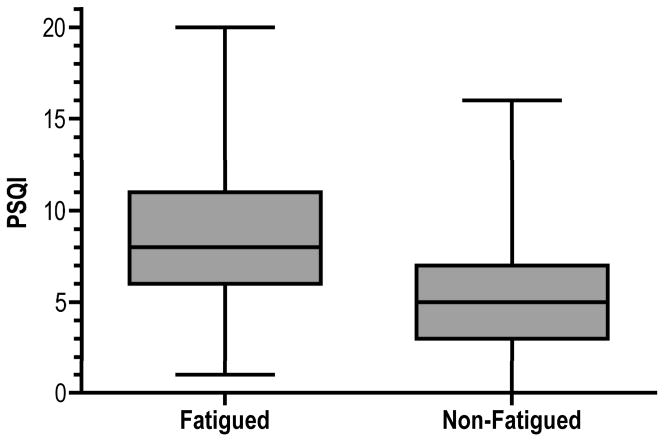
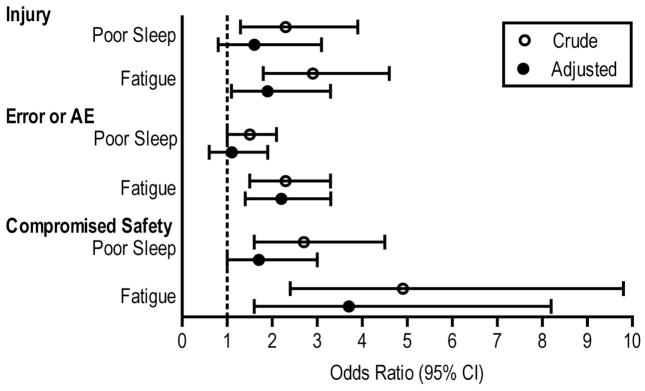
Results: We received 547 surveys from 30 EMS agencies (a 35.6% mean agency response rate). The mean PSQI score exceeded the benchmark for poor sleep (6.9, 95% confidence interval [CI] 6.6, 7.2). More than half of the respondents were classified as fatigued (55%, 95% CI 50.7, 59.3). Eighteen percent of the respondents reported an injury (17.8%, 95% CI 13.5, 22.1), 41% reported a medical error or AE (41.1%, 95% CI 36.8, 45.4), and 90% reported a safety-compromising behavior (89.6%, 95% CI 87, 92). After controlling for confounding, we identified 1.9 greater odds of injury (95% CI 1.1, 3.3), 2.2 greater odds of medical error or AE (95% CI 1.4, 3.3), and 3.6 greater odds of safety-compromising behavior (95% CI 1.5, 8.3) among fatigued respondents versus nonfatigued respondents.
Conclusions: In this sample of EMS workers, poor sleep quality and fatigue are common. We provide preliminary evidence of an association between sleep quality, fatigue, and safety outcomes.
Figures
References
-
- West CP, Tan AD, Habermann TM, Sloan JA, Shanafelt TD. Association of resident fatigue and distress with perceived medical errors. JAMA. 2009;302(12):1294–1300. - PubMed
-
- Kohn LT, Corrigan JM, Donaldson MS. To Err is Human: Building a Safer Health System. Washington, DC: National Academies of Science; 2000. - PubMed
-
- WHO. WHO Patient Safety Curriculum Guide for Medical Schools. Geneva: 2009.
-
- Nasca TJ, Day SH, Amis ES, Force ADHT. The new recommendations on duty hours from the ACGME Task Force. N Engl J Med. 2010;363(2) - PubMed
-
- Rittenberger JC, Beck PW, Paris PM. Errors of omission in the treatment of prehospital chest pain patients. Prehosp Emerg Care. 2005;9(1):2–7. - PubMed
Publication types
MeSH terms
Grants and funding
LinkOut - more resources
Full Text Sources
Medical
