


Preliminary efficacy of the anti-insulin-like growth factor type 1 receptor antibody figitumumab in patients with refractory Ewing sarcoma
- PMID: 22025154
- PMCID: PMC3236653
- DOI: 10.1200/JCO.2010.33.0670
Preliminary efficacy of the anti-insulin-like growth factor type 1 receptor antibody figitumumab in patients with refractory Ewing sarcoma
Abstract
Purpose: Patients with Ewing sarcoma (ES) with metastases and those who relapse fare poorly and receive therapies that carry significant toxicity. This phase 1/2 study was conducted to evaluate the efficacy of figitumumab in advanced ES.
Patients and methods: Patients with sarcoma 10 to 18 years old were enrolled in two dose escalation cohorts (20 and 30 mg/Kg intravenously every 4 weeks) in the phase 1 portion of the study. Patients with ES 10 years old or older were enrolled in the phase 2 portion of the study. The primary phase 2 objective was objective response rate (ORR).
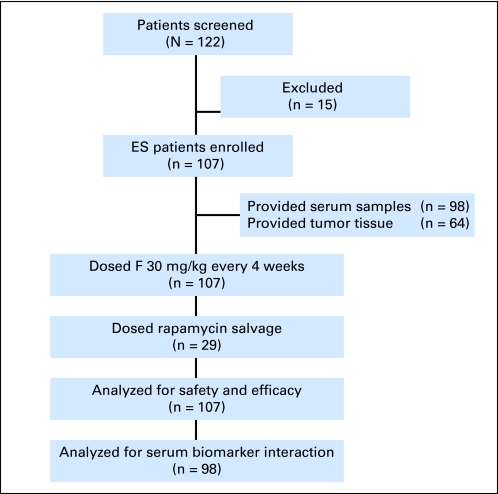
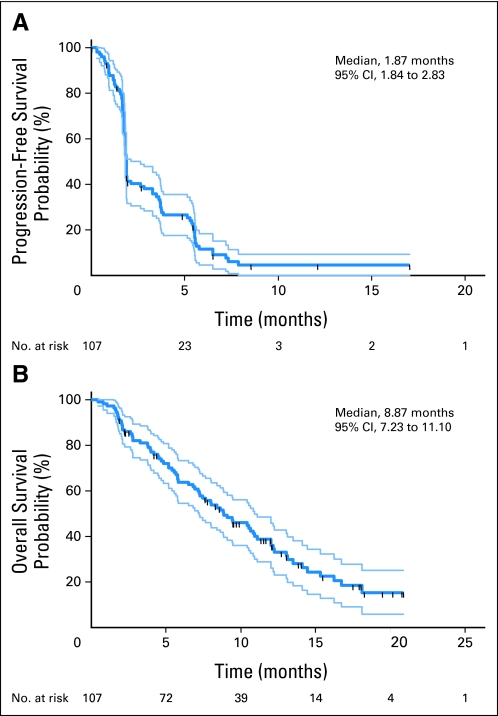
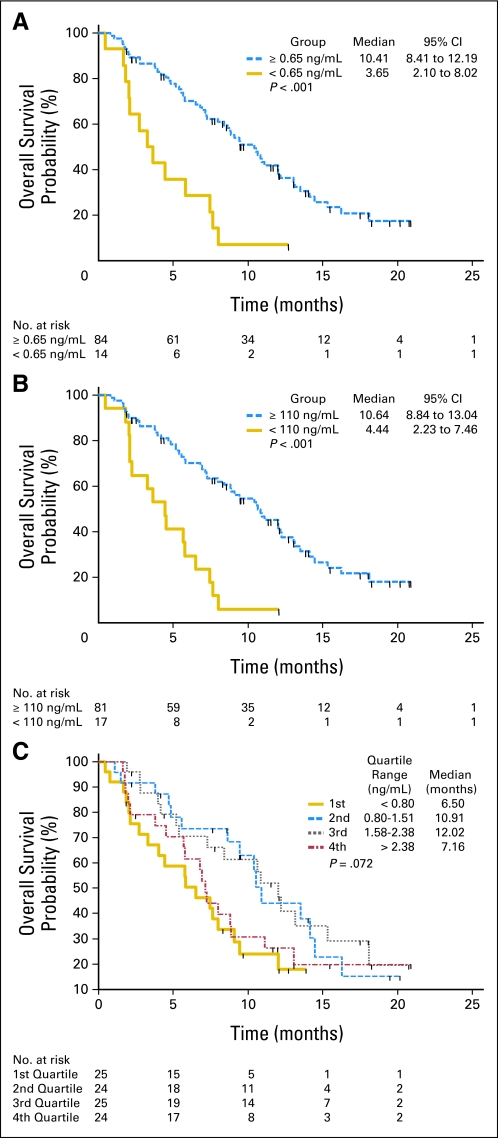
Results: Thirty-one patients with ES (n = 16), osteosarcoma (n = 11), or other sarcomas (n = 4) were enrolled in the phase 1 portion of the study. Dose escalation proceeded to 30 mg/kg every 4 weeks with no dose-limiting toxicity identified. In the phase 2 portion of the study, 107 patients with ES received figitumumab at 30 mg/kg every 4 weeks for a median of 2 cycles (range, 1 to 16). Sixty three percent of phase 2 patients had received at least three prior treatment regimens. Of 106 evaluable patients, 15 had a partial response (ORR, 14.2%) and 25 had stable disease. Median overall survival was 8.9 months. Importantly, patients with a pretreatment circulating free insulin-like growth factor (IGF) -1 lower than 0.65 ng/mL (n = 14) had a median OS of 3.6 months, whereas those with a baseline free IGF-1 ≥ 0.65 ng/mL (n = 84) had a median OS of 10.4 months (P < .001).
Conclusion: Figitumumab had modest activity as single agent in advanced ES. A strong association between pretreatment serum IGF-1 and survival benefit was identified.
Trial registration: ClinicalTrials.gov NCT00560235.
Conflict of interest statement
Authors' disclosures of potential conflicts of interest and author contributions are found at the end of this article.
Figures
Comment in
-
Targeting of insulin-like growth factor type 1 receptor in Ewing sarcoma: unfulfilled promise or a promising beginning?J Clin Oncol. 2011 Dec 1;29(34):4581-3. doi: 10.1200/JCO.2011.38.2374. Epub 2011 Oct 24. J Clin Oncol. 2011. PMID: 22025158 Free PMC article. No abstract available.
References
-
- Helman LJ, Meltzer P. Mechanisms of sarcoma development. Nat Rev Cancer. 2003;3:685–694. - PubMed
-
- Fletcher CDM, Unni KK, Mertens F. World Health Organisation Classification of Tumours: Pathology and Genetics of Tumours of Soft Tissue and Bone. Lyon, France: IARC Press; 2002.
-
- Toretsky JA, Kalebic T, Blakesley V, et al. The insulin-like growth factor-I receptor is required for EWS/FLI-1 transformation of fibroblasts. J Biol Chem. 1997;272:30822–30827. - PubMed
-
- Olmos D, Tan DS, Jones RL, et al. Biological rationale and current clinical experience with anti-insulin-like growth factor 1 receptor monoclonal antibodies in treating sarcoma: Twenty years from the bench to the bedside. Cancer J. 2010;16:183–194. - PubMed
Publication types
MeSH terms
Substances
Associated data
Grants and funding
LinkOut - more resources
Full Text Sources
Other Literature Sources
Medical
Miscellaneous
