Review
. 2011;3(6):550-64.
doi: 10.1159/000329099. Epub 2011 Sep 19.

Mucosal macrophages in intestinal homeostasis and inflammation

Affiliations
Review

Mucosal macrophages in intestinal homeostasis and inflammation

Allan McI Mowat et al. J Innate Immun. 2011.

Abstract

Intestinal macrophages are essential for local homeostasis and in keeping a balance between commensal microbiota and the host. However, they also play essential roles in inflammation and protective immunity, when they change from peaceful regulators to powerful aggressors. As a result, activated macrophages are important targets for treatment of inflammatory bowel diseases such as Crohn's disease. Until recently, the complexity and heterogeneity of intestinal macrophages have been underestimated and here we review current evidence that there are distinct populations of resident and inflammatory macrophages in the intestine. We describe the mechanisms that ensure macrophages remain partially inert in the healthy gut and cannot promote inflammation despite constant exposure to bacteria and other stimuli. This may be because the local environment 'conditions' macrophage precursors to become unresponsive after they arrive in the gut. Nevertheless, this permits some active, physiological functions to persist. A new population of pro-inflammatory macrophages appears in inflammation and we review the evidence that this involves recruitment of a distinct population of fully responsive monocytes, rather than alterations in the existing cells. A constant balance between these resident and inflammatory macrophages is critical for maintaining the status quo in healthy gut and ensuring protective immunity when required.


Figures

Fig. 1
Fig. 1
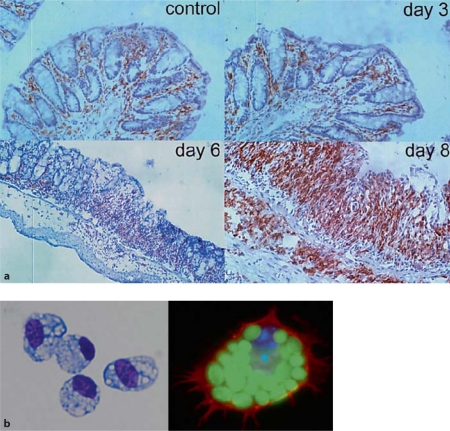
Location and morphology of mΦ in healthy colon. a F4/80+ cells in control mouse colon and 3, 6 and 8 days after induction of DSS colitis, showing the presence of mΦ in healthy intestine and the intense infiltrate in inflammation. Reproduced with permission from Stevceva et al. [109]. b Purified F4/80+ class II MHC+ mΦ from normal mouse colon show the morphological appearances of activation, with abundant foamy cytoplasmic granules and they phagcoytose FITC-labelled zymosan particles.
Fig. 2
Fig. 2
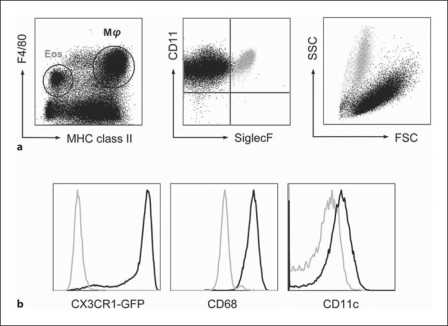
Phenotypic features of resident mΦ in healthy mouse colon. Two major populations of F4/80 + cells are present in populations of live CD45+ cells isolated by enzymatic digestion of mouse colon. The F4/80hi class II MHChi cells are mΦ, as assessed by FSC, SSC and expression of CD68. Unlike resident mΦ in other tissues, they also express very high levels of CX3CR1 and significant amounts of CD11c. The cells that express lower levels of F4/80 are class II MHC– and Siglec F+. They also have high SSC and are eosinophils.
Fig. 3
Fig. 3
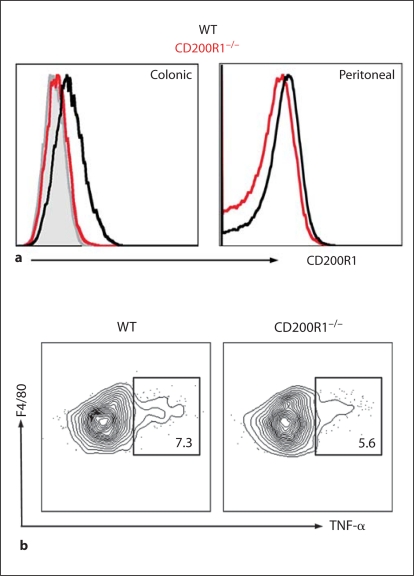
CD200R1 and intestinal mΦ function. Resident colonic mΦ express CD200R1 (a), but lack of CD200R1 does not affect the production of TNF-α by purified colonic F4/80hi class II MHChi mΦ in response to the TLR2 ligand bacterial lipopeptide (b).
Fig. 4
Fig. 4
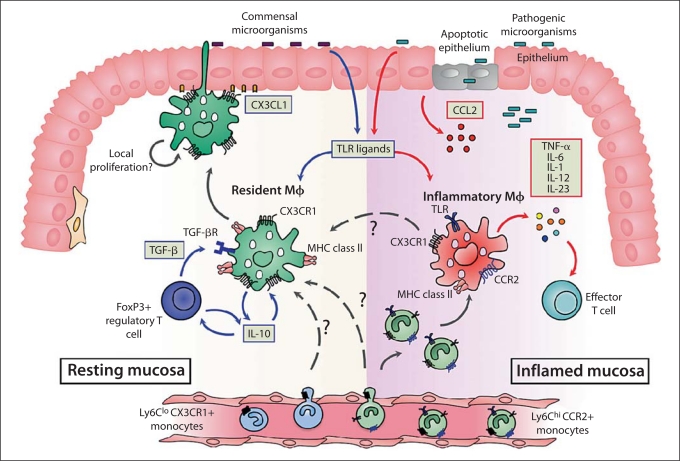
Origin and diversity of intestinal mΦ in healthy and inflamed intestine. In resting intestine, the majority of intestinal mΦ express high levels of CX3CR1, the receptor for the transmembrane chemokine fractalkine (CX3CL1) expressed by intestinal epithelial cells. These mΦ can ingest and kill commensal bacteria, perhaps by extending processes across the epithelial barrier into the lumen. They produce IL-10 constitutively, but are unable to produce pro-inflammatory mediators in response to TLR or other stimuli. This means that resident intestinal mΦ cannot assist effector T cell activity, but instead, their production of IL-10 is needed to maintain the survival of local FoxP3+ Treg. In turn, the Treg produce TGF- β which, together with IL-10 and other local factors, maintain resident mΦ in their state of partial inertia. This may also require TLR signalling from the commensal microbiota. The resident mΦ are long-lived, and may be replenished directly from the bloodstream either by resident CX3CR1+ Ly6Clo monocytes or by inflammatory CX3CR1lo Ly6Chi monocytes. There may also be local turnover of resident mΦ, or differentiation of the small numbers of CX3CR1int inflammatory mΦ present in normal mucosa (see text for details). After breach of the epithelial barrier, or pathogenic invasion, the mucosa is infiltrated by large numbers of inflammatory mΦ which express lower levels of CX3CR1. These CX3CR1int mΦ are derived from recently divided inflammatory CX3CR1lo Ly6Chi CCR2+ monocytes in the bloodstream, recruited in response to increased levels of CCR2 ligands. The CX3CR1int mΦ produce large amounts of pro-inflammatory mediators that drive local inflammation and promote the function of effector T cells. Some inflammatory CX3CR1int mΦ may eventually differentiate into resident CX3CR1hi mΦ to assist resolution of damage.

References

    1. Hume DA. The mononuclear phagocyte system. Curr Opin Immunol. 2006;18:49–53. - PubMed
    1. Lee SH, Starkey PM, Gordon S. Quantitative analysis of total macrophage content in adult mouse tissues. Immunochemical studies with monoclonal antibody F4/80. J Exp Med. 1985;161:475–489. - PMC - PubMed
    1. Niess JH, Adler G. Enteric flora expands gut lamina propria CX3CR1+ dendritic cells supporting inflammatory immune responses under normal and inflammatory conditions. J Immunol. 2010;184:2026–2037. - PubMed
    1. Rogler G, Hausmann M, Vogl D, Aschenbrenner E, Andus T, Falk W, Andreesen R, Scholmerich J, Gross V. Isolation and phenotypic characterization of colonic macrophages. Clin Exp Immunol. 1998;112:205–215. - PMC - PubMed
    1. Denning TL, Wang YC, Patel SR, Williams IR, Pulendran B. Lamina propria macrophages and dendritic cells differentially induce regulatory and interleukin 17-producing T cell responses. Nat Immunol. 2007;8:1086–1094. - PubMed

Publication types