


Circulating neuregulin-1β levels vary according to the angiographic severity of coronary artery disease and ischemia
- PMID: 22027878
- PMCID: PMC3217257
- DOI: 10.1097/MCA.0b013e32834d3346
Circulating neuregulin-1β levels vary according to the angiographic severity of coronary artery disease and ischemia
Abstract
Background: Coronary artery disease (CAD) is the leading killer in the United States. Patients with severe CAD and ischemia have worse prognosis. Therefore expansion of biomarker research, to identify at-risk individuals and explain the complex biology between cardiovascular growth factors and atherosclerosis is needed. Neuregulin-1β (NRG-1β) is a myocardial stress activated growth and survival factor released from endocardial and endothelial cells. NRG-1β is essential for cardiovascular development and a regulator of angiogenesis. We postulated that plasma and serum levels of NRG-1β would vary in relation to CAD severity and the presence of stress-induced ischemia.
Methods: We measured serum and plasma levels of NRG-1β and vascular endothelial growth factor (VEGF) in 60 patients undergoing cardiac catheterization. CAD severity was calculated from angiographic results using a modified Duke jeopardy score.
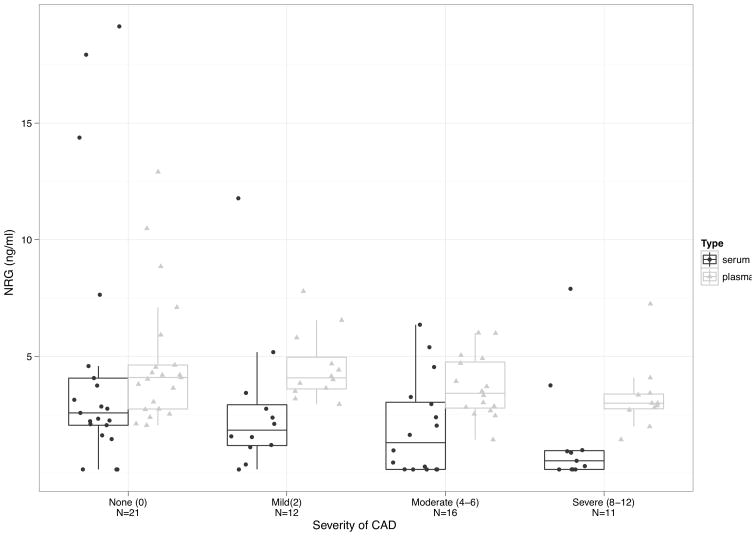
Results: Serum NRG-1β (sNRG-1β), plasma NRG-1β (pNRG-1β), serum VEGF, and plasma VEGF were detectable in the majority of patients. The pNRG-1β levels were approximately two-fold higher than sNRG-1β. Both sNRG-1β and pNRG-1β correlated inversely with CAD severity. pNRG-1β levels were statistically higher in patients with stress-induced ischemia denoted by a positive myocardial perfusion imaging study that correlated with angiographic findings (P=0.02).
Conclusion: Both sNRG-1β and pNRG-1β correlated inversely with angiographic severity of CAD. pNRG-1β levels were two-fold higher than serum and were higher in patients with stress-induced ischemia. Therefore we conclude that plasma is the optimal source for the further exploration of the biological significance of NRG-1β as a biomarker of CAD severity and ischemia.
© 2011 Wolters Kluwer Health | Lippincott Williams & Wilkins
Figures
References
-
- Kuramochi Y, Cote GM, Guo X, Lebrasseur NK, Cui L, Liao R, et al. Cardiac endothelial cells regulate reactive oxygen species-induced cardiomyocyte apoptosis through neuregulin-1beta/erbB4 signaling. J Biol Chem. 2004 Dec 3;279(49):51141–7. - PubMed
-
- Lebrasseur NK, Cote GM, Miller TA, Fielding RA, Sawyer DB. Regulation of neuregulin/ErbB signaling by contractile activity in skeletal muscle. Am J Physiol Cell Physiol. 2003 May;284(5):C1149–55. - PubMed
-
- Lemmens K, Doggen K, De Keulenaer GW. Role of neuregulin-1/ErbB signaling in cardiovascular physiology and disease: implications for therapy of heart failure. Circulation. 2007 Aug 21;116(8):954–60. - PubMed
-
- Lemmens K, Segers VF, Demolder M, De Keulenaer GW. Role of neuregulin-1/ErbB2 signaling in endothelium-cardiomyocyte cross-talk. J Biol Chem. 2006 Jul 14;281(28):19469–77. - PubMed
-
- Cote GM, Miller TA, Lebrasseur NK, Kuramochi Y, Sawyer DB. Neuregulin-1alpha and beta isoform expression in cardiac microvascular endothelial cells and function in cardiac myocytes in vitro. Exp Cell Res. 2005 Nov 15;311(1):135–46. - PubMed
Publication types
MeSH terms
Substances
Grants and funding
LinkOut - more resources
Full Text Sources
Other Literature Sources
Medical
Miscellaneous
