


Amniocentesis in twin pregnancies: a systematic review of the literature
- PMID: 22028248
- PMCID: PMC3330135
- DOI: 10.1002/pd.2897
Amniocentesis in twin pregnancies: a systematic review of the literature
Abstract
Objective: Using published data, we sought to determine the amniocentesis-related loss rate in twin gestations.
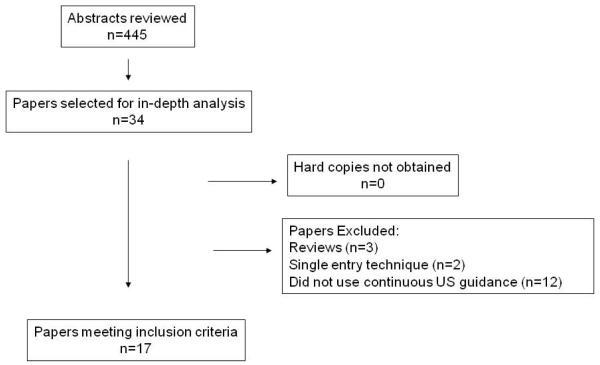
Methods: We searched the PUBMED database using keywords "amniocentesis", "twin" and "twins" to identify articles evaluating genetic amniocentesis in twin gestations published from January 1970 to December 2010. Random effects models were used to pool procedure-related loss rates from included studies.
Results: The definition of "loss" varied across the 17 studies identified (Table 1). The pooled procedure-related loss rate at < 24 weeks was 3.5% (95% confidence interval [CI] 2.6-4.7) (Figure 2). Pooled loss rates at < 28 weeks (Figure 4) and to term (Figure 5) could not be calculated due to unacceptable heterogeneity of available data. Seven studies included a control (no amniocentesis) group and reported a pooled odds ratio for total pregnancy loss among cases of 1.8 (95% CI 1.2-2.7) (Figure 3). Only 1 study reported procedure-related loss rates by chorionicity (7.7% among monochorionics vs 1.4% among controls; p 0.02).
Conclusion: Analysis of published data demonstrated a pooled amniocentesis-related loss rate of 3.5% in twin gestations < 24 weeks. Pooled loss rates within other post-amniocentesis intervals or other gestational age windows and the impact of chorionicity on procedure-related loss rates cannot be determined from published data.
© 2011 John Wiley & Sons, Ltd.
Figures


References
-
- ACOG Invasive prenatal testing for aneuploidy. Obstet Gynecol. 2007 Dec;110:1459. Practice Bulletin No. 88. - PubMed
-
- Anderson R, Goldberg J, Golbus M. Prenatal diagnosis in multiple gestation: 20 year’s experience with amniocentesis. Prenat Diag. 1990;10:25–28. - PubMed
-
- Antsaklis A, Souka A, Daskalakis G, Kavalakis Y, et al. Second-trimester amniocentesis vs. chorionic villus sampling for prenatal diagnosis in multiple gestations. Ultrasound Obstet Gynecol. 2002 Nov;20(5):476–81. - PubMed
-
- Blondel B, Kaminski M. Trends in the occurrence, determinants, and consequences of multiple births. Semin Perinatol. 2002;26:239. - PubMed
-
- Cahill A, Macones G, Stamilio D, Dicke J, et al. Pregnancy loss rate after mid-trimester amniocentesis in twin pregnancies. Am J Obstet Gynecol. 2009;200:257.e1–257.e6. - PubMed
Publication types
MeSH terms
Grants and funding
LinkOut - more resources
Full Text Sources
