


Quantitative real-time polymerase chain reaction for enteropathogenic Escherichia coli: a tool for investigation of asymptomatic versus symptomatic infections
- PMID: 22028433
- PMCID: PMC3214587
- DOI: 10.1093/cid/cir730
Quantitative real-time polymerase chain reaction for enteropathogenic Escherichia coli: a tool for investigation of asymptomatic versus symptomatic infections
Abstract
Background: Enteropathogenic Escherichia coli (EPEC) strains are pediatric pathogens commonly isolated from both healthy and sick children with diarrhea in areas of endemicity. The aim of this study was to compare the bacterial load of EPEC isolated from stool samples from children with and without diarrhea to determine whether bacterial load might be a useful tool for further study of this phenomenon.
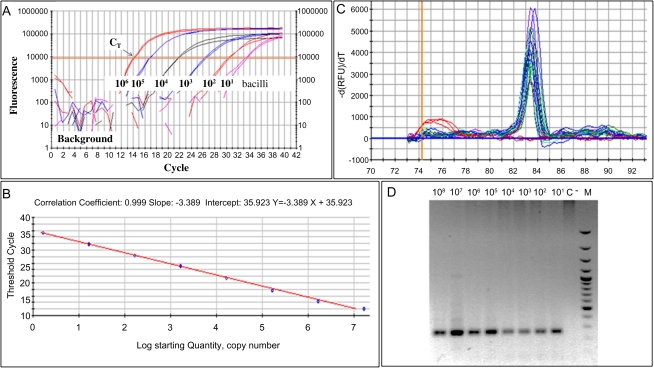
Methods: EPEC was detected by polymerase chain reaction (PCR) of colonies isolated on MacConkey plates from 53 diarrheal and 90 healthy children aged <2 years. DNA was isolated from stool samples by cetyltrimethylammonium bromide extraction. To standardize quantification by quantitative real-time PCR (qRT-PCR), the correlation between fluorescence threshold cycle and copy number of the intimin gene of EPEC E2348/69 was determined.
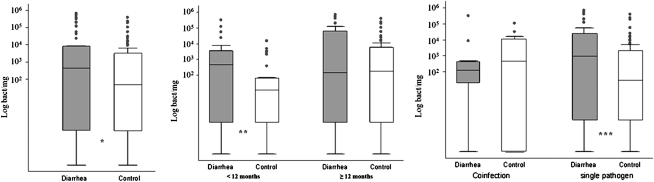
Results: The detection limit of qRT-PCR was 5 bacteria/mg stool. The geometric mean load in diarrhea was 299 bacteria/mg (95% confidence interval [CI], 77-1164 bacteria/mg), compared with 29 bacteria/mg (95% CI, 10-87 bacteria/mg) in control subjects (P = .016). Bacterial load was significantly higher in children with diarrhea than in control subjects among children <12 months of age (178 vs 5 bacteria/mg; P = .006) and among children with EPEC as the sole pathogen (463 vs 24 bacteria/mg; P = .006).
Conclusions: EPEC load measured by qRT-PCR is higher in diarrheal than in healthy children. qRT-PCR may be useful to study the relationship between disease and colonization in settings of endemicity.
Figures
References
-
- Chen HD. Frankel G. Enteropathogenic Escherichia coli: unravelling pathogenesis. FEMS Microbiol Rev. 2005;29:83–98. - PubMed
-
- Alikhani MY, Mirsalehian A, Aslani MM. Detection of typical and atypical enteropathogenic Escherichia coli (EPEC) in Iranian children with and without diarrhoea. J Med Microbiol. 2006;55:1159–63. - PubMed
Publication types
MeSH terms
Grants and funding
LinkOut - more resources
Full Text Sources
Medical
