


Comparison of therapeutic effects between pulsed and continuous wave 810-nm wavelength laser irradiation for traumatic brain injury in mice
- PMID: 22028832
- PMCID: PMC3196530
- DOI: 10.1371/journal.pone.0026212
Comparison of therapeutic effects between pulsed and continuous wave 810-nm wavelength laser irradiation for traumatic brain injury in mice
Abstract
Background and objective: Transcranial low-level laser therapy (LLLT) using near-infrared light can efficiently penetrate through the scalp and skull and could allow non-invasive treatment for traumatic brain injury (TBI). In the present study, we compared the therapeutic effect using 810-nm wavelength laser light in continuous and pulsed wave modes in a mouse model of TBI.
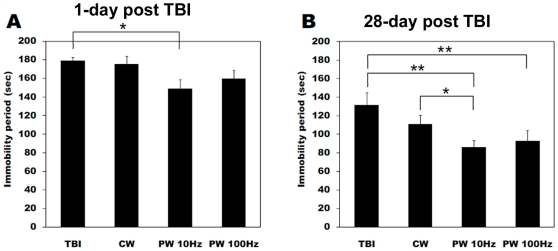
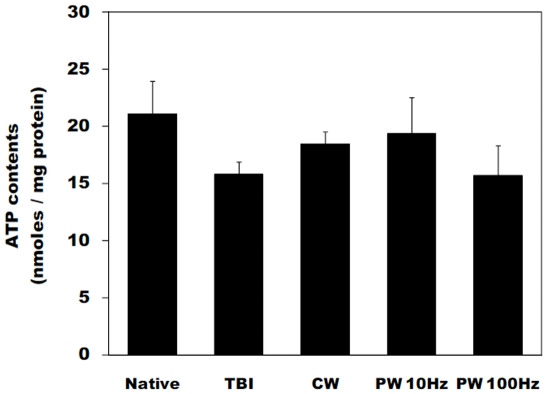
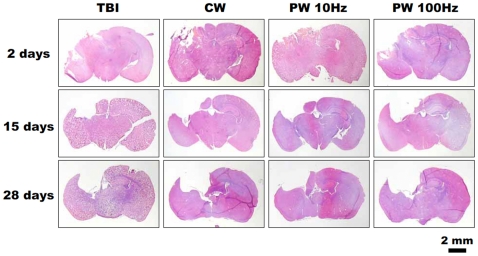
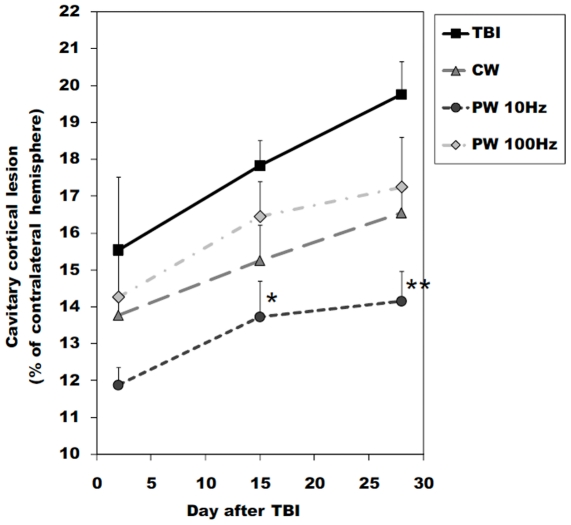
Study design/materials and methods: TBI was induced by a controlled cortical-impact device and 4-hours post-TBI 1-group received a sham treatment and 3-groups received a single exposure to transcranial LLLT, either continuous wave or pulsed at 10-Hz or 100-Hz with a 50% duty cycle. An 810-nm Ga-Al-As diode laser delivered a spot with diameter of 1-cm onto the injured head with a power density of 50-mW/cm(2) for 12-minutes giving a fluence of 36-J/cm(2). Neurological severity score (NSS) and body weight were measured up to 4 weeks. Mice were sacrificed at 2, 15 and 28 days post-TBI and the lesion size was histologically analyzed. The quantity of ATP production in the brain tissue was determined immediately after laser irradiation. We examined the role of LLLT on the psychological state of the mice at 1 day and 4 weeks after TBI using tail suspension test and forced swim test.
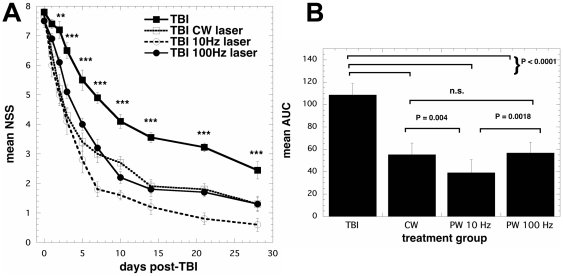
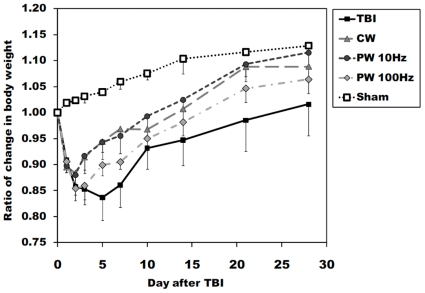
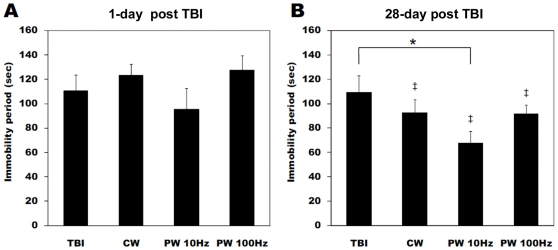
Results: The 810-nm laser pulsed at 10-Hz was the most effective judged by improvement in NSS and body weight although the other laser regimens were also effective. The brain lesion volume of mice treated with 10-Hz pulsed-laser irradiation was significantly lower than control group at 15-days and 4-weeks post-TBI. Moreover, we found an antidepressant effect of LLLT at 4-weeks as shown by forced swim and tail suspension tests.
Conclusion: The therapeutic effect of LLLT for TBI with an 810-nm laser was more effective at 10-Hz pulse frequency than at CW and 100-Hz. This finding may provide a new insight into biological mechanisms of LLLT.
Conflict of interest statement
Figures
References
-
- Thurman DJ, Alverson C, Dunn KA, Guerrero J, Sniezek JE. Traumatic brain injury in the United States: A public health perspective. J Head Trauma Rehabil. 1999;14:602–615. - PubMed
-
- Langlois JA, Rutland-Brown W, Thomas KE. The incidence of traumatic brain injury among children in the United States: differences by race. J Head Trauma Rehabil. 2005;20:229–238. - PubMed
-
- Finkelstein EA, Corso P, Miller TR. The incidence and economic burden of injuries in United States. 2006. Oxford University Press, Newyork, NY.
-
- Faul M, Wald MM, Rutland-Brown W, Sullivent EE, Sattin RW. Using a cost-benefit analysis to estimate outcomes of a clinical treatment guideline: testing theBrain Trauma Foundation guidelines for the treatment of severe traumatic brain injury. J Trauma. 2007;63:1271–1278. - PubMed
Publication types
MeSH terms
Substances
Grants and funding
LinkOut - more resources
Full Text Sources
Medical
