


Factors affecting infestation by Triatoma infestans in a rural area of the humid Chaco in Argentina: a multi-model inference approach
- PMID: 22028941
- PMCID: PMC3196485
- DOI: 10.1371/journal.pntd.0001349
Factors affecting infestation by Triatoma infestans in a rural area of the humid Chaco in Argentina: a multi-model inference approach
Abstract
Background: Transmission of Trypanosoma cruzi by Triatoma infestans remains a major public health problem in the Gran Chaco ecoregion, where understanding of the determinants of house infestation is limited. We conducted a cross-sectional study to model factors affecting bug presence and abundance at sites within house compounds in a well-defined rural area in the humid Argentine Chaco.
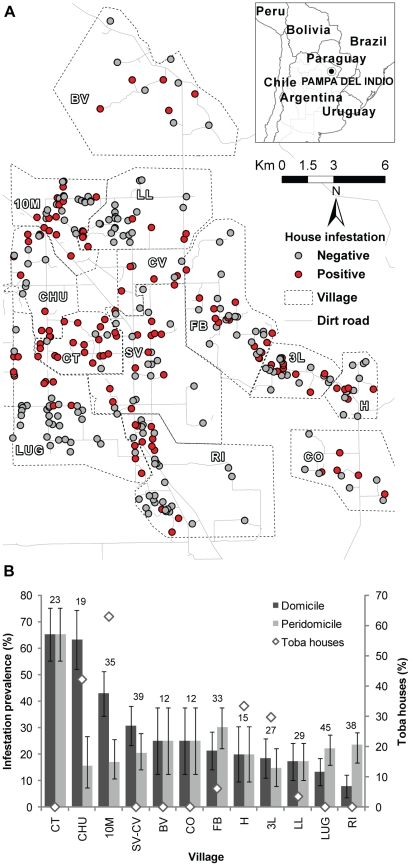
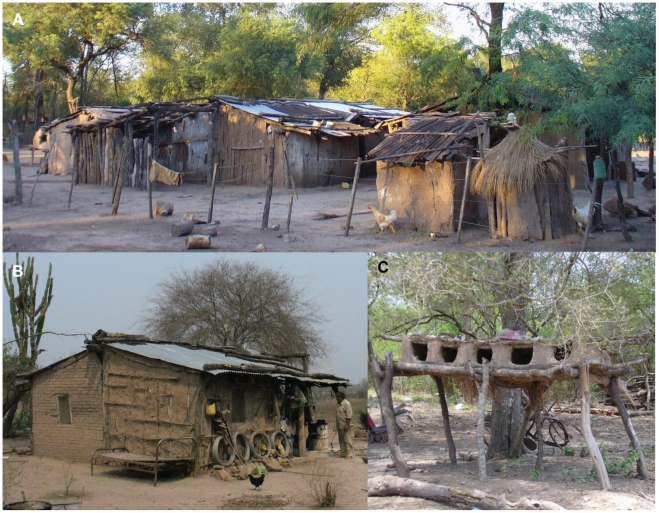
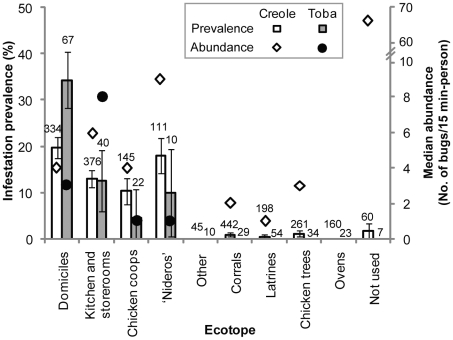
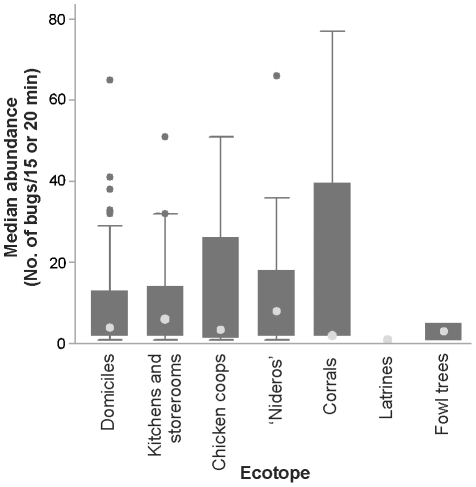
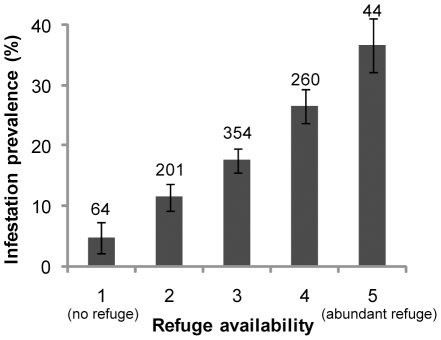
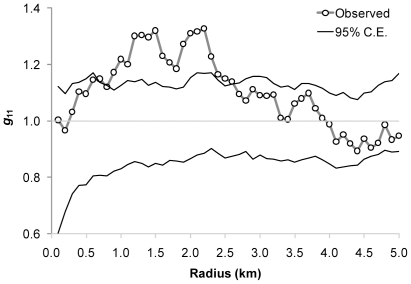
Methodology/principal findings: Triatoma infestans bugs were found in 45.9% of 327 inhabited house compounds but only in 7.4% of the 2,584 sites inspected systematically on these compounds, even though the last insecticide spraying campaign was conducted 12 years before. Infested sites were significantly aggregated at distances of 0.8-2.5 km. The most frequently infested ecotopes were domiciles, kitchens, storerooms, chicken coops and nests; corrals were rarely infested. Domiciles with mud walls and roofs of thatch or corrugated tarred cardboard were more often infested (32.2%) than domiciles with brick-and-cement walls and corrugated metal-sheet roofs (15.1%). A multi-model inference approach using Akaike's information criterion was applied to assess the relative importance of each variable by running all possible (17,406) models resulting from all combinations of variables. Availability of refuges for bugs, construction with tarred cardboard, and host abundance (humans, dogs, cats, and poultry) per site were positively associated with infestation and abundance, whereas reported insecticide use showed a negative association. Ethnic background (Creole or Toba) adjusted for other factors showed little or no association.
Conclusions/significance: Promotion and effective implementation of housing improvement (including key peridomestic structures) combined with appropriate insecticide use and host management practices are needed to eliminate infestations. Fewer refuges are likely to result in fewer residual foci after insecticide spraying, and will facilitate community-based vector surveillance. A more integrated perspective that considers simultaneously social, economic and biological processes at local and regional scales is needed to attain effective, sustainable vector and disease control.
Conflict of interest statement
The authors have declared that no competing interests exist.
Figures
References
-
- World Health Organization. Reporte sobre la enfermedad de Chagas. 2007. TDR/SWG/09.
-
- Briceño-León R, Méndez Galván J. The social determinants of Chagas disease and the transformations of Latin America. Mem Inst Oswaldo Cruz. 2007;102:109–112. - PubMed
-
- Panamerican Health Organization. XV Reunión de la Comisión Intergubernamental del Cono Sur para la Eliminación de Triatoma infestans y la Interrupción de la Transmisión de Tripanosomiasis Transfusional (INCOSUR-Chagas) (Brasilia, Brasil, 6–9 junio 2006). 2006. http://www.paho.org/spanish/ad/dpc/cd/dch-incosur-xv.htm.
-
- Schofield CF, Jannin J, Salvatella R. The future of Chagas disease control. Trends Parasitol. 2006;22:583–588. - PubMed
Publication types
MeSH terms
Substances
Grants and funding
LinkOut - more resources
Full Text Sources
Miscellaneous
