


Child abuse and neglect, MAOA, and mental health outcomes: a prospective examination
- PMID: 22030358
- PMCID: PMC3295575
- DOI: 10.1016/j.biopsych.2011.09.008
Child abuse and neglect, MAOA, and mental health outcomes: a prospective examination
Abstract
Background: Studies have examined the interaction of MAOA genotype with childhood maltreatment in relation to depressive symptomatology and alcohol abuse with conflicting findings. Both high- and low-activity allele combinations have been shown to be protective for maltreated children with direction of findings varying by study methodology and participants' sex.
Methods: Participants in a prospective cohort design study involving court-substantiated cases of child abuse and neglect and a matched comparison group were followed up into adulthood and interviewed (N = 802). Eighty-two percent consented to provide blood, 631 gave permission for DNA extraction and analyses, and 575 were included in the final sample. This sample included male, female, white, and nonwhite (primarily black) participants. Symptoms of dysthymia, major depression, and alcohol abuse were assessed using the National Institutes of Mental Health Diagnostic Interview Schedule-III-R.
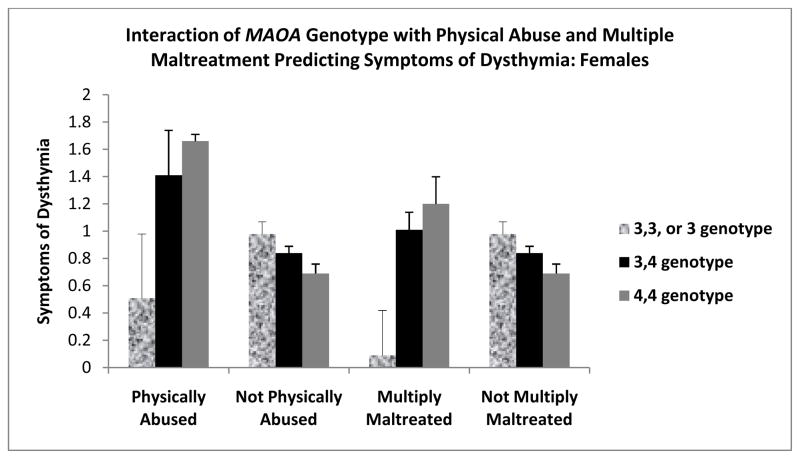
Results: Significant three-way interactions, MAOA genotype by abuse by sex, predicted dysthymic symptoms. Low-activity MAOA genotype buffered against symptoms of dysthymia in physically abused and multiply-maltreated women. Significant three-way interactions, MAOA genotype by sexual abuse by race, predicted all outcomes. Low-activity MAOA genotype buffered against symptoms of dysthymia, major depressive disorder, and alcohol abuse for sexually abused white participants. The high-activity genotype was protective in the nonwhite sexually abused group.
Conclusions: This prospective study provides evidence that MAOA interacts with child maltreatment to predict mental health outcomes. Reasons for sex differences and race findings are discussed.
Copyright © 2012 Society of Biological Psychiatry. Published by Elsevier Inc. All rights reserved.
Figures

Comment in
-
Child abuse and psychiatric illness.Biol Psychiatry. 2012 Feb 15;71(4):280-1. doi: 10.1016/j.biopsych.2011.12.006. Biol Psychiatry. 2012. PMID: 22265025 Free PMC article. No abstract available.
References
-
- Widom CS, DuMont KA, Czaja SJ. A prospective investigation of major depressive disorder and comorbidity in abused and neglected children grown up. Arch Gen Psychiatry. 2007;64:176–187. - PubMed
-
- Libby AM, Orton HD, Novis DK, Beals J, Manson SM Al SUPERPFP Team. Childhood physical and sexual abuse and subsequent depressive and anxiety disorders for two American Indian tribes. Psychol Med. 2005;35:329–340. - PubMed
-
- Gibb BE, Butler AC, Beck JS. Childhood abuse, depression, and anxiety in adult psychiatric outpatients. Depress Anxiety. 2003;17:226–228. - PubMed
-
- Brown GR, Anderson B. Psychiatric morbidity in adult inpatients with childhood histories of sexual and physical abuse. Am J Psychiatry. 1991;148:55–61. - PubMed
-
- Kessler RC, Crum RM, Warner LA, Nelson CB. Lifetime co-occurrence of DSM-III-R alcohol abuse and dependence with other psychiatric disorders in the National Comorbidity Survey. Arch Gen Psychiatry. 1997;54:313–321. - PubMed
MeSH terms
Substances
Grants and funding
LinkOut - more resources
Full Text Sources
Medical
