


Methicillin-resistant Staphylococcus aureus (MRSA) pyruvate kinase as a target for bis-indole alkaloids with antibacterial activities
- PMID: 22030393
- PMCID: PMC3248012
- DOI: 10.1074/jbc.M111.289033
Methicillin-resistant Staphylococcus aureus (MRSA) pyruvate kinase as a target for bis-indole alkaloids with antibacterial activities
Abstract
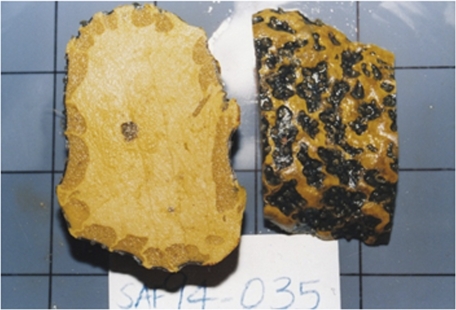
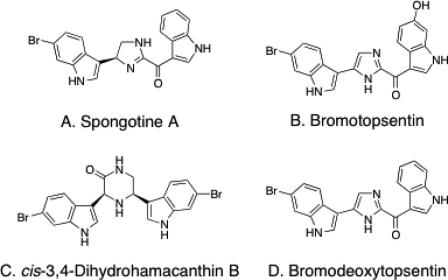
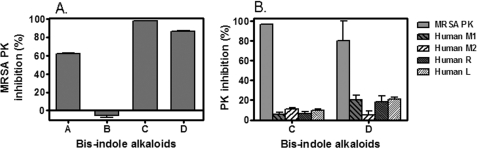
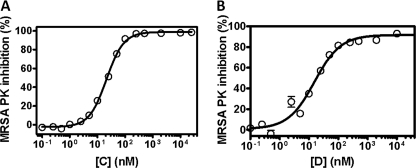
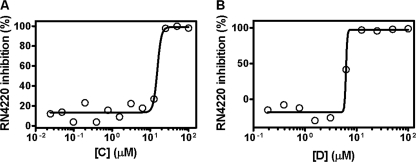
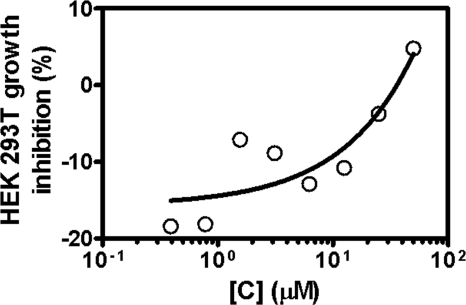
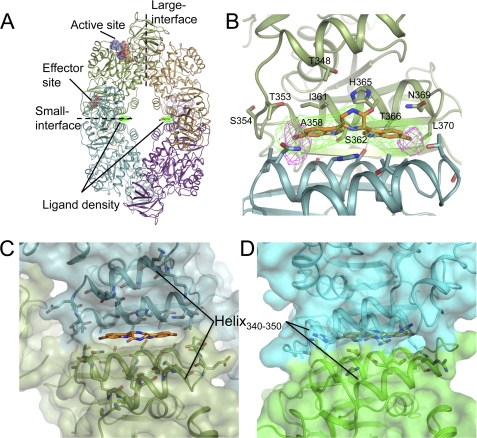
Novel classes of antimicrobials are needed to address the emergence of multidrug-resistant bacteria such as methicillin-resistant Staphylococcus aureus (MRSA). We have recently identified pyruvate kinase (PK) as a potential novel drug target based upon it being an essential hub in the MRSA interactome (Cherkasov, A., Hsing, M., Zoraghi, R., Foster, L. J., See, R. H., Stoynov, N., Jiang, J., Kaur, S., Lian, T., Jackson, L., Gong, H., Swayze, R., Amandoron, E., Hormozdiari, F., Dao, P., Sahinalp, C., Santos-Filho, O., Axerio-Cilies, P., Byler, K., McMaster, W. R., Brunham, R. C., Finlay, B. B., and Reiner, N. E. (2011) J. Proteome Res. 10, 1139-1150; Zoraghi, R., See, R. H., Axerio-Cilies, P., Kumar, N. S., Gong, H., Moreau, A., Hsing, M., Kaur, S., Swayze, R. D., Worrall, L., Amandoron, E., Lian, T., Jackson, L., Jiang, J., Thorson, L., Labriere, C., Foster, L., Brunham, R. C., McMaster, W. R., Finlay, B. B., Strynadka, N. C., Cherkasov, A., Young, R. N., and Reiner, N. E. (2011) Antimicrob. Agents Chemother. 55, 2042-2053). Screening of an extract library of marine invertebrates against MRSA PK resulted in the identification of bis-indole alkaloids of the spongotine (A), topsentin (B, D), and hamacanthin (C) classes isolated from the Topsentia pachastrelloides as novel bacterial PK inhibitors. These compounds potently and selectively inhibited both MRSA PK enzymatic activity and S. aureus growth in vitro. The most active compounds, cis-3,4-dihyrohyrohamacanthin B (C) and bromodeoxytopsentin (D), were identified as highly potent MRSA PK inhibitors (IC(50) values of 16-60 nM) with at least 166-fold selectivity over human PK isoforms. These novel anti-PK natural compounds exhibited significant antibacterial activities against S. aureus, including MRSA (minimal inhibitory concentrations (MIC) of 12.5 and 6.25 μg/ml, respectively) with selectivity indices (CC(50)/MIC) >4. We also report the discrete structural features of the MRSA PK tetramer as determined by x-ray crystallography, which is suitable for selective targeting of the bacterial enzyme. The co-crystal structure of compound C with MRSA PK confirms that the latter is a target for bis-indole alkaloids. It elucidates the essential structural requirements for PK inhibitors in "small" interfaces that provide for tetramer rigidity and efficient catalytic activity. Our results identified a series of natural products as novel MRSA PK inhibitors, providing the basis for further development of potential novel antimicrobials.
Figures
References
-
- Cherkasov A., Hsing M., Zoraghi R., Foster L. J., See R. H., Stoynov N., Jiang J., Kaur S., Lian T., Jackson L., Gong H., Swayze R., Amandoron E., Hormozdiari F., Dao P., Sahinalp C., Santos-Filho O., Axerio-Cilies P., Byler K., McMaster W. R., Brunham R. C., Finlay B. B., Reiner N. E. (2011) J. Proteome Res. 10, 1139–1150 - PubMed
-
- Zoraghi R., See R. H., Axerio-Cilies P., Kumar N. S., Gong H., Moreau A., Hsing M., Kaur S., Swayze R. D., Worrall L., Amandoron E., Lian T., Jackson L., Jiang J., Thorson L., Labriere C., Foster L., Brunham R. C., McMaster W. R., Finlay B. B., Strynadka N. C., Cherkasov A., Young R. N., Reiner N. E. (2011) Antimicrob. Agents Chemother. 55, 2042–2053 - PMC - PubMed
-
- Pathania R., Brown E. D. (2008) Biochem. Cell Biol. 86, 111–115 - PubMed
-
- Zoraghi R., See R. H., Gong H., Lian T., Swayze R., Finlay B. B., Brunham R. C., McMaster W. R., Reiner N. E. (2010) Biochemistry 49, 7733–7747 - PubMed
-
- Fraser H. B., Hirsh A. E., Steinmetz L. M., Scharfe C., Feldman M. W. (2002) Science 296, 750–752 - PubMed
Publication types
MeSH terms
Substances
Associated data
- Actions
- Actions
LinkOut - more resources
Full Text Sources
Medical
Miscellaneous
