


Review
doi: 10.1126/scitranslmed.3002944.
From DNA to targeted therapeutics: bringing synthetic biology to the clinic
Affiliations
- PMID: 22030748
- PMCID: PMC3285276
- DOI: 10.1126/scitranslmed.3002944
Item in Clipboard
Review
From DNA to targeted therapeutics: bringing synthetic biology to the clinic
Sci Transl Med.
.
Abstract
Synthetic biology aims to make biological engineering more scalable and predictable, lowering the cost and facilitating the translation of synthetic biological systems to practical applications. Increasingly sophisticated, rationally designed synthetic systems that are capable of complex functions pave the way to translational applications, including disease diagnostics and targeted therapeutics. Here, we provide an overview of recent developments in synthetic biology in the context of translational research and discuss challenges at the interface between synthetic biology and clinical medicine.
Figures

Synthetic biology uses both natural and engineered biological components to construct genetic circuits that generate desired functional outputs in response to specified input signals. Synthetic biological systems have achieved various functions with translational potential, including initiating cell apoptosis in response to endogenous proteins such as β-catenin (6); discriminating cancer (HeLa) cells from other cell types (7); and controlling T cell proliferation in vivo using small-molecule drugs (8). PCMV, cytomegalovirus (CMV) promoter; PTRE, tetracycline-responsive promoter; PCAGop, CMV early enhancer element combined with chicken β-actin promoter followed by an intron with two LacO sites; PEF1α, elongation factor 1α promoter. CREDIT: B. STRAUCH/SCIENCE TRANSLATIONAL MEDICINE
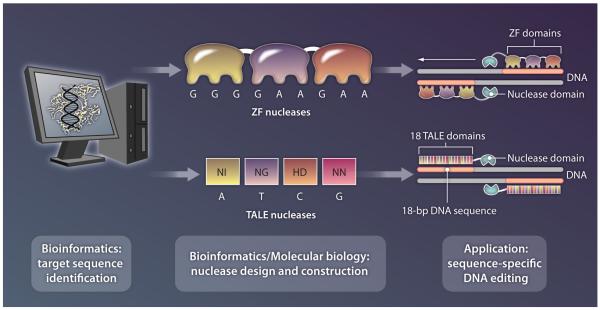
Emerging genetic engineering technologies enable site-specific integration of synthetic elements. ZFs and TALEs can be rationally designed to bind specific DNA sequences that have been identified through bioinformatics as targets of interest. Several computational algorithms have been developed to aid in the design of ZFs (23-26). TALEs follow well-defined rules such that specific amino acid pairs (NI, NG, HD, and NN) in the TALE sequence define the respective DNA base (A, T, C, and G) to be recognized. When coupled to nucleases, pairs of ZFs and TALEs bind to DNA to enable nuclease domain dimerization, site-specific cleavage of double-stranded DNA, and precise insertion of transgenic elements into target chromosomal locations. CREDIT: B. STRAUCH/SCIENCE TRANSLATIONAL MEDICINE
References
-
- Endy D. Foundations for engineering biology. Nature. 2005;438:449–453. doi:10.1038/nature04342 Medline. - PubMed
-
- Canton B, Labno A, Endy D. Refinement and standardization of synthetic biological parts and devices. Nat. Biotechnol. 2008;26:787–793. doi:10.1038/nbt1413 Medline. - PubMed
-
- Purnick PE, Weiss R. The second wave of synthetic biology: From modules to systems. Nat. Rev. Mol. Cell Biol. 2009;10:410–422. doi:10.1038/nrm2698 Medline. - PubMed
Publication types
MeSH terms
Substances
Grants and funding
LinkOut - more resources
Full Text Sources
