. 2012 Jan;20(1):119-26.
doi: 10.1038/mt.2011.232. Epub 2011 Oct 25.

Bifunctional RNAs targeting the intronic splicing silencer N1 increase SMN levels and reduce disease severity in an animal model of spinal muscular atrophy

Affiliations

Bifunctional RNAs targeting the intronic splicing silencer N1 increase SMN levels and reduce disease severity in an animal model of spinal muscular atrophy

Erkan Y Osman et al. Mol Ther. 2012 Jan.

Abstract

Spinal muscular atrophy (SMA) is a neurodegenerative disease caused by loss of survival motor neuron-1 (SMN1). A nearly identical copy gene, SMN2, is present in all SMA patients. Although the SMN2 coding sequence has the potential to produce full-length SMN, nearly 90% of SMN2-derived transcripts are alternatively spliced and encode a truncated protein. SMN2, however, is an excellent therapeutic target. Previously, we developed antisense-based oligonucleotides (bifunctional RNAs) that specifically recruit SR/SR-like splicing factors and target a negative regulator of SMN2 exon-7 inclusion within intron-6. As a means to optimize the antisense sequence of the bifunctional RNAs, we chose to target a potent intronic repressor downstream of SMN2 exon 7, called intronic splicing silencer N1 (ISS-N1). We developed RNAs that specifically target ISS-N1 and concurrently recruit the modular SR proteins SF2/ASF or hTra2β1. RNAs were directly injected in the brains of SMA mice. Bifunctional RNA injections were able to elicit robust induction of SMN protein in the brain and spinal column of neonatal SMA mice. Importantly, hTra2β1-ISS-N1 and SF2/ASF-ISS-N1 bifunctional RNAs significantly extended lifespan and increased weight in the SMNΔ7 mice. This technology has direct implications for SMA therapy and provides similar therapeutic strategies for other diseases caused by aberrant splicing.


Figures

Figure 1
Figure 1
Schematic representation of specific bifunctional RNAs targeting intronic splicing silencer N1 (ISS-N1). The organization of the bifunctional RNA is illustrated with the antisense domain targeting the sequences of the ISS-N1 repressor; with high-affinity exonic splice enhancer sequences for either transformer-2 protein homolog β (hTra2β1) or splicing factor2/alternative splicing factor (SF2/ASF). The ISS-N1 bifunctional RNAs have an uninterrupted antisense specific for ISS-N1 with an additional six nucleotides downstream to ensure coverage of the negative region. In addition the RNA has a linked domain that contains triplicate exonic splicing enhancer (ESE) recruitment domains (data not shown).
Figure 2
Figure 2
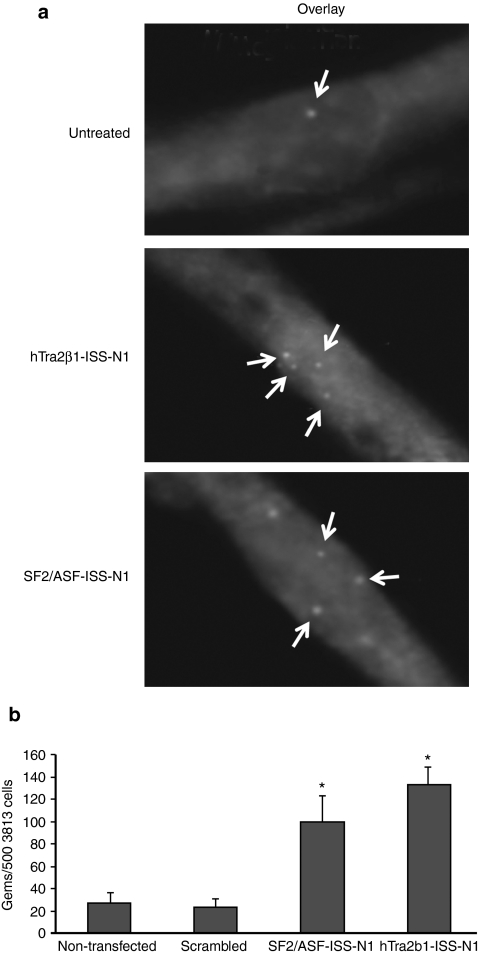
2′-O-Methyl bifunctional RNAs increase survival motor neuron (SMN) protein and gem number in patient fibroblasts. (a) Spinal muscular atrophy (SMA) patient fibroblasts (3,813 cells) were transiently transfected with 100 ng of hTra2β1-ISS-N1 and SF2/ASF-ISS-N1 2′-O-methyl bifunctional RNAs for 48 hours. Representative cells after immunofluorescence (IMF) staining. 3,813 cells are shown in the top row as positive control staining (b) 500 3,813 cells were randomly counted (n = 3) and total gem number determined. ISS-N1, intronic splicing silencer N1.
Figure 3
Figure 3
Injection of 2′-O-methyl bifunctional RNAs targeting the intronic splicing silencer N1 (ISS-N1) repressor increase total survival motor neuron (SMN) protein in the SMNΔ7 mouse model. Intracerebroventricular (ICV) injections of hTra2β1-ISS-N1 and SF2/ASF-ISS-N1 2′-O-methyl bifunctional RNAs increase SMN protein levels in (a) brain and (b) spinal cord. Western blots (n = 5) for each treatment group were performed on brain and spinal cord at PND6 and the fold increase in SMN protein induction was compared to the nontreated group (n = 5).
Figure 4
Figure 4
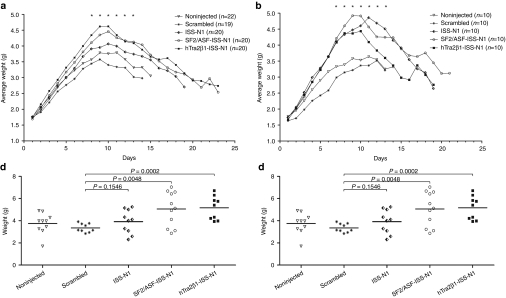
Bifunctional RNAs injected animals were heavier than untreated spinal muscular atrophy (SMA) controls starting at PND6. Intracerebroventricular (ICV) injections of 2′-O-methyl intronic splicing silencer N1 (ISS-N1) bifunctional RNAs into SMNΔ7 mice on PND1, PND3 and PND5. (a) Total body weight was measured daily for noninjected, scrambled RNA, ISS-N1, SF2/ASF-ISS-N1, and hTra2β1-ISS-N1 injected mice with oligo concentration of 1 µg/µl. (b) Spinal muscular atrophy (SMA) animals injected with the same bifunctional RNAs and controls with an oligo concentration of 10 µg/µl. Mice were weighed daily after injection. Days with significant weight gain are indicated with (*). (c) Individual weights on PND11 for all animals treated with 1 µg/µl of 2′-O-methyl ISS-N1 bifunctional RNAs. Student's t-test was used to compare each group against the scrambled control: ISS-N1 P = 0.0262; SF2/ASF P = 0.005; hTra2β1-ISS-N1 P = 0.0021. (d) Individual weights on PND11 for animals treated with 10 µg/µl of 2′-O-methyl ISS-N1 bifunctional RNAs. Student's t-test comparing each group against the scrambled control: ISS-N1 P = 0.1546; SF2/ASF P = 0.0048; hTra2β1-ISS-N1 P = 0.0002. SMN, survival motor neuron
Figure 5
Figure 5
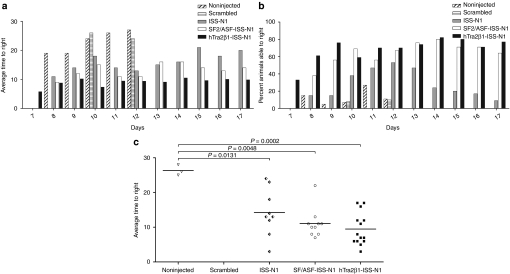
Overall fitness was assessed by the ability of the mice to right themselves from a prone position. (a) Graph representing raw data of the average time to right from PND7 to PND17. Animals injected with the hTra2β1-ISS-N1 and SF2/ASF-ISS-N1 bifunctional RNAs were able to right themselves within 10 and 15 seconds, respectively. (b) Graph representing the fraction of animals able to right themselves within 30 seconds measured from PND7 to PND17. Treated spinal muscular atrophy (SMA) mice performed considerably better than negative control and untreated SMA mice. (c) Scatter plot of time-to-right (TTR) performance of mice injected with hTra2β1-ISS-N1 bifunctional RNA. To highlight the performance of individual mice, TTR values are shown for PND11 All three treatment groups outperformed the noninjected controls (Student's t-test ISS-N1 P = 0.0131; SF2/ASF P = 0.0001; hTra2β1-ISS-N1 P = 0.0001). ISS-N1 intronic splicing silencer N1.
Figure 6
Figure 6
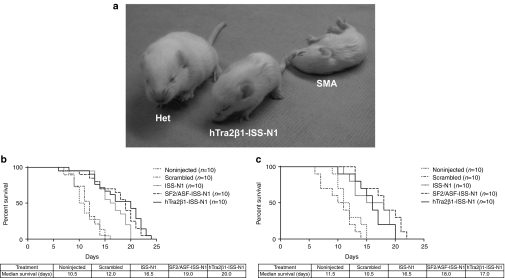
SMNΔ7 mice showed significant improvement in survival and motor function tests after intracerebroventricular (ICV) injections with bifunctional RNA oligonucleotides. (a) The treated spinal muscular atrophy (SMA) animal (labeled “Tra2-ISS-N1”) and the untreated heterozygous littermate (labeled “Het”) were able to right themselves within 10 seconds and to consistently ambulate compared to the untreated SMA pup (labeled “SMA”) at PND10. (b, c) Bifunctional RNA treatment increased longevity of SMNΔ7 mice. Kaplan–Meier survival curves were constructed from the various treatment groups as indicated. Log-rank (Mantel–Cox) statistics were applied for comparisons between groups. [(b) (1 µg/µl) For all tested groups survival of noninjected versus intronic splicing silencer N1 (ISS-N1), SF2/ASF-ISS-N1, and hTra2β1-ISS-N1 P < 0.0001; Survival of: ISS-N1 versus SF2/ASF-ISS-N1 P = 0.06; ISS-N1 versus hTra2β1-ISS-N1 P = 0.01; (c) (10 µg/µl) Survival of noninjected versus ISS-N1 P < 0.006; noninjected versus SF2/ASF-ISS-N1 P < 0.0005; Noninjected versus hTra2β1-ISS-N1 P < 0.002; ISS-N1 versus SF2/ASF-ISS-N1 P = 0.16; ISS-N1 versus hTra2β1-ISS-N1 P = 0.85]. The survival curves depict a significant increase in life expectancy for SF2/ASF-ISS-N1 and hTra2β1-ISS-N1 injected animals with increases in median survival for both treatment concentrations [(b) 1 µg/µl or (c) 10 µg/µl]. SMN, survival motor neuron.

References

    1. Crawford TO., and, Pardo CA. The neurobiology of childhood spinal muscular atrophy. Neurobiol Dis. 1996;3:97–110. - PubMed
    1. Feldkötter M, Schwarzer V, Wirth R, Wienker TF., and, Wirth B. Quantitative analyses of SMN1 and SMN2 based on real-time lightCycler PCR: fast and highly reliable carrier testing and prediction of severity of spinal muscular atrophy. Am J Hum Genet. 2002;70:358–368. - PMC - PubMed
    1. Lorson CL, Rindt H., and, Shababi M. Spinal muscular atrophy: mechanisms and therapeutic strategies. Hum Mol Genet. 2010;19 R1:R111–R118. - PMC - PubMed
    1. Kernochan LE, Russo ML, Woodling NS, Huynh TN, Avila AM, Fischbeck KH.et al. (2005The role of histone acetylation in SMN gene expression Hum Mol Genet 141171–1182. - PubMed
    1. Passini MA, Bu J, Roskelley EM, Richards AM, Sardi SP, O'Riordan CR.et al. (2010CNS-targeted gene therapy improves survival and motor function in a mouse model of spinal muscular atrophy J Clin Invest 1201253–1264. - PMC - PubMed

Publication types

Substances