A feasibility trial of a cognitive-behavioural symptom management program for chronic pelvic pain for men with refractory chronic prostatitis/chronic pelvic pain syndrome
- PMID: 22031613
- PMCID: PMC3202005
- DOI: 10.5489/cuaj.10201
A feasibility trial of a cognitive-behavioural symptom management program for chronic pelvic pain for men with refractory chronic prostatitis/chronic pelvic pain syndrome
Abstract
Background: Our objective was to determine the feasibility of a cognitive behavioural symptom management program for the acute improvement of psychosocial risk factors of diminished quality of life (QoL) in men suffering from chronic prostatitis/chronic pelvic pain syndrome (CP/CPPS).
Materials and methods: We assessed CP/CPPS symptoms and impact (i.e., chronic prostatitis symptom index [CPSI] pain, urinary, QoL domains), psychosocial risk factors were assessed at baseline and weekly for 8 weeks. We included the following psychosocial risk factors: catastrophizing (Pain Catastrophizing Scale, PCS), mood (Center for Epidemiological Studies in Depression Scale, CES-D), social support (Multidimensional Scale of Perceived Social Support, MSPSS) and general pain (McGill Pain Questionnaire). Patient sessions dispute and replace pessimistic thinking with health-focused thinking and behaviour.
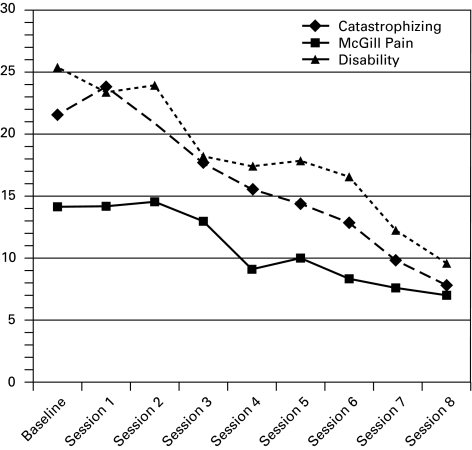
Results: Eleven men completed the psychosocial management program (mean age = 51.3, standard deviaton [SD] = 12.49). Mean CPSI baseline total score was 25.2 (SD = 10.21). Repeated measures ANOVAs showed the program was associated with significant linear reductions for pain (p = 0.051), disability (p= 0.020) and catastrophizing (p = 0.005), but no changes in depressive symptoms or social support. The CPSI baseline scores compared to follow-up scores (n = 8) were significantly reduced (p = 0.007), with CPSI pain (p = 0.015) and QoL impact (p = 0.013) reduced, but not for urinary scores. Correlations between change scores at the baseline and at 8 weeks for CPSI and psychosocial risk factors indicated that reductions in catastrophizing were most strongly associated with score reductions for the CPSI; these reductions, however, were not significant.
Conclusions: The psychosocial management program targets and significantly reduces several empirically supported psychosocial risk factors associated with poorer CP/CPPS outcomes. Psychosocial management for CP/CPPS is feasible, but requires a randomized controlled trial with longitudinal follow-up.
Figures
Comment in
- Can Urol Assoc J. 5(5):333.
References
-
- Schaeffer AJ, Landis JR, Knauss JS, et al. Demographic and clinical characteristics of men with chronic prostatitis: The NIH chronic prostatitis cohort (CPC) study. J Urol. 2002;168:593–8. - PubMed
-
- Calhoun EA, McNaughton-Collins M, Pontari MA, et al. Chronic Prostatitis Collaborative Research Network: The economic impact of chronic prostatitis. Arch Intern Med. 2004;164:1231–6. - PubMed
-
- Krieger JN, Riley DE, Cheah PY, et al. Epidemiology of prostatitis: new evidence for a world-wide problem. World J Urol. 2003;21:70–4. - PubMed
-
- Tripp DA, Nickel JC, Ross S, et al. Prevalence, Symptom Impact and Predictors of Prostatitis-like Symptoms in North American Males aged 16–19 years. BJU Int. 2008;103:1080–4. - PubMed
-
- Wenninger K, Heiman JR, Rothman I, et al. Sickness impact of chronic nonbacterial prostatitis and its correlates. J Urol. 1996;155:965–96. - PubMed
LinkOut - more resources
Full Text Sources
Miscellaneous