


Randomized Controlled Trial
doi: 10.1523/JNEUROSCI.2002-11.2011.
Random noise stimulation improves neuroplasticity in perceptual learning
Affiliations
- PMID: 22031888
- PMCID: PMC6703532
- DOI: 10.1523/JNEUROSCI.2002-11.2011
Item in Clipboard
Randomized Controlled Trial
Random noise stimulation improves neuroplasticity in perceptual learning
J Neurosci.
.
Abstract
Perceptual learning is considered a manifestation of neural plasticity in the human brain. We investigated brain plasticity mechanisms in a learning task using noninvasive transcranial electrical stimulation (tES). We hypothesized that different types of tES would have varying actions on the nervous system, which would result in different efficacies of neural plasticity modulation. Thus, the principal goal of the present study was to verify the possibility of inducing differential plasticity effects using two tES approaches [i.e., direct current stimulation (tDCS) and random noise stimulation (tRNS)] during the execution of a visual perceptual learning task.
Figures
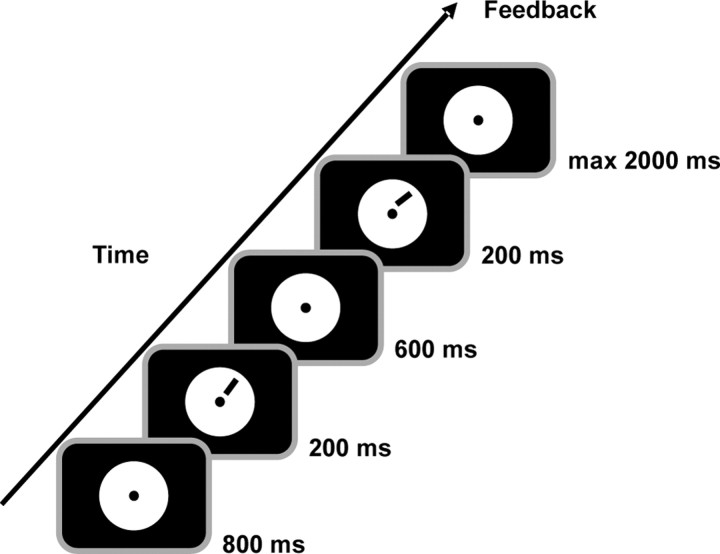
Trial structure. Example of an orientation discrimination task trial with the reference and target stimuli presented in the upper right hemifield.
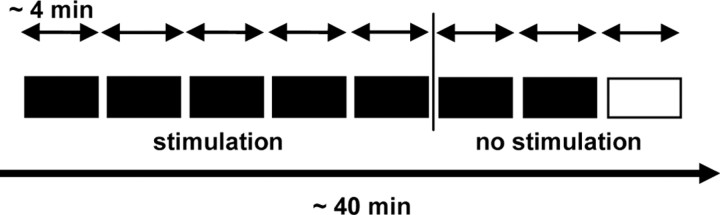
Experimental procedure. The main experiment was designed to be between subjects with six stimulation conditions: hf-tRNS, lf-tRNS, a-tDCS, c-tDCS, sham, and Cz. Subjects received the stimulation only in the first five blocks. The last block was a fictitious block (white represented); data from this block were not analyzed.
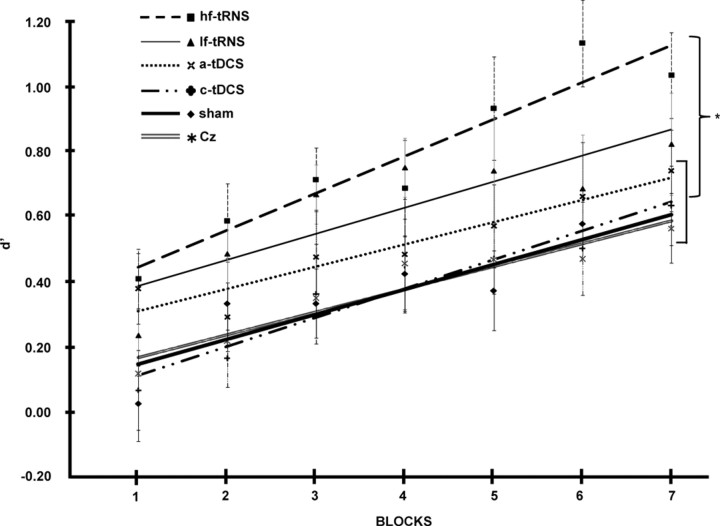
Main experiment results. Data are represented as the mean ± SEM. The lines represent the fit of each condition: the broken line corresponds to hf-tRNS, the continuous thin line corresponds to lf-tRNS, the dotted line represents a-tDCS, the mixed dotted-broken line represents c-tDCS, the continuous thick line corresponds to sham, and the double gray line represents Cz stimulation. The asterisk near the curly bracket indicates the statistically significant differences between hf-tRNS and the conditions in the square bracket (p < 0.05).

Control-hf-tRNS experiment results compared with main experiment hf-tRNS and sham groups. Data of control-hf-tRNS group are represented as the mean ± SEM. The lines represent the fit of each condition: the thick dashed line corresponds to control-hf-tRNS, the thin dashed line corresponds to hf-tRNS, and the continuous thick line corresponds to sham. The asterisk near the curly bracket indicates the statistically significant differences between both control-hf-tRNS and sham (p < 0.05) and hf-tRNS and sham (p < 0.05).
References
-
- Accornero N, Li Voti P, La Riccia M, Gregori B. Visual evoked potentials modulation during direct current cortical polarization. Exp Brain Res. 2007;178:261–266. - PubMed
-
- Ambrus GG, Paulus W, Antal A. Cutaneous perception thresholds of electrical stimulation methods: comparison of tDCS and tRNS. Clin Neurophysiol. 2010;121:1908–1914. - PubMed
-
- Antal A, Paulus W. Transcranial direct current stimulation and visual perception. Perception. 2008;37:367–374. - PubMed
-
- Antal A, Nitsche MA, Paulus W. External modulation of visual perception in humans. Neuroreport. 2001;12:3553–3555. - PubMed
-
- Antal A, Kincses TZ, Nitsche MA, Paulus W. Manipulation of phosphene thresholds by transcranial direct current stimulation in man. Exp Brain Res. 2003a;150:375–378. - PubMed
Publication types
MeSH terms
LinkOut - more resources
Full Text Sources
Other Literature Sources
Medical
