


Contributions of Rad9 to tumorigenesis
- PMID: 22034047
- PMCID: PMC3264844
- DOI: 10.1002/jcb.23424
Contributions of Rad9 to tumorigenesis
Abstract
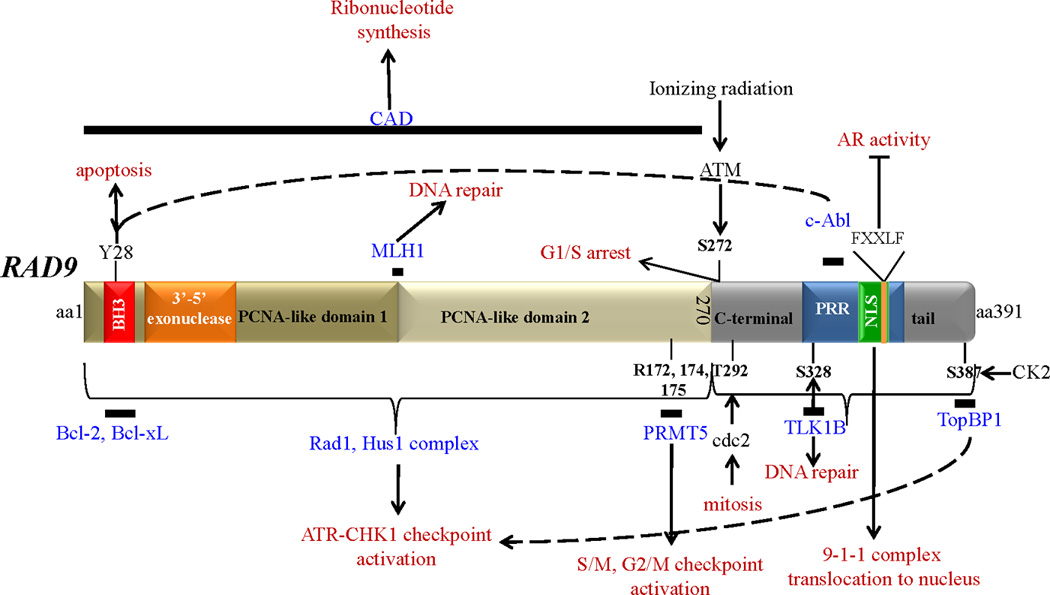
Rad9 plays a crucial role in maintaining genomic stability by regulating cell cycle checkpoints, DNA repair, telomere stability, and apoptosis. Rad9 controls these processes mainly as part of the heterotrimeric 9-1-1 (Rad9-Hus1-Rad1) complex. However, in recent years it has been demonstrated that Rad9 can also act independently of the 9-1-1 complex as a transcriptional factor, participate in immunoglobulin class switch recombination, and show 3'-5' exonuclease activity. Aberrant Rad9 expression has been associated with prostate, breast, lung, skin, thyroid, and gastric cancers. High expression of Rad9 is causally related to, at least, human prostate cancer growth. On the other hand, deletion of Mrad9, the mouse homolog, is responsible for increased skin cancer incidence. These results reveal that Rad9 can act as an oncogene or tumor suppressor. Which of the many functions of Rad9 are causally related to initiation and progression of tumorigenesis and the mechanistic details by which Rad9 induces or suppresses tumorigenesis are presently not known, but are crucial for the development of targeted therapeutic interventions.
Copyright © 2011 Wiley Periodicals, Inc.
Figures
References
-
- Bao S, Lu T, Wang X, Zheng H, Wang LE, Wei Q, Hittelman WN, Li L. Disruption of the Rad9/Rad1/Hus1 (9-1-1) complex leads to checkpoint signaling and replication defects. Oncogene. 2004;23:5586–5593. - PubMed
-
- Bessho T, Sancar A. Human DNA damage checkpoint protein hRAD9 is a 3' to 5' exonuclease. J Biol Chem. 2000;275:7451–7454. - PubMed
Publication types
MeSH terms
Substances
Grants and funding
LinkOut - more resources
Full Text Sources
Research Materials
