Review
. 2011 Dec;44(3):426-40.
doi: 10.1007/s12035-011-8213-1. Epub 2011 Oct 30.

Neurexins and neuroligins: recent insights from invertebrates

Affiliations
Review

Neurexins and neuroligins: recent insights from invertebrates

David Knight et al. Mol Neurobiol. 2011 Dec.

Abstract

During brain development, each neuron must find and synapse with the correct pre- and postsynaptic partners. The complexity of these connections and the relatively large distances some neurons must send their axons to find the correct partners makes studying brain development one of the most challenging, and yet fascinating disciplines in biology. Furthermore, once the initial connections have been made, the neurons constantly remodel their dendritic and axonal arbours in response to changing demands. Neurexin and neuroligin are two cell adhesion molecules identified as important regulators of this process. The importance of these genes in the development and modulation of synaptic connectivity is emphasised by the observation that mutations in these genes in humans have been associated with cognitive disorders such as Autism spectrum disorders, Tourette syndrome and Schizophrenia. The present review will discuss recent advances in our understanding of the role of these genes in synaptic development and modulation, and in particular, we will focus on recent work in invertebrate models, and how these results relate to studies in mammals.


Figures
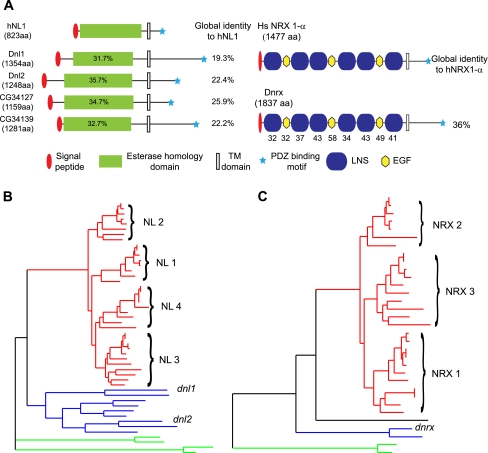
Fig. 1
Fig. 1
Neurexin and neuroligin structure, function and evolution. A Domain structure of Drosophila neuroligins and neurexin compared to human neuroligin 1 and neurexin 1-α. The conservation of individual protein domains between Drosophila homologues and the human gene are given as a % identity. The global conservation is listed to the right side of each homologue. B Phylogenetic tree of neuroligin sequences from multiple species. Red branches indicate neuroligin sequences in vertebrates, blue branches indicate neuroligin sequences in insects and green branches indicate neuroligin sequences in worms. This tree was adapted from tree TF326187 (available at http://www.treefam.org). As seen from this tree, neuroligin sequences diversified independently in insects and vertebrates from a common ancestral neuroligin sequence. Branches corresponding to the four neuroligin genes in vertebrates and the two characterised neuroligin genes in Drosophila are indicated. C Phylogenetic tree of neurexin sequences from multiple species. Red branches indicate neurexin sequences in vertebrates, blue branches indicate neurexin sequences in insects and green branches indicate neurexin sequences in worms. This tree was adapted from tree TF32103 (available at http://www.treefam.org). Neurexin sequences have shown less diversification in insects than vertebrates. Branches corresponding to the three neurexin genes in vertebrates and the Drosophila dnrx gene are indicated
Fig. 2
Fig. 2
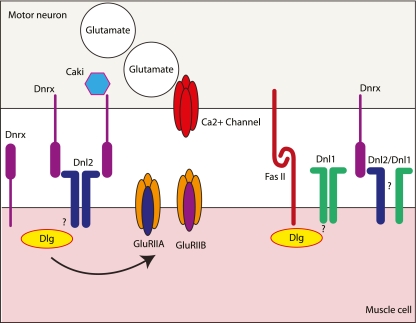
Model of known and potential interactions involving neurexin and neuroligin at the Drosophila neuromuscular junction. Dnl1 and Dnl2 are expressed in the postsynaptic muscle while Dnrx is expressed in the presynaptic neurons. Dnrx has also been shown to be present in the muscle during embyrogenisis. Based on their similarity to mammalian neuroligins, it seems likely that the Drosophila neuroligins form dimers, although this remains to be shown directly. Whether Drosophila neuroligins form exclusively as homodimers or as heterodimers (as shown for Dnl1/Dnl2) remains to be determined. Dnl2 forms a complex with Dnrx in vivo while the same has not been shown for Dnl1. Compelling evidence does exist however to suggest that dnrx complements dnl1 function (see text for details). In the presynaptic terminal, Dnrx has been shown to interact with Caki, a Drosophila homologue of mammalian CASK. Mammalian neuroligins have been shown to interact with PSD-95 at excitatory synapses. Based on their similarity to mammalian neuroligins, we would predict that the Drosophila neuroligins may also interact with discs large (Dlg), the Drosophila homologue of PSD-95, although this remains to be shown experimentally. Dlg is known to bind to the homophilic cell adhesion molecule Fascicilin II (FasII) and regulate both presynaptic morphology and postsynaptic membrane organisation. Dlg also regulates the size of postsynaptic glutamate receptor (GluR) patches and the subunit composition of GluRs. As is the case for mammalian neurexins and neuroligins, both Dnrx and the Drosophila neuroligins are likely involved in many other interactions at the NMJ, but further work will be required to elucidate these interactions

References

    1. Chih B, Engelman H, Scheiffele P. Control of excitatory and inhibitory synapse formation by neuroligins. Science. 2005;307:1324–1328. - PubMed
    1. Graf ER, Zhang X, Jin SX, Linhoff MW, Craig AM. Neurexins induce differentiation of GABA and glutamate postsynaptic specializations via neuroligins. Cell. 2004;119:1013–1026. - PMC - PubMed
    1. Nam CI, Chen L. Postsynaptic assembly induced by neurexin–neuroligin interaction and neurotransmitter. Proc Natl Acad Sci U S A. 2005;102:6137–6142. - PMC - PubMed
    1. Scheiffele P, Fan J, Choih J, Fetter R, Serafini T. Neuroligin expressed in nonneuronal cells triggers presynaptic development in contacting axons. Cell. 2000;101:657–669. - PubMed
    1. Chubykin AA, Atasoy D, Etherton MR, Brose N, Kavalali ET, Gibson JR, Sudhof TC. Activity-dependent validation of excitatory versus inhibitory synapses by neuroligin-1 versus neuroligin-2. Neuron. 2007;54:919–931. - PMC - PubMed

Publication types

MeSH terms

LinkOut - more resources