Review
. 2012 Jan;241(1):107-18.
doi: 10.1002/dvdy.22771. Epub 2011 Oct 28.

Drosophila cancer models

Affiliations
Review

Drosophila cancer models

Vivek A Rudrapatna et al. Dev Dyn. 2012 Jan.

Abstract

Cancer is driven by complex genetic and cellular mechanisms. Recently, the Drosophila community has become increasingly interested in exploring cancer issues. The Drosophila field has made seminal contributions to many of the mechanisms that are fundamental to the cancer process; several of these mechanisms have already been validated in vertebrates. Less well known are the Drosophila field's early direct contributions to the cancer field: some of the earliest tumor suppressors were identified in flies. In this review, we identify major contributions that Drosophila studies have made toward dissecting the pathways and mechanisms underlying tumor progression. We also highlight areas, such as drug discovery, where we expect Drosophila studies to make a major scientific impact in the future.


Figures

Fig. 1
Fig. 1
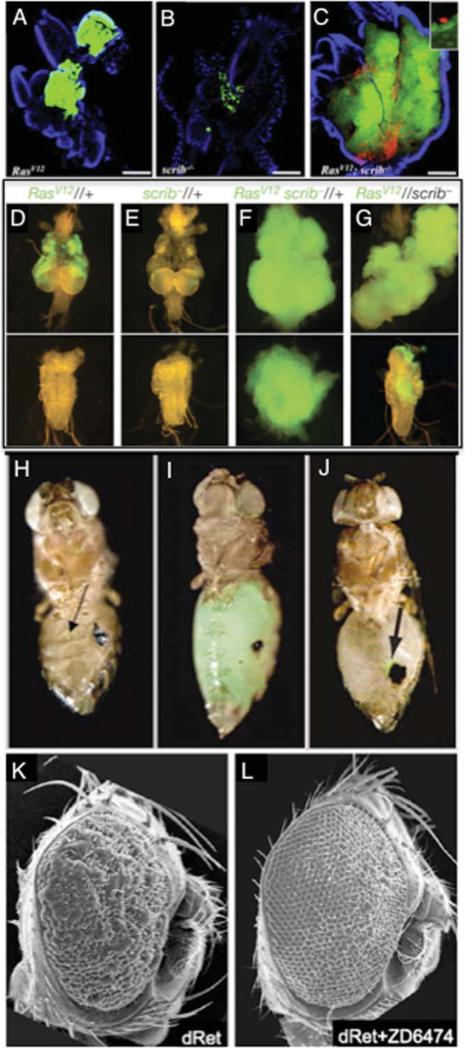
Teaching an old fly new tricks. A–C: Immune cells known as hemocytes were labeled with red fluorescent protein (RFP) and transplanted into flies expressing oncogenic Ras and/or lacking the tumor suppressor scrib. These hemocytes were only recruited to site of the transgene expression in RasV12;scrib tumors (Cordero et al., 2010). D–G: Oncogenic RasV12 and scrib loss of function synergize within a given clone to produce malignant over-growth and invasion into adjacent tissues. However, they may also synergize when present in adjacent clones (Wu et al., 2010). H–J: Wild-type (left) and l(3)mbt mutant (middle) tissue labeled with green fluorescent protein (GFP) were serially transplanted into the abdomen of adult hosts. Comparison of expression profiles showed l(3)mbt tumors were enriched for mRNA's of genes required for germline maintenance. Removal of some germline genes, such as piwi (right), abrogated tumor overgrowth (Janic et al., 2010). K,L: Overexpression of dRetMEN2 in the fly eye results in dysplastic growth, reminiscent of tumors from the MEN2 cancer syndrome. Administration of a kinase inhibitor ZD6474 restores these eyes to a wild-type pattern (Vidal et al., 2005). This therapeutic has been validated for MEN2 patients.
Fig. 2
Fig. 2
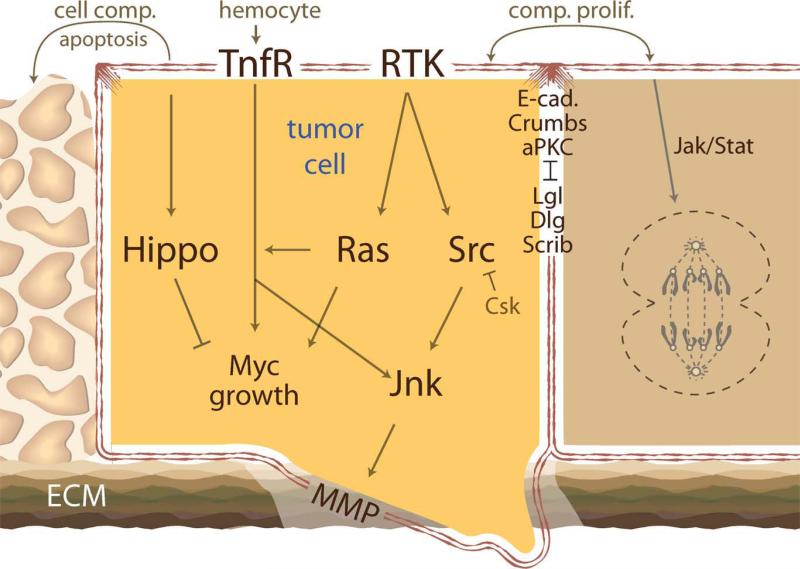
A schematic showing some major pathways implicated in cancer progression using Drosophila studies. Mechanisms of tumor cell behavior, like cell competition (cell comp.) and compensatory proliferation (comp. prolif.), were also first characterized in flies. Signal from the cell surface receptors to Hippo pathway depicted with an arrow.

References

    1. Bagchi A, Mills AA. The quest for the 1p36 tumor suppressor. Cancer Res. 2008;68:2551–2556. - PMC - PubMed
    1. Bagchi A, Papazoglu C, Wu Y, Capurso D, Brodt M, Francis D, Bredel M, Vogel H, Mills AA. CHD5 is a tumor suppressor at human 1p36. Cell. 2007;128:459–475. - PubMed
    1. Barkan B, Starinsky S, Friedman E, Stein R, Kloog Y. The Ras inhibitor farnesylthiosalicylic acid as a potential therapy for neurofibromatosis type 1. Clin Cancer Res. 2006;12:5533–5542. - PubMed
    1. Bergmann A, Agapite J, McCall K, Steller H. The Drosophila gene hid is a direct molecular target of Ras-dependent survival signaling. Cell. 1998;95:331–341. - PubMed
    1. Bobinski M, Greco CM, Schrot RJ. Giant intracranial medullary thyroid carcinoma metastasis presenting as apoplexy. Skull Base. 2009;19:359–362. - PMC - PubMed

Publication types

LinkOut - more resources