. 2011 Dec 1;204(11):1654-62.
doi: 10.1093/infdis/jir633.

C21orf91 genotypes correlate with herpes simplex labialis (cold sore) frequency: description of a cold sore susceptibility gene

Affiliations

C21orf91 genotypes correlate with herpes simplex labialis (cold sore) frequency: description of a cold sore susceptibility gene

John D Kriesel et al. J Infect Dis. .

Abstract

Background: Herpes simplex virus type 1 (HSV-1) infects >70% of the United States population. We identified a 3-megabase region on human chromosome 21 containing 6 candidate genes associated with herpes simplex labialis (HSL, "cold sores").

Methods: We conducted single nucleotide polymorphism (SNP) scans of the chromosome 21 region to define which of 6 possible candidate genes were associated with cold sore frequency. We obtained the annual HSL frequency for 355 HSV-1 seropositive individuals and determined the individual genotypes by SNPlex for linkage analysis and parental transmission disequilibrium testing (ParenTDT).

Results: Two-point linkage analysis showed positive linkage between cold sore frequency and 2 SNPs within the C21orf91 region, 1 of which is nonsynonymous. ParenTDT analysis revealed a strong association between another C21orf91 SNP, predicted to lie in the 3' untranslated region, and frequent HSL (P = .0047). C21orf 91 is a predicted open reading frame of unknown function that encodes a cytosolic protein.

Conclusions: We evaluated candidate genes in the cold sore susceptibility region using fine mapping with 45 SNP markers. 2 complementary techniques identified C21orf91 as a gene of interest for susceptibility to HSL. We propose that C21orf91 be designated the Cold Sore Susceptibility Gene-1 (CSSG1).


Figures
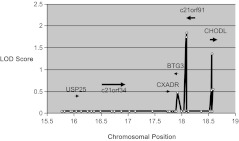
Figure 1.
Figure 1.
Single nucleotide polymorphism (SNP) linkage plot. Logarithm of odds (LOD) scores are shown for each SNP tested within the human chromosome 21 region of interest. White circles denote the chromosomal locations (bp x 106) of the tested SNPs. LOD scores, shown on the y-axis, were computed with the Fastlink application using a dominant mode of inheritance of the cold sore phenotype (frequently affected vs unaffected) in the expanded data set of 43 families. The labeled black bars show the approximate gene locations with arrows indicating the direction of transcription.
Figure 2.
Figure 2.
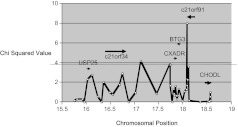
Parent transmission disequilibrium testing in the chromosome 21 region. Single nucleotide polymorphism (SNP) genotypes were tested for association with the cold sore phenotype (frequently affected vs unaffected) among 25 family trios (50 parents + 25 offspring) from the Utah Genetic Reference project. White circles denote the chromosomal locations (bp × 106) of the tested SNPs plotted against the computed χ2. The black bars show the approximate gene locations. Arrows indicate the direction of transcription of the gene. The dashed line across the figure represents P ≤ .05 (χ2 ≈ 3.8).
Figure 3.
Figure 3.
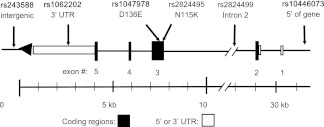
Map of the SNPs genotyped and tested within and adjacent to C21orf91.The C21orf91 gene spans 30 300 bp of chromosome 21. It is transcribed from the minus strand (right to left in this figure). The locations of the 6 single nucleotide polymorphisms (SNPs) presented in Table 1 are indicated by arrows. Nonsynonymous (amino acid–changing) SNPs are shown (D136E and N115K). The SNPs labeled in boldface type were associated with the cold-sore phenotype by linkage or transmission disequilibrium testing. The distance along the chromosome in kb is shown.
Figure 4.
Figure 4.
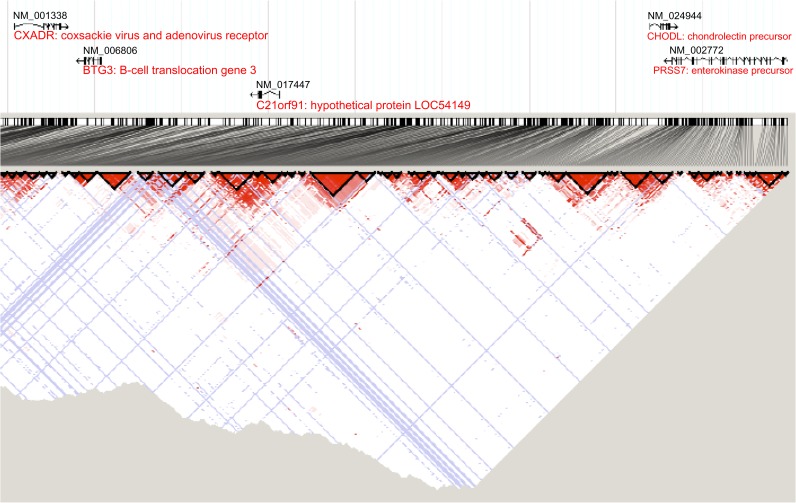
Linkage disequilibrium within the cold sore susceptibility region. This plot showing linkage disequilibrium (LD) was generated in the Haploview computer application using data obtained from the HapMap CEU database (http://hapmap.ncbi.nlm.nih.gov). Areas of high LD are shown in red. Blue indicates areas without informative data. The relative locations of the genes are indicated above the plot. This data indicates that significant LD is not present between C21orf91 and the adjacent genes CHODL, BTG3, and CXADR.
Figure 5.
Figure 5.
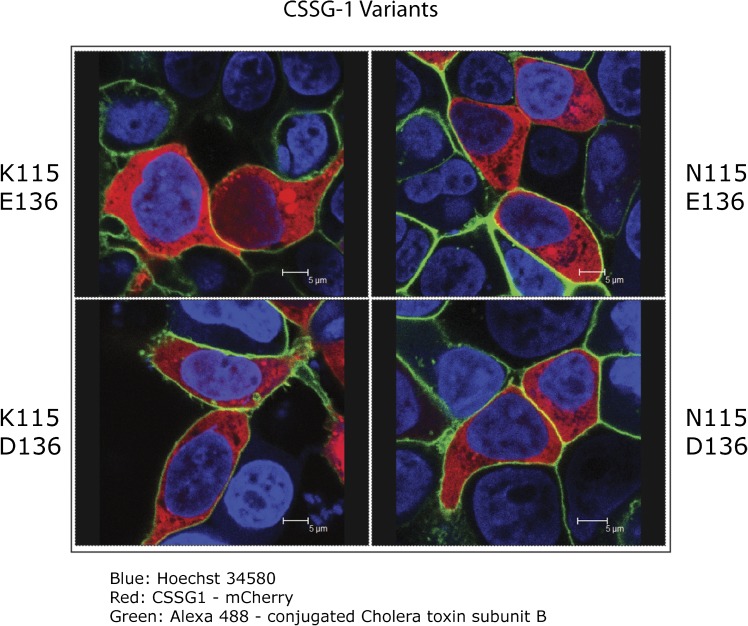
Expression of C21orf91 in human embryonic kidney (HEK293) cells. HEK293FT cells expressing C21ORF91 with a C-terminal mCherry fluorescent tag (red) were imaged by confocal microscopy. Nuclei were stained with Hoechst 34580 (blue). Plasma membranes were stained with cholera toxin B subunit (green). HEK293FT cells were transfected with complementary DNAs encoding C21ORF91 proteins with either lysine (K) or asparagine (N) at position 115 and either aspartic acid (D) or glutamic acid (E) at position 136.

Comment in

References

    1. Spruance S, Kriesel J. Treatment of herpes simplex labialis. Herpes. 2002;9:6–11. - PubMed
    1. Hobbs MR, Jones BB, Otterud BE, Leppert M. Kriesel JD. Identification of a herpes simplex labialis susceptibility region on human chromosome 21. J Infect Dis. 2008;197:340–6. - PubMed
    1. Hoshino Y, Pesnicak L, Cohen J, Straus S. Rates of reactivation of latent herpes simplex virus from mouse trigeminal ganglia ex vivo correlate directly with the viral load and inversely with the number of infiltrating CD8+T cells. J Virol. 2007;81:8157–64. - PMC - PubMed
    1. Sawtell N. The probability of in vivo reactivation of herpes simplex virus type 1 increases with the number of latently infected neurons in the ganglia. J Virol. 1998;72:6888–92. - PMC - PubMed
    1. Spruance SL, Kriesel JD, Evans TG, McKeough MB. Susceptibility to herpes labialis following multiple experimental exposures to ultraviolet radiation. Antiviral-Res. 1995;28:57–67. - PubMed

Publication types

Substances